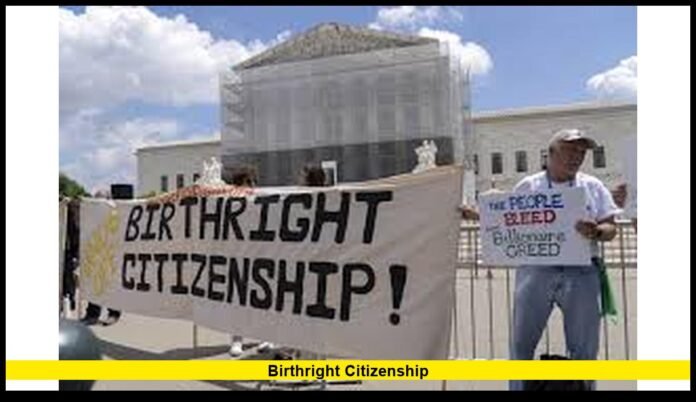

Birthright citizenship is once again in the spotlight. On December 5, 2025, the U.S. Supreme Court announced it will hear a challenge to the executive order signed by President Donald Trump earlier this year — an order that aims to end automatic citizenship for many children born on U.S. soil.
Understanding Birthright Citizenship and Its Legal Roots
At its core, birthright citizenship is the principle that virtually everyone born in the United States becomes a U.S. citizen at birth. This principle traces back to the 1868 adoption of the 14th Amendment, which guarantees that “all persons born or naturalized in the United States, and subject to the jurisdiction thereof, are citizens of the United States and of the State wherein they reside.”
More than a century ago, a landmark decision by the Supreme Court affirmed that children born in the country to immigrant parents qualify for citizenship — effectively embedding birthright citizenship into American law and identity. The principle has ensured that citizenship depends on birthplace rather than parental immigration status, with only narrow exceptions (for example, children born to foreign diplomats).
What Changed in 2025: The Executive Order and Legal Challenge
The New Executive Order
On January 20, 2025 — his first day back in office — President Trump signed an executive order titled “Protecting the Meaning and Value of American Citizenship.” That order attempted to redefine who qualifies for citizenship at birth. Under its terms, a child born in the U.S. would only automatically become a citizen if at least one parent were a U.S. citizen or a lawful permanent resident. Children born to parents on temporary visas, undocumented immigrants, or those with no legal status would not automatically receive U.S. citizenship. The order was written to apply to children born on or after February 19, 2025.
This marked a radical shift in the traditional understanding of citizenship, grounding the change in a new interpretation of the 14th Amendment’s “subject to the jurisdiction thereof” clause.
Immediate Backlash and Lawsuits
Almost as soon as the order was issued, it triggered widespread legal challenges.
- Several states and civil-rights organizations filed lawsuits, arguing the measure violated the 14th Amendment and longstanding judicial precedent.
- Federal judges in multiple districts — including in Washington State and New Hampshire — issued preliminary injunctions blocking enforcement of the order nationwide.
- The administration sought to stay those injunctions through appeals, but courts repeatedly preserved them, effectively preventing any application of the executive order so far.
Despite the order, birthright citizenship has not changed in practice. Children born on U.S. soil continue to be recognized as citizens under existing law.
2025 Litigation Developments: Courts Push Back
A critical turning point occurred in summer 2025. The Supreme Court, in a case brought against the executive order under the name Trump v. CASA, addressed only a narrow legal question: whether federal courts could issue “universal injunctions” — broad orders that apply nationwide. The Court ruled they generally could not. That decision complicated efforts to block the order for all potential cases at once.
In response, a group of civil-rights organizations filed a nationwide class-action lawsuit, known as Barbara v. Trump. On July 10, 2025, a federal judge granted a preliminary nationwide injunction under that case, once again blocking the executive order’s implementation for all children born after the relevant cutoff date. This class-action approach effectively closed the loophole created by the Court’s limitation on universal injunctions.
Since then, no court has found the executive order constitutional. Every judge considering the question has agreed it likely violates the 14th Amendment’s citizenship clause.
Where Things Stand Right Now: December 2025
- The Supreme Court has formally agreed to hear arguments on the legality of the executive order targeting birthright citizenship.
- The case is expected to be argued in spring 2026, with a final decision anticipated by early summer 2026.
- Until then, the nationwide injunction remains in force — meaning birthright citizenship remains intact for all children born in the United States under current law.
- In practice, there has been no change: citizenship at birth continues regardless of parental immigration status.
Although the Court’s earlier decision on injunctions did not directly rule on the constitutionality of the order, the fact that every lower court to consider it has blocked it suggests strong judicial consensus against the policy. Many legal experts view efforts to replace such a fundamental constitutional guarantee via executive order — rather than amendment — as deeply problematic.
Why This Matters: Families, Communities, and Constitutional Rights
The potential impact of undoing birthright citizenship would be massive. Here’s why:
- Every child born here would face uncertainty. Hundreds of thousands of babies are born in the United States each year to noncitizen parents. Without automatic citizenship, they would follow difficult or uncertain paths to secure legal status.
- Risk of statelessness or exclusion. Some children could end up stateless if no country recognizes them as citizens. That means no passport, no access to fundamental rights and benefits, potentially no Social Security number, no eligibility for public assistance, or inability to obtain a passport or travel freely.
- Long-term social and legal disruption. Many U.S.-born children might grow up without the full rights and protections of citizenship. This could ripple across education, healthcare, communities, and the workforce.
- Constitutional and historical implications. Birthright citizenship is more than policy — it’s a constitutional guarantee rooted in history and tied to justice and equality. Rewriting that through executive order would mark a major deviation in American legal tradition.
For immigrant families, mixed-status households, and entire communities, the stakes are deeply personal. This debate taps into national values around opportunity, equality, and identity.
What to Watch Next: Key Dates and What They Mean
| Milestone | What It Means | Timeline |
|---|---|---|
| Supreme Court oral arguments | The justices will hear from both sides and weigh whether the executive order conflicts with the 14th Amendment and precedent | Spring 2026 |
| Supreme Court final ruling | Could either uphold the constitutional guarantee of birthright citizenship or allow restrictions on it | By early Summer 2026 |
| Any subsequent policy changes or governmental guidance | Would shape how citizenship is granted, with nationwide legal and social impact | Immediately after decision |
Once the Court issues its ruling, the outcome will likely reshape American citizenship law — either reinforcing longstanding protections or altering the legal foundation of who can be an American by birth. The decision will affect not only individual families, but the broader character of the nation for generations.
The debate over birthright citizenship is more than legal technicality. It strikes at the heart of what it means to be American — whether being born here is enough to claim citizenship, or whether citizenship depends on political decisions about who belongs. As the Supreme Court prepares to weigh in, the eyes of families, communities, and history remain fixed on the outcome.
I encourage you to share your thoughts on this issue below and watch closely as the story unfolds.