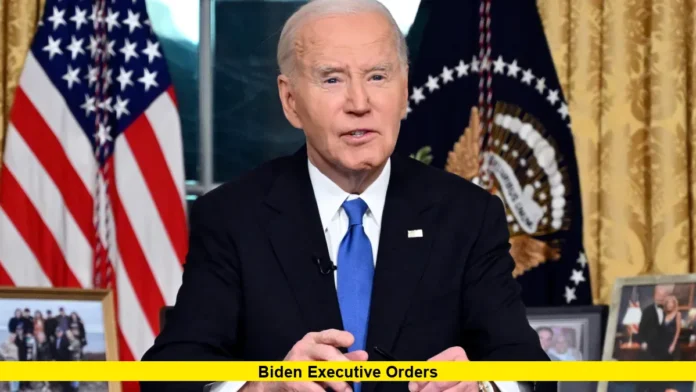

President Biden’s recent use of executive authority has taken center stage again as legal debates, political claims, and procedural questions collide in Washington. Public attention intensified this week after renewed scrutiny of how certain presidential actions were signed and whether any of them could be challenged or revoked. As discussions unfold, the broader implications for biden executive orders — from agency operations to legal standards — have become a major point of national interest for policymakers, lawyers, and everyday Americans.
A shifting landscape surrounding presidential action
In the final weeks of 2025, an unusual mix of political declarations and legal commentary created renewed uncertainty around the status of several presidential directives. Current and incoming officials have publicly signaled their intent to re-evaluate actions issued over the past year, particularly those signed during periods when the president was traveling or dealing with scheduling demands. Those statements prompted immediate attention from legal experts who emphasize that executive actions do not rise or fall on headlines but on established constitutional principles.
Federal records continue to document each presidential action issued throughout 2025, including executive orders, memoranda, and proclamations. These records form the official legal history of presidential decisions. Every executive order is logged with a publication number and date, making it traceable for courts, agencies, and legal analysts. This formal process is what agencies rely on when implementing federal policy, not political commentary or social-media statements.
How executive orders function inside the federal system
Executive orders are directives from the president that instruct federal agencies on how to interpret or implement laws. Although they carry the force of law within the executive branch, they do not override acts of Congress. They also cannot be used to appropriate funds, rewrite statutes, or impose obligations without legal authority.
In practice, executive orders fall into several categories:
- Policy directives, which shift agency priorities or set new goals.
- Administrative instructions, which reorganize responsibilities within departments.
- Emergency directives, issued during national crises.
- Regulatory instructions, which activate or halt rulemaking processes.
Because these orders guide federal departments, they can have wide-reaching effects. Immigration enforcement priorities, climate regulations, technology policies, pandemic protocols, and workplace protections have all been shaped by presidential directives in recent years.
But the legal power of these orders depends on one key question: Did the president authorize them?
Why signatures became part of the conversation
Modern presidents often rely on authorized mechanical or delegated signing options when traveling or attending events. The tool most often discussed in public debate is the autopen — a mechanical device capable of reproducing a handwritten signature.
The use of mechanical signing tools is not new. Multiple previous administrations have used them for decades. Their legality has historically rested on the same principle: whether the president approved the substance of the action being signed. Courts have not treated the usage of mechanical devices as inherently invalid. Instead, authorization is the determining factor.
Legal scholars note that the device is merely a pen guided by a machine. The signature is symbolic; the presidential decision behind the signature is what carries authority. Without evidence that the president failed to authorize an action, the signature mechanism itself does not change the validity of an executive order.
This distinction has become especially important as political rhetoric intensifies. Challenges based solely on signing tools, rather than authorization, face substantial legal obstacles.
Why retroactive cancellation of executive orders is extremely difficult
While a new president can revoke or replace prior executive actions, attempting to nullify orders retroactively based on questions about their execution is far more complex.
Several legal barriers make sweeping cancellations unlikely:
1. Final actions and reliance interests
When federal agencies carry out an order — by issuing grants, enforcing regulations, funding programs, or approving projects — people and businesses rely on those actions. Courts weigh these reliance interests heavily. Judges are cautious about allowing sudden reversals that would impose financial or operational harm on states, industries, or individuals.
2. Certain actions are irrevocable
Some presidential powers, like granting pardons, are considered final once issued. Even if a procedural dispute were raised, courts treat the act itself as complete and binding. Attempts to withdraw such decisions would likely fail under established constitutional doctrine.
3. Agency rulemaking cannot be undone overnight
When an executive order directs an agency to make or modify rules, the agency typically conducts a legally required process — including notice, public comment, and justification. Undoing those rules requires the same rigorous steps. Courts often strike down sudden reversals that skip procedural requirements.
4. The burden of proof is high
To challenge the validity of a past executive action, opponents would need clear evidence the president did not authorize the directive. Courts rarely invalidate presidential actions without strong factual support. This is one reason why generalized political claims rarely result in practical legal consequences.
What federal agencies are doing now
Despite public debate, federal agencies operate only on official directives. They are required to follow written orders, official memos, and regulatory instructions — not press statements.
In the near term:
- Agencies continue implementing directives already on the books.
- Program funding, grants, and regulatory enforcement remain active unless a formal suspension is issued.
- Agency lawyers review potential changes to ensure compliance with administrative law before making adjustments.
- Departments prepare transition plans for possible policy updates under new leadership.
What agencies cannot do is preemptively halt actions based on speculation or political pressure. This helps prevent instability in programs that affect millions of Americans.
How a new administration could revise or replace existing directives
A new president has several legally recognized options for changing course:
Issuing a new executive order
The most common approach is signing a new order that modifies or revokes a prior one. This method provides clear legal authority and immediate direction for agencies.
Ordering an agency review
Presidents frequently direct agencies to reassess existing rules or enforcement priorities. Agencies can then pause some actions while undergoing review, as long as the pause follows legal requirements.
Narrowing the interpretation of an order
Agencies can shift priorities or update guidance to reflect a different interpretation of previous directives, provided the interpretation is consistent with law.
Seeking legislation
Congress can solidify, restrict, or override prior presidential actions. This route is harder but provides long-term stability.
In each case, the federal government must follow established legal processes. While political debates move quickly, administrative changes often take months because they must withstand judicial scrutiny.
Legal experts highlight the difference between political claims and constitutional reality
Law professors, administrative-law specialists, and former government attorneys have emphasized several points:
- Mechanical signing tools do not invalidate a presidential action.
- Authorization is the determining factor in legality.
- Broad, retroactive cancellation would likely lead to extended litigation.
- Courts generally defer to official records, not public statements.
- Agencies cannot reverse course without proper legal procedure.
This framework helps explain why executive orders remain active and enforceable unless and until they are formally revoked.
How these developments may affect everyday Americans
While the political debate is intense, the practical impact will depend on what federal agencies decide and how courts respond. Key areas likely to experience ripple effects include:
Healthcare and insurance programs
Changes to health-policy directives could affect enrollment plans, subsidies, and regulatory requirements for insurers.
Immigration policy
Executive orders often shape enforcement priorities, asylum processing, and visa procedures. Any shifts could influence timelines and agency resources.
Climate and energy projects
Directive-driven initiatives involving federal lands, emissions goals, or grant funding may be slowed or reevaluated if agencies receive new guidance.
Technology and cybersecurity regulations
New orders could alter federal approaches to AI governance, data standards, and critical-infrastructure protections.
Business compliance expectations
Regulated industries monitor executive orders closely because policy swings affect planning, investments, and reporting obligations.
For the public, the most visible changes typically occur when agencies release new guidelines, freeze certain actions, or adjust enforcement priorities.
Key developments to watch for next
Over the next several weeks, several signals will indicate how policy may shift:
- Formal announcements of new executive actions
- Agency memos outlining temporary pauses or reviews
- Federal Register notices describing regulatory changes
- Early court challenges if attempts at retroactive cancellations proceed
- Transition briefings announcing new policy directions
These formal documents — not public remarks — determine what changes are legally enforceable.
Conclusion
The renewed focus on the structure, authorization, and durability of presidential authority illustrates how central executive orders have become to modern governance. While political discussions may raise questions, the legal system relies on established constitutional rules, administrative requirements, and documented authorization. With numerous policy areas shaped by presidential directives, the next several months will bring close legal scrutiny, targeted revisions, and a clearer picture of how federal agencies will operate moving forward.