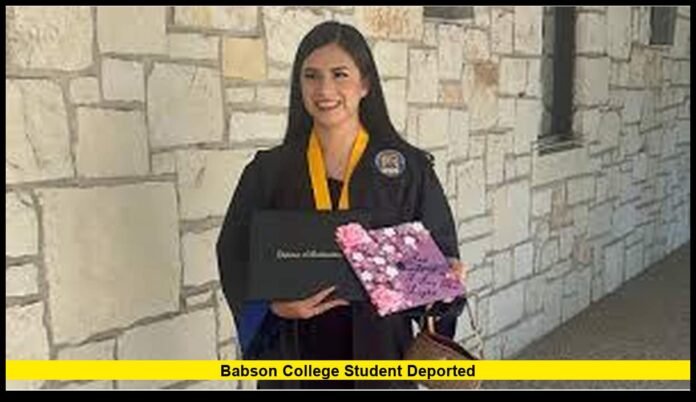

A Babson College student deported during an active court-ordered protection window has become the center of growing national concern. The case involves 19-year-old first-year student Any Lucia Lopez Belloza, whose removal from the United States has raised major questions about enforcement procedures, due process, and the handling of students with long-standing ties to their communities.
Lopez Belloza’s deportation took place only two days after she was detained at Boston Logan International Airport while preparing for a domestic trip. Her legal team secured a judge’s temporary protection order that required officials to pause any removal for 72 hours. Despite that order, she was placed on a flight out of the country and transported to Honduras. The rapid sequence of events left her family, her college community, and legal observers stunned.
The following breakdown provides a complete, verified, and detailed look at the circumstances surrounding her detention, deportation, and the aftermath now unfolding.
A Detailed Timeline of Events
November 20: Initial Detention at Boston Logan Airport
Lopez Belloza arrived at Boston Logan International Airport with plans to fly to Texas. Her goal was simple: a surprise visit home during the Thanksgiving holiday. She had completed the first months of her freshman year at Babson College and wanted to spend the break with family.
Her travel plans shifted dramatically at the boarding gate. Airline staff alerted her to a problem with her reservation. What began as a routine inconvenience quickly became serious. Airport staff directed her to a service counter, where immigration officials approached her. She was soon detained and taken into custody.
At the time of her detention, she did not receive a clear explanation. Her belongings were taken, and she was transported away from the terminal for processing. Her family learned about her situation only after she had already been taken by officials.
November 21: Federal Judge Issues a 72-Hour Protective Order
After learning of her detention, her attorney filed an emergency request seeking court intervention. A federal judge responded with a 72-hour stay, explicitly instructing that she was not to be removed from Massachusetts or the United States. The order was intended to preserve her legal rights and provide time to review the circumstances behind the sudden detention.
The stay should have guaranteed at least three days of protection while her legal counsel worked to address the underlying issue: an old removal order dated from several years earlier. Her legal team argued that her family believed that matter had been closed long ago.
November 22: Deportation Occurs Despite Court-Ordered Protection
Just one day after the court issued its instruction, Lopez Belloza was moved to another facility and then placed on a flight out of the country. Her removal took place while the 72-hour stay remained active and enforceable.
Officials transported her to Texas, and shortly afterward she was placed on a plane to Honduras. She was unable to communicate with her attorney before the deportation, and her family did not receive advance notice.
Once she reached Honduras, she contacted her father and confirmed that she was staying with her grandparents.
Current Confirmed Status
- She is physically safe in Honduras.
- Her legal team continues to challenge the deportation and review options for her return.
- Her college has acknowledged awareness of her situation but has not received direct communication from authorities.
- No public explanation has been issued by the federal agencies involved in her removal.
Who Is Any Lucia Lopez Belloza?
Lopez Belloza’s story reflects the experiences of many young immigrants who arrived in the United States as children and built their lives within American communities.
She lived in the United States for years, attended school, and eventually earned a place at Babson College—an institution well-known for its entrepreneurship programs. Her academic path represented stability, long-term goals, and the desire to build a future rooted in education.
Family members have said that she dreamed of using her college degree to support her family and participate in her community. Her academic performance was strong, and she was adapting well to college life.
Her detention and deportation disrupted that progress in an instant.
Legal and Procedural Concerns Raised by the Case
The circumstances of Lopez Belloza’s deportation have raised several major concerns among legal observers and community advocates.
1. Removal During an Active Court-Ordered Stay
The most pressing issue is the deportation occurring while a court order explicitly barred her removal for 72 hours. Such orders are designed to protect individuals from sudden enforcement actions that could interfere with due process.
A removal conducted under these circumstances carries significant legal implications. Many observers have questioned how the order was overlooked, how communication between agencies broke down, and why the court directive did not prevent the deportation.
2. Disputed 2015 Removal Order
Officials involved in her deportation referenced an old removal order dating back to 2015. Her attorney countered that the family had been under the impression that the matter had been resolved in 2017.
This discrepancy raises important questions:
- Was the order active without proper notice?
- Did the family receive correct information about the case?
- How did the order resurface during a routine domestic flight?
The lack of clarity has intensified scrutiny on case management and communication within immigration enforcement procedures.
3. No Access to Legal Representation Before Removal
Her legal team stated that she was not provided the opportunity to speak with her attorney at the moment when she most needed representation. Deportation without access to counsel, especially under an active court stay, raises concerns about procedural fairness and whether her rights were upheld.
The short time between detention and deportation—less than 48 hours—left little opportunity for legal intervention or a meaningful review of her situation.
4. Rapid Transfer and Lack of Family Notification
The speed of her transfer, combined with the lack of communication with her family and college, left the people closest to her scrambling for answers. Her family did not receive timely updates. Her attorney struggled to locate her. Her college was unaware of developments until after the deportation was completed.
This level of isolation and lack of transparency has drawn significant criticism.
Impact on Her Education and Future
Lopez Belloza’s deportation has put her academic future in jeopardy. She was in the middle of her first semester and had been settling into college life.
Her removal has produced several immediate consequences:
- She cannot continue her coursework from Honduras.
- Her student status is uncertain.
- Her plans to complete her degree are suspended indefinitely.
- She now faces significant obstacles to returning to the U.S., even if her legal case is resolved.
For a student who excelled academically and built her life in the United States, the disruption is profound.
Wider Implications for Students and Immigrant Communities
This single case has triggered broader discussions about enforcement practices, student protections, and the reliability of legal safeguards.
1. Students Who Are Long-Term U.S. Residents Face Uncertainty
Many young people who arrived in the country as children assume that years of community involvement, academic progress, and clean records will shield them from abrupt enforcement. This case suggests otherwise.
2. Domestic Airports May See Increased Enforcement Activity
Lopez Belloza was detained while attempting to board a domestic flight—not an international one. This has sparked concern among immigrant communities that domestic travel is increasingly being used as a touchpoint for enforcement actions.
3. Court Orders and Due Process Must Be Re-Examined
The violation of a court-ordered stay has raised alarm. If protective orders are not reliably enforced, individuals undergoing immigration review may face greater risks during routine travel or daily life.
4. Colleges and Universities May Need Stronger Support Protocols
The absence of communication with her school during the process has prompted discussions on how institutions can better support students facing emergencies related to immigration enforcement.
What Her Legal Team Is Working On Now
Her attorney is pursuing options that may include:
- Seeking court review of the removal that took place during an active stay
- Requesting return to the United States for further proceedings
- Challenging the validity of the long-standing removal order
- Examining the procedural failures that led to her deportation
The process may be lengthy. The outcome could shape how similar cases are handled in the future, especially for students who entered the country as children and have deep community ties.
Why This Case Continues to Capture Public Attention
The situation resonates strongly because it touches on several broader issues:
- The rights of students
- Respect for judicial authority
- Fairness in immigration enforcement
- The human cost of policy decisions
Lopez Belloza’s sudden removal serves as a powerful example of how policy, legal process, and individual lives intersect. Her story shows the fragility of stability for many young people who came to the United States seeking opportunity and have built their entire lives here.
The future of her case remains uncertain, but public interest continues to grow as more people learn about the circumstances of her deportation. Share your thoughts below about how this case is unfolding and what it may mean for others facing similar challenges.