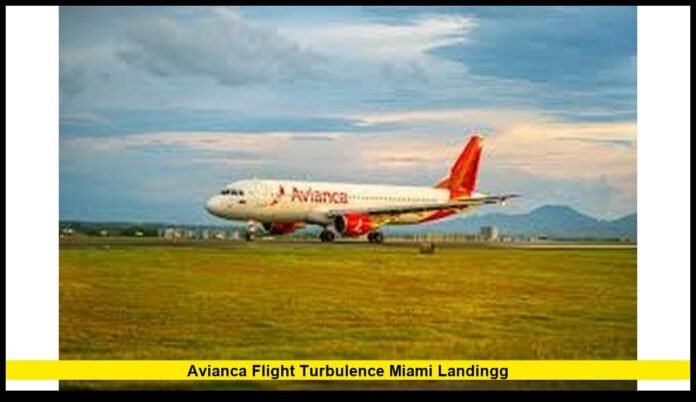

The avianca flight turbulence miami landing incident has raised fresh concerns about in-flight safety after a Colombia-to-New York passenger flight encountered severe turbulence and diverted to Miami International Airport early Friday, October 9, 2026. At least eight people were transported to hospitals following the incident, while the airline reported that nine people, including six passengers and three cabin crew members, required medical attention. The aircraft landed safely, allowing emergency responders to assist those affected.
The flight, operated by Avianca as AV042, was traveling from Medellín, Colombia, to New York’s John F. Kennedy International Airport when the unexpected turbulence disrupted the journey. The crew changed the aircraft’s destination and brought it to Miami, where emergency medical personnel responded after touchdown.
The incident quickly attracted attention because of the number of people injured and the decision to divert a long-distance international flight. Although the aircraft landed safely, questions remain about the precise atmospheric conditions that triggered the turbulence and the final medical outcomes for those affected.
What Happened Aboard Avianca Flight AV042?
Avianca Flight AV042 departed from José María Córdova International Airport near Medellín on Thursday night, October 8. Its scheduled destination was John F. Kennedy International Airport in New York City.
The flight was progressing toward its destination when the aircraft encountered severe turbulence. The sudden movements reportedly caused injuries among people inside the cabin, prompting the crew to prioritize medical assistance.
Instead of continuing to New York, the pilots diverted the aircraft to Miami International Airport in Florida. The plane arrived at approximately 3:30 a.m. Eastern Daylight Time on Friday, October 9.
The diversion allowed emergency personnel to meet the aircraft and evaluate the injured passengers and crew members. The plane landed safely, and medical teams began assisting those who needed treatment.
The incident did not involve a reported crash. Rather, the immediate emergency centered on injuries sustained during the flight and the need to reach medical facilities as quickly as possible.
How Many Passengers and Crew Members Were Injured?
The initial emergency response involved multiple people who suffered injuries during the turbulent flight.
Miami-Dade Fire Rescue confirmed that at least eight people were transported to area hospitals. Separately, Avianca reported that nine people required medical attention, comprising six passengers and three members of the cabin crew.
These figures describe different aspects of the response. The airline’s number covers people affected who required medical care, while the hospital figure identifies those transported for further treatment.
The complete severity of every injury was not established in the initial public reports. Information about the patients’ subsequent recovery and discharge remained limited.
One important consideration is that turbulence can injure both passengers and airline employees. Cabin crew members often move through the aircraft while performing their duties, which can expose them to sudden movements when unexpected turbulence occurs.
Passengers may also sustain injuries if they are standing, reaching for luggage, using the restroom, or sitting without their seat belts fastened.
Even when an aircraft remains under control, powerful movements can throw people against seats, cabin walls, overhead compartments, and other surfaces.
Why Did the Aircraft Divert to Miami International Airport?
The decision to divert the aircraft provided a way to get injured people medical attention without waiting for the original journey to end in New York.
When a flight experiences a medical emergency, the pilots must consider several factors before selecting an alternate airport. These include the condition of the people onboard, the distance to suitable airports, weather, airport facilities, and the aircraft’s operational circumstances.
In this incident, Miami provided an opportunity for emergency responders to meet the plane shortly after it landed.
The diversion also allowed the airline to address the immediate needs of passengers and crew members. Once the aircraft reached the ground, medical personnel could assess injuries and determine who needed transportation to a hospital.
An emergency diversion does not automatically mean that an aircraft has suffered mechanical damage. Flights may land early because of medical concerns even when the airplane can continue flying safely.
In this case, the reported turbulence-related injuries explain why reaching medical assistance became the priority.
What Is Known About the Flight’s Route and Aircraft?
AV042 was operating between Medellín, Colombia, and New York City when the incident occurred. The route connects Colombia with one of the United States’ major international travel destinations.
The aircraft was expected to arrive at John F. Kennedy International Airport but instead landed at Miami International Airport.
The unexpected stop affected the flight’s planned arrival and required the airline to make arrangements for travelers who still needed to reach New York.
Flight-tracking reports identified the service as Avianca Flight 042. However, the precise aircraft registration and a complete technical account of the event were not established in the initial public information.
It is important to distinguish confirmed flight details from claims about the aircraft’s movement or condition. A flight-tracking record can help establish a route and arrival time, but it does not independently explain the atmospheric conditions inside the flight path or determine whether an aircraft experienced structural damage.
Those questions require additional operational information and, where appropriate, a formal investigation.
What Causes Severe Turbulence During Commercial Flights?
Turbulence occurs when an aircraft moves through irregular air currents. The resulting changes in airflow can produce sudden vertical or horizontal movements that passengers experience as bumps, jolts, or abrupt drops.
Several atmospheric conditions can create turbulence.
Jet streams: These fast-moving currents of air can contain areas of changing wind speed and direction. Aircraft traveling near them may encounter turbulent conditions.
Thunderstorms: Strong updrafts, downdrafts, and rapidly changing winds around thunderstorms can create dangerous turbulence. Flight crews generally take precautions to avoid hazardous storm activity.
Weather fronts: Where air masses with different temperatures and wind patterns meet, atmospheric instability can create turbulence.
Mountain waves: Air flowing over mountainous terrain can generate waves and turbulent conditions that extend beyond the immediate mountain area.
Clear-air turbulence: This type can occur without visible clouds or nearby thunderstorms. Because it may be difficult to identify through visual observation alone, it can surprise passengers and crew members.
The specific weather system responsible for the turbulence experienced by AV042 had not been conclusively identified in the initial reporting. Without further evidence, it would be premature to attribute the incident to a particular storm, jet stream, or other atmospheric phenomenon.
Could the Turbulence Have Been Predicted?
Pilots and airline dispatch teams use weather forecasts, aviation reports, radar information, and communications with other aircraft to assess conditions along a planned route.
These resources help crews identify potential turbulence and adjust their flight paths when necessary. Air traffic controllers can also help coordinate changes in altitude or routing when conditions warrant them.
However, forecasting turbulence is not an exact science. Some turbulent areas develop quickly, while others are difficult to detect before an aircraft enters them.
Clear-air turbulence presents a particular challenge because it may occur in apparently clear skies. Passengers can therefore encounter sudden movement even when they cannot see clouds or storms outside the windows.
The absence of a visible storm does not necessarily mean the atmosphere is smooth.
The Avianca incident illustrates why seat belt precautions remain important throughout a flight, not only during takeoff, landing, or periods when storm clouds are visible.
What Should Passengers Do When Severe Turbulence Strikes?
Passengers cannot control the weather encountered by an aircraft, but they can take practical steps to reduce their risk of injury.
Keep the seat belt fastened while seated. This is one of the most important precautions. Unexpected turbulence can begin without much warning, and a fastened belt can help prevent a passenger from being lifted out of the seat.
Follow the seat belt sign. When the sign illuminates, passengers should return to their seats as soon as it is safe and secure their belts.
Listen to the cabin crew. Flight attendants receive safety training and can provide instructions during changing conditions. Passengers should follow those instructions promptly.
Secure personal belongings. Loose items can move around the cabin during sudden aircraft movements. Bags and other belongings should remain properly stowed.
Avoid unnecessary movement. Walking through the cabin during turbulence increases the risk of falls and collisions. Passengers should wait until conditions improve before moving around when possible.
Report injuries immediately. Anyone who experiences a fall, impact, or other injury should notify a flight attendant so the crew can assess the situation and arrange assistance.
The Federal Aviation Administration encourages travelers to keep their seat belts fastened whenever they are seated, even when the seat belt sign is off. Sudden turbulence can occur before the crew has time to issue a warning.
What Happened to the Other Passengers After Landing?
The diversion created two immediate priorities: providing medical assistance and helping unaffected passengers continue their journey.
Emergency responders attended to those who needed treatment after the plane reached Miami. At least eight people were transported to hospitals, while the airline reported nine people requiring medical attention.
Passengers who were not transported for treatment still faced an unexpected interruption to their travel plans.
International flights can involve connecting services, hotel arrangements, ground transportation, and time-sensitive appointments. A diversion may affect these plans even when the aircraft lands safely.
Airlines typically assess the operational situation before determining whether passengers will continue on the same aircraft, transfer to another flight, or receive revised itineraries.
Travelers affected by the incident should rely on direct airline communications for confirmed information about rebooking, departure times, baggage, and onward connections.
The available initial reports did not establish the final arrangements for every passenger or confirm the ultimate medical outcomes for all those injured.
Will the Incident Affect Other Avianca Flights?
The diversion of a single flight does not automatically mean that an airline’s entire network will experience widespread disruption.
However, an unexpected landing can affect aircraft schedules, crew assignments, and passenger connections. The scale of any wider impact depends on the airline’s operational arrangements and the resources available to accommodate affected travelers.
Passengers scheduled to travel with Avianca should check their own reservations for current flight status rather than assume that all flights are affected.
Travelers connecting through New York or Miami should pay particular attention to revised departure times and connection requirements. An updated itinerary may be necessary if the original flight arrives later than planned.
It is also important to distinguish a turbulence-related diversion from a confirmed mechanical problem. The fact that an aircraft changes its destination does not establish that other aircraft operated by the same airline face a similar issue.
No broader fleet-wide problem can be inferred from this incident alone.
Will Authorities Investigate the Turbulence Incident?
Aviation authorities may review an incident involving multiple injuries to understand the circumstances and determine whether additional information is needed.
The Federal Aviation Administration has a role in U.S. civil aviation safety, including reviewing reports of significant events. The exact investigative steps and findings associated with this flight must be established through official updates.
A thorough assessment could consider flight data, crew reports, weather information, communications, and accounts of what happened inside the cabin.
Such information can help clarify when the turbulence occurred, how the flight crew responded, and whether any additional safety lessons emerge.
It is too early to draw conclusions about fault or the precise cause of the event based only on the initial reports. A sudden encounter with turbulence does not, by itself, demonstrate that pilots or airline personnel acted improperly.
Any definitive assessment should rest on verified evidence rather than assumptions about the flight’s movements or the injuries reported after landing.
What the Incident Means for Air Travel Safety
Turbulence remains one of the important sources of injury in commercial aviation, but a turbulent flight does not necessarily indicate that an aircraft is in danger of crashing.
Modern aircraft are designed to withstand demanding operating conditions, and flight crews receive training to manage turbulence and other unexpected events. Nevertheless, passengers and crew members can suffer injuries when the aircraft moves abruptly.
The most effective everyday precaution for passengers is to keep their seat belts fastened while seated. That simple action can reduce the risk of being thrown from a seat when turbulence develops unexpectedly.
The incident also demonstrates the importance of coordination between airline crews, airport personnel, emergency responders, and hospitals. When injuries occur thousands of feet above the ground, reaching a suitable airport can become the fastest route to medical care.
For the airline, the immediate responsibilities include assisting injured people, communicating with passengers, and arranging onward travel where necessary.
For travelers, the lesson is straightforward: turbulence may be uncomfortable and occasionally dangerous, but following cabin safety instructions can help reduce the risk of injury.
Latest Update on the Avianca Flight Incident
As of the latest available reporting on October 9, 2026, Avianca Flight AV042 had diverted from its scheduled Medellín-to-New York route and landed safely at Miami International Airport at approximately 3:30 a.m. Eastern Time.
At least eight people were transported to hospitals after suffering turbulence-related injuries. Avianca reported that six passengers and three cabin crew members required medical attention.
The full circumstances surrounding the turbulence, the final condition of those injured, and any subsequent investigative findings remained incompletely established in the initial reports.
The incident has highlighted the potential consequences of unexpected turbulence and the importance of keeping seat belts fastened while seated. Further verified updates may clarify the circumstances of the encounter and the recovery of those affected.
What are your thoughts on airline safety measures during unexpected turbulence? Share your comments and stay tuned for the latest developments in aviation safety.