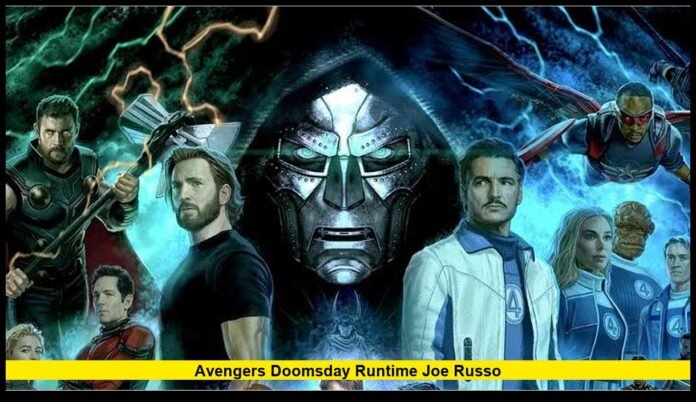

Avengers Doomsday runtime Joe Russo is drawing attention as Marvel fans look for the latest information about the upcoming Avengers movie and how long its theatrical experience may last. Joe Russo’s recent comments suggest that Avengers: Doomsday is expected to run approximately two and a half hours, giving audiences a better idea of the film’s anticipated length. However, Marvel Studios has not yet announced an exact, finalized theatrical runtime.
The discussion has become particularly important because different runtime figures have circulated online. Some earlier listings and reports suggested that the movie could last approximately two hours and 45 minutes, while Joe Russo’s more recent remarks point toward a shorter duration of around 150 minutes. The difference has created questions among fans about which number reflects the current plan.
With Avengers: Doomsday expected to bring together a massive collection of Marvel characters, including the Avengers, Fantastic Four, and actors associated with earlier X-Men movies, audiences are naturally interested in how the filmmakers will manage the story. The runtime could play an important role in shaping expectations for the movie’s pacing, action sequences, character interactions, and overall theatrical experience.
Although the final length remains unconfirmed, Joe Russo’s comments provide an important indication of the film’s expected duration. The movie appears to be planned as a major cinematic event without necessarily reaching the three-hour length of Avengers: Endgame.
What Joe Russo Actually Said About the Movie’s Length
The recent runtime discussion began when Joe Russo spoke about the movie’s promotional campaign and the way Marvel has introduced the story to audiences ahead of its theatrical release.
Russo explained that the character-focused promotional material represents pieces of a larger story. He indicated that audiences would ultimately experience those elements as part of approximately two and a half hours of movie time on December 18.
His statement is important because it provides a direct estimate from a filmmaker involved in the production. It also helps explain why the marketing campaign has included different character-focused elements rather than relying entirely on a conventional trailer strategy.
The comment points toward a movie running approximately 150 minutes. However, Russo did not announce an exact number of minutes or confirm that the final theatrical cut has been locked.
That distinction matters when discussing a major film that remains in the final stages of production and preparation for release.
The approximate figure versus an exact runtime
A statement describing a movie as approximately two and a half hours does not necessarily mean the final version will run exactly 150 minutes.
The finished movie could be slightly shorter or longer depending on the final edit, theatrical format, credits, and other release considerations. The director’s estimate gives audiences a useful expectation, but the official runtime should ultimately come from finalized studio or theater information.
For now, the best way to describe the film’s expected duration is approximately two and a half hours, based on Joe Russo’s recent remarks.
Why Earlier Reports Suggested a 2-Hour-45-Minute Movie
The runtime discussion has become more complicated because earlier reports placed Avengers: Doomsday at approximately 165 minutes.
That figure equals two hours and 45 minutes. It appeared in reporting connected to early theatrical and ticketing information, leading many fans to believe that the upcoming Avengers movie could be one of the longest Marvel releases.
A 165-minute runtime would have placed the movie between Avengers: Infinity War and Avengers: Endgame in terms of length, depending on the comparison being made with the franchise’s earlier films.
However, a movie’s runtime can change during production and post-production. The editing process may involve removing scenes, adjusting sequences, shortening dialogue, changing transitions, or reorganizing material to improve the overall narrative.
Different reports may reflect different stages
The 165-minute figure and the approximately 150-minute estimate do not necessarily mean that one report was deliberately incorrect.
They may reflect different stages of the movie’s production or different information available when each report appeared. An early listing can remain online even after newer information becomes available.
That is why readers may still see a runtime of 2 hours and 45 minutes on certain entertainment websites or movie platforms.
The most recent comments from Joe Russo point toward approximately 150 minutes. Nevertheless, other currently displayed listings may continue to show the earlier 165-minute figure.
Until Marvel Studios confirms the final theatrical duration, fans should recognize that the runtime remains subject to clarification.
Why the Final Runtime Has Not Been Clearly Settled
Movie runtimes often attract attention long before the final cut reaches theaters. That is particularly true for major franchise films with extensive visual effects, large casts, and complicated production schedules.
Avengers: Doomsday is expected to feature multiple superhero teams and characters from different cinematic universes. Such a project requires considerable planning, editing, and coordination.
The directors may need to balance:
- The introduction of Doctor Doom
- The central threat facing the heroes
- The Avengers’ involvement
- The Fantastic Four’s role in the conflict
- Returning characters from earlier Marvel movies
- Classic X-Men characters
- Major action sequences
- Character relationships and emotional developments
- Connections to the larger Multiverse Saga
- The movie’s ending and potential setup for Avengers: Secret Wars
Each of these elements could influence the final length.
A film with a large cast does not automatically need to run three hours. The directors may use existing audience familiarity with Marvel characters to move directly into the story without repeating lengthy introductions.
At the same time, a shorter runtime creates a creative challenge. The filmmakers must make sure that important characters and storylines receive enough attention while maintaining a clear narrative.
Anthony Russo’s Earlier Explanation of the Story Structure
Joe Russo’s recent comments are not the only runtime-related remarks from the directors.
Anthony Russo previously described the movie as approximately two and a half hours long while discussing the challenge of organizing its large cast around a central story.
His explanation focused on the need for a narrative with a clear direction. Instead of allowing the film to become a collection of disconnected character appearances, the directors want the story to have a central organizing idea.
This approach is particularly important for a crossover film involving characters from multiple universes.
A central narrative can help manage the ensemble
A large superhero cast creates opportunities for exciting interactions, but it can also create storytelling difficulties.
If the film spends too much time moving between unrelated character stories, audiences may struggle to understand the main conflict. A central narrative structure can help connect the different groups and make their individual roles more meaningful.
The directors’ comments suggest that the creative challenge involves determining how every major character and storyline fits into the larger conflict.
That approach could allow Doomsday to remain focused even with a substantial cast.
Avengers: Doomsday Runtime Compared With Previous Avengers Movies
The expected runtime of approximately 150 minutes places Avengers: Doomsday close to some of the franchise’s most successful theatrical releases.
The Avengers movies have varied considerably in length. The earlier films were generally shorter than the major crossover events that followed, while Endgame became one of Marvel’s longest theatrical releases.
| Movie | Approximate Runtime |
|---|---|
| The Avengers | 143 minutes |
| Avengers: Age of Ultron | 141 minutes |
| Avengers: Infinity War | 149 minutes |
| Avengers: Endgame | 181 minutes |
| Avengers: Doomsday | Approximately 150 minutes based on Joe Russo’s comments |
If the final movie runs approximately 150 minutes, it would be close to Infinity War and substantially shorter than Endgame.
That comparison may help fans understand what kind of theatrical experience to expect.
The comparison with Avengers: Infinity War
Infinity War is particularly relevant because it featured a large number of characters and multiple storylines that gradually came together around a central conflict.
The movie moved between different groups of heroes, locations, and objectives while maintaining a clear connection to the larger threat.
A similar approach may be useful for Doomsday, which is expected to bring together characters from different Marvel universes.
A runtime of approximately 150 minutes would give the directors considerable time to develop the central story while avoiding the length of Endgame.
The comparison with Avengers: Endgame
Endgame ran approximately three hours and one minute.
Its length reflected the film’s role as a major conclusion to the Infinity Saga. It had to address the consequences of Infinity War, develop emotional storylines involving the original Avengers, and deliver a major final confrontation.
Doomsday has a different narrative role. It is expected to introduce and develop a new major conflict while preparing the larger story for the next Avengers movie.
The shorter expected runtime does not automatically indicate a smaller story. It simply means the filmmakers may be approaching the narrative differently.
Why Avengers: Doomsday Could Be a Focused Two-and-a-Half-Hour Film
The scale of Avengers: Doomsday has led some fans to expect a movie longer than three hours. The announced cast includes actors associated with several Marvel franchises, and the film is expected to explore a major Multiverse conflict.
However, the directors may not need to give every character a separate storyline.
Many of the characters already have established backgrounds, relationships, and histories. Marvel audiences know Thor, Captain America, Ant-Man, the Fantastic Four, and several of the X-Men characters from previous films.
That familiarity could help the movie move more quickly into the central conflict.
Established characters require less introductory material
A traditional superhero movie often needs to explain the hero’s origin, abilities, motivations, relationships, and personal challenges. A crossover film can reduce some of that introductory work because audiences already understand many of the characters.
Instead of spending substantial time explaining who each hero is, the filmmakers can focus on what happens when the characters meet, disagree, cooperate, or confront a shared threat.
This approach may be particularly useful for a film featuring multiple superhero teams.
The movie still needs to provide enough context for viewers who may not have watched every Marvel release. However, it can potentially avoid repeating information that longtime fans already know.
The challenge of keeping the story moving
A large ensemble can make a film feel crowded if too many scenes are devoted to separate characters without advancing the central plot.
The directors must determine which moments are essential, which characters need the most development, and how the action can move between different groups without disrupting the story.
A runtime around 150 minutes could provide enough space for these decisions while maintaining momentum.
The effectiveness of that approach will ultimately depend on the final film rather than the runtime alone.
Doctor Doom Is Expected to Drive the Central Conflict
Doctor Doom is one of the most important elements of Avengers: Doomsday.
Marvel Studios has announced Robert Downey Jr. as Victor von Doom, marking a major change for an actor who previously played Tony Stark, also known as Iron Man.
The casting has created significant interest because Downey Jr. became closely associated with the MCU’s original central hero. His return in a villainous role introduces a new dimension to the franchise.
Doctor Doom is one of Marvel Comics’ most powerful and complex villains. The character is traditionally known for his intelligence, technological abilities, political ambitions, armor, mastery of science, and connection to magic.
His role in the movie is expected to be central to the larger conflict, although Marvel has not revealed the complete storyline.
Why Doctor Doom’s role matters to the runtime
A movie with a central antagonist can use that character to connect the story’s different elements.
Doctor Doom may serve as the narrative force that brings various superhero groups into the same conflict. The Avengers, Fantastic Four, and other characters could become involved because of the threat he represents.
That type of structure can help the film maintain a central direction.
Rather than treating every superhero as the main character, the movie can establish the larger threat and allow the different teams to respond according to their individual motivations.
The final cut will determine how much time the film devotes to Doom, the heroes, the Multiverse, and the broader consequences of the conflict.
The Avengers Return for Another Major Crossover
The Avengers remain at the heart of the Marvel cinematic franchise, and Doomsday is expected to bring several familiar heroes into a new major confrontation.
The film’s cast includes actors associated with previous Avengers movies, including Chris Hemsworth, Chris Evans, Anthony Mackie, Sebastian Stan, Paul Rudd, and other MCU stars.
The presence of these characters creates opportunities for new interactions and relationships.
The Avengers have changed considerably since their earliest appearances. Some original members are no longer part of the team in the same way, while newer characters have taken on major responsibilities.
The upcoming movie may explore how the current generation of heroes responds to a threat that affects multiple realities.
A different Avengers lineup
The MCU’s current superhero landscape is different from the one audiences saw in the early Avengers films.
New heroes have been introduced through standalone movies, streaming series, and other projects. Characters who once played supporting roles may now have greater importance.
This creates a challenge for the filmmakers because they must establish the relationships among the characters without making the movie feel like a long series of introductions.
The central story will likely determine which heroes receive the most attention.
The Fantastic Four Bring Another Universe Into the Story
The Fantastic Four are also expected to play an important role in Avengers: Doomsday.
The team’s introduction into the broader MCU has generated substantial interest because its members have a long history in Marvel Comics and previous movie adaptations.
The announced cast includes Pedro Pascal as Reed Richards, Vanessa Kirby as Sue Storm, Joseph Quinn as Johnny Storm, and Ebon Moss-Bachrach as Ben Grimm.
The Fantastic Four are often associated with exploration, scientific discovery, cosmic adventures, and family relationships. Their presence may provide a different perspective on the movie’s central conflict.
Why the Fantastic Four could be important
The Fantastic Four’s connection to science and exploration could make them particularly relevant to a story involving the Multiverse.
Their characters may have different knowledge, experiences, and motivations from those of the Avengers. That could create opportunities for new relationships and disagreements as the teams confront the larger threat.
Marvel has not revealed exactly how the Fantastic Four will become involved in the story, so their precise role remains unconfirmed.
Nevertheless, their inclusion represents one of the major elements that makes Doomsday different from previous Avengers movies.
Classic X-Men Characters Add Another Layer to the Crossover
The announced cast also includes actors associated with classic X-Men movies.
Several familiar names from earlier superhero films are expected to return, including Patrick Stewart, Ian McKellen, James Marsden, Alan Cumming, Kelsey Grammer, and Rebecca Romijn.
Their involvement is significant because it creates the possibility of bringing different generations of Marvel movie characters together.
For many viewers, these actors helped establish the early era of superhero cinema before the modern MCU became the dominant Marvel film franchise.
A reunion across Marvel movie eras
The inclusion of classic X-Men characters adds a historical dimension to the movie.
The film can potentially connect characters who previously appeared in separate cinematic franchises. This is one of the major advantages of Marvel’s Multiverse storytelling approach.
Audiences may see characters from different eras interact in ways that were previously impossible within a single movie continuity.
However, Marvel has not publicly disclosed the complete plot, so the exact relationships between these characters and the main Avengers storyline remain unknown.
How the Multiverse Could Connect the Different Teams
The Multiverse is expected to be a major part of the story.
Marvel’s recent movies and series have introduced alternate realities, different timelines, and variations of familiar characters. These concepts have gradually created a larger storytelling framework that allows characters from different universes to interact.
For Doomsday, the Multiverse appears to be more than a background concept. The official premise describes heroes from three distinct universes being placed on a collision course and facing an existential threat.
That description suggests a major conflict with consequences beyond a single universe.
Why a Multiverse story needs careful pacing
A Multiverse movie can introduce complicated concepts quickly.
The filmmakers need to make sure audiences understand why different characters are meeting, what the threat is, and what could happen if the conflict is not resolved.
If the movie introduces too many concepts without enough explanation, viewers may find the story difficult to follow.
A clear central narrative could therefore be particularly important.
The directors’ comments about creating a focused story with a central organizing principle suggest that they are aware of the challenge involved in connecting such a large cast and complicated storyline.
The final movie will show how successfully that approach works.
The Latest Avengers: Doomsday Runtime Update
The newest discussion about the movie’s length comes from Joe Russo’s recent remarks about the film and its promotional campaign.
His comments suggest a duration of approximately two and a half hours, or around 150 minutes. This is shorter than the earlier 165-minute figure that appeared in reports and listings.
The difference has attracted attention because both numbers have been associated with the upcoming movie at different times.
What the latest information indicates
The available runtime information currently points toward three important details:
- Joe Russo has recently described the movie as approximately two and a half hours.
- Earlier reporting and listings suggested a runtime of 165 minutes.
- The exact final theatrical runtime has not been officially confirmed by Marvel Studios.
These details should be kept separate when discussing the film’s length.
A director’s approximate statement provides a strong indication of the expected runtime, but it is not necessarily the same as a formal final announcement.
Fans should also remember that movie listings may not update immediately when new information becomes available.
What Fans Should Expect From the December Release
Avengers: Doomsday is scheduled to arrive in U.S. theaters on December 18, 2026.
The release date places the movie in the holiday season, when major theatrical releases traditionally attract audiences looking for large-scale entertainment.
The film’s anticipated cast, Doctor Doom storyline, Multiverse connections, and return of the Russo brothers make it one of the most closely watched Marvel releases.
The expected runtime of approximately 150 minutes is useful for viewers planning their theater visits.
A two-and-a-half-hour movie is long enough to deliver an extensive story, but audiences should remember that the actual time spent at a theater will include trailers, advertisements, and any other pre-show material.
The movie’s final runtime should be checked through updated theater information when tickets and showtimes become available.
Will Avengers: Doomsday Be One of the Longest Marvel Movies?
If the movie ultimately runs approximately 150 minutes, it will be among the longer Marvel theatrical releases.
However, it will not exceed Avengers: Endgame, which remains significantly longer at approximately 181 minutes.
The expected duration would put Doomsday close to Infinity War, a film that also featured numerous characters, different locations, and a large-scale central conflict.
That comparison may offer a useful indication of the experience Marvel is preparing.
The upcoming movie could deliver a substantial crossover event without requiring audiences to sit through a three-hour theatrical presentation.
Nevertheless, runtime alone does not determine whether a movie feels long, short, rushed, or satisfying.
A tightly organized story can feel complete at 150 minutes, while a less focused movie may feel unnecessarily long even with a shorter runtime.
Why the Movie’s Ending Is Also Generating Interest
Joe Russo has also discussed the film’s ending in recent interviews, describing it as surprising without revealing specific plot details.
That comment has generated additional interest because Doomsday is expected to play an important role in the larger Multiverse Saga.
The ending could potentially connect the movie’s central conflict to the next major Avengers project. However, Marvel has not disclosed exactly how the story will conclude.
Fans should avoid treating unofficial plot descriptions or rumored endings as confirmed information.
The movie’s final act will be one of the most closely watched parts of the theatrical release because it may establish the direction of the next stage of Marvel’s larger storyline.
How the Runtime Could Affect Character Screen Time
The size of the cast has become one of the biggest questions surrounding Avengers: Doomsday.
Fans naturally want to know how much time their favorite characters will receive. A runtime of approximately 150 minutes creates enough room for numerous interactions, but it does not guarantee equal screen time for every character.
The directors may prioritize characters according to their importance to the central storyline.
Some characters could receive substantial roles, while others may appear in more focused scenes that support the main conflict.
Screen time is different from the movie’s overall length
The total runtime measures the length of the film, not how much time each actor or character appears on screen.
A movie can feature a large cast while still concentrating heavily on a smaller number of central characters.
For example, the story may focus primarily on Doctor Doom, the Avengers, and the characters most directly connected to the main threat. Other heroes may appear as part of supporting storylines or major sequences.
Marvel has not released a detailed breakdown of individual character screen time, so fans will have to wait for the film to see how the ensemble is organized.
Could the Runtime Be Different in Different Theater Formats?
The theatrical presentation may also create questions about whether different formats have different durations.
Movies can occasionally include format-specific presentation details, but audiences should not assume that every premium theater version contains additional story footage.
The final runtime information should be checked through the specific theater and format being booked.
Until Marvel confirms the final cut, the approximate 150-minute estimate remains the most useful current indication from Joe Russo’s recent comments.
Final Thoughts
The latest information surrounding Avengers Doomsday runtime Joe Russo suggests that Marvel’s upcoming crossover is expected to run approximately two and a half hours.
Joe Russo’s recent comments have helped clarify the discussion after earlier reports suggested a longer 165-minute duration. The difference may reflect separate stages of the movie’s production, but Marvel Studios has not officially confirmed the final theatrical runtime.
The expected length places Doomsday close to Avengers: Infinity War and considerably shorter than Avengers: Endgame. That duration could provide the filmmakers with enough time to bring together the Avengers, Fantastic Four, classic X-Men characters, Doctor Doom, and the wider Multiverse conflict.
The movie’s success will ultimately depend on its storytelling, pacing, character development, action, and emotional impact—not simply the number of minutes it runs.
With the December 18, 2026, theatrical release approaching, the runtime remains one of the most closely watched details surrounding the next major Avengers event. An official final figure may provide additional clarity as Marvel continues its promotional campaign.
Frequently Asked Questions
Q1. How long is Avengers: Doomsday according to Joe Russo?
Joe Russo’s recent comments indicate that Avengers: Doomsday is expected to run approximately two and a half hours, or around 150 minutes. The exact final runtime has not been officially confirmed.
Q2. Is Avengers: Doomsday officially 150 minutes long?
Not yet. Joe Russo has described the movie as approximately two and a half hours, but Marvel Studios has not announced an exact finalized theatrical runtime.
Q3. Why was Avengers: Doomsday previously listed as 165 minutes?
Earlier reports and listings suggested a runtime of 165 minutes, equal to two hours and 45 minutes. That information may reflect an earlier production stage or preliminary listing. Joe Russo’s more recent comments point toward an approximate duration of 150 minutes.
Q4. Is Avengers: Doomsday shorter than Avengers: Endgame?
Yes, based on the current estimate. If Doomsday runs approximately 150 minutes, it will be around 31 minutes shorter than Avengers: Endgame, which runs approximately 181 minutes.
Q5. How does Avengers: Doomsday compare with Infinity War?
The expected runtime is very close to Avengers: Infinity War, which runs approximately 149 minutes. If the estimate holds, Doomsday will be about one minute longer.
Are you excited about a roughly two-and-a-half-hour Avengers movie, or do you think this massive Marvel crossover deserves a longer theatrical experience? Share your opinion in the comments and stay tuned for the latest Avengers: Doomsday updates.