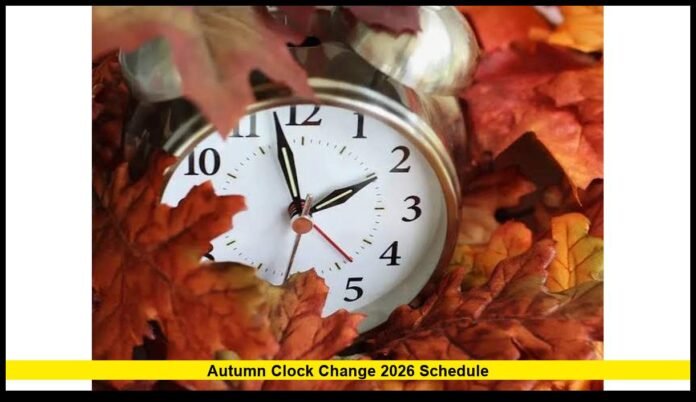

The autumn clock change 2026 schedule is set for Sunday, November 1, across most of the United States, with clocks moving back one hour as the country returns to standard time.
For most Americans, the change will happen at 2 a.m. local daylight time. At that moment, the clock will move back to 1 a.m. The result is an extra hour during the overnight period and an earlier sunset schedule beginning that evening.
The date is confirmed under the current federal rules. No new law has taken effect that would cancel the November adjustment for 2026.
That makes November 1 the key date to remember for households, businesses, travelers and anyone responsible for manually adjusted clocks.
When Do Clocks Change in 2026?
The fall adjustment takes place on Sunday, November 1, 2026.
In areas that observe seasonal clock changes, the official transition occurs at 2 a.m. local time. The clock moves backward to 1 a.m.
This means the hour between 1 a.m. and 2 a.m. occurs twice during the overnight transition.
The change takes place during the early morning rather than at midnight. As a result, Saturday night gradually turns into Sunday morning before the repeated hour occurs.
For people planning around the event, the simplest rule is:
- Date: Sunday, November 1, 2026
- Direction: One hour backward
- Transition: 2 a.m. becomes 1 a.m.
- Result: One additional clock hour
- Time standard afterward: Standard time
The adjustment applies to most U.S. states but not every American location.
What Happens at 2 a.m.?
The most important detail is what happens when the local clock reaches 2 a.m.
Instead of continuing to 3 a.m., the clock returns to 1 a.m.
The sequence looks like this:
1:00 a.m. → 1:59 a.m. → 1:00 a.m. → 1:59 a.m. → 2:00 a.m.
The first 1 a.m. occurs while the area is still on daylight time. The repeated 1 a.m. begins standard time.
This creates an unusual overnight period because one hour appears twice on the clock.
For most people, the change will happen without much effort. Smartphones, computers, tablets and many connected devices can update automatically when their time-zone settings are correct.
Manual clocks require more attention.
Why November 1 Is the Date
The United States uses a federal schedule for locations that observe the seasonal clock change.
Under the current rules, the annual transition back to standard time occurs on the first Sunday in November.
Since the first Sunday in November falls on November 1 in 2026, the fall adjustment arrives earlier in the calendar than it does in some other years.
The date does not depend on the autumnal equinox.
The start of astronomical autumn and the clock adjustment are separate events. The clock schedule follows federal timekeeping rules rather than the date of the seasonal equinox.
This is why Americans should use November 1 when planning for the 2026 change.
Will Every U.S. State Change Its Clocks?
No.
Most states observe the seasonal adjustment, but some locations remain on standard time throughout the year.
The two most familiar state-level exceptions are Hawaii and most of Arizona.
Hawaii does not observe the seasonal clock change. Most of Arizona also stays on standard time year-round.
There is an important distinction within Arizona.
The Navajo Nation observes the seasonal change, so not every location within the state follows the same clock practice.
This can create confusion for travelers crossing Arizona or communicating with people in different parts of the state.
Anyone making travel plans should check the specific location rather than assuming that every part of the country changes at the same time.
Which U.S. Territories Stay on Standard Time?
Several U.S. territories also do not observe the seasonal clock adjustment.
These include:
- American Samoa
- Guam
- Northern Mariana Islands
- Puerto Rico
- U.S. Virgin Islands
Those locations will not move their clocks backward on November 1.
The difference is especially relevant for people coordinating flights, phone calls, business meetings or online events across the mainland and U.S. territories.
A time difference that exists during one part of the year can also change when mainland locations switch between daylight and standard time.
What Changes After the November Adjustment?
The clock change does not create more sunlight.
Instead, it changes where daylight appears on the clock.
After the November transition, sunrise occurs earlier by the clock, while sunset also occurs earlier.
The effect becomes particularly noticeable during late afternoon and early evening.
Someone who was accustomed to sunset occurring at a particular clock time in October will see darkness arrive about an hour earlier after the November adjustment.
Morning conditions move in the opposite direction.
Sunrise occurs earlier according to the clock, which can make early mornings appear brighter compared with the weeks immediately before the transition.
The amount of daylight available still depends on the date and location. The clock adjustment simply changes how those daylight hours are labeled.
Does the Fall Change Add an Hour?
Yes, the November transition creates an extra clock hour.
When 2 a.m. becomes 1 a.m., the day contains 25 hours in locations that make the adjustment.
That is why the event is commonly associated with gaining an hour.
However, people do not automatically receive an extra hour of sleep.
Someone may choose to remain awake during the repeated hour, work during it or simply adjust their usual schedule.
The clock provides the additional hour, but each person’s routine determines how it is used.
What Should You Do With Manual Clocks?
Most modern electronic devices can handle the transition automatically. Older or manually operated clocks may not.
Before going to bed on Saturday night, October 31, people can check clocks that require manual adjustment.
Common examples include:
- Wall clocks
- Analog watches
- Traditional alarm clocks
- Some vehicle clocks
- Microwave clocks
- Oven clocks
- Older electronic displays
- Certain workplace clocks
The easiest approach is to adjust these devices before the new day begins.
People who depend on an alarm clock should pay particular attention. A clock that does not update correctly could display the wrong time after the transition.
Smartphones and internet-connected devices generally handle the adjustment automatically when their settings are configured correctly.
Will Phones Automatically Change?
Many modern phones automatically update their clocks based on the selected time zone and system settings.
The same can apply to computers, tablets, smartwatches and other connected devices.
However, automatic adjustment should not be assumed for every device.
Older electronics may rely on programmed rules that do not account for newer timekeeping changes. Devices with incorrect time-zone settings can also display the wrong local time.
People who have important appointments, alarms or travel plans on November 1 should check their devices after the transition.
The risk is usually small, but a quick check can prevent confusion.
How the Change Affects U.S. Time Zones
The transition applies across the major U.S. time zones that observe the seasonal schedule.
The clock moves from daylight time to standard time in each participating zone.
The familiar changes include:
- Eastern Daylight Time to Eastern Standard Time
- Central Daylight Time to Central Standard Time
- Mountain Daylight Time to Mountain Standard Time
- Pacific Daylight Time to Pacific Standard Time
- Alaska Daylight Time to Alaska Standard Time
The exact local transition happens at 2 a.m. within each participating area.
That means there is not one single nationwide moment when every clock changes simultaneously.
Instead, each time zone follows its own local clock.
What About Travel on November 1?
Travelers should pay close attention to the change.
A person traveling between locations can encounter different clock rules, especially when the trip involves Hawaii, Arizona or a U.S. territory.
Airlines and other transportation systems operate using established local and system time standards, but passengers should still check their schedules carefully.
The November transition can also affect hotel check-in times, rental-car arrangements, event schedules and personal alarms.
For road trips, travelers crossing multiple time zones should rely on updated devices and official schedules rather than trying to calculate the change manually.
Is the 2026 Change Still Going Ahead?
Yes.
As of September 27, 2026, the November transition remains part of the federal schedule.
That matters because Congress has been considering legislation that could change the nation’s approach to seasonal clock changes.
The U.S. House passed a measure in July 2026 that would make daylight time permanent for most areas currently covered by the seasonal system.
However, passing the House did not make the proposal law.
The measure still requires further action before it could change the existing federal rules.
Therefore, the November 1 transition remains the date Americans should use when making plans for 2026.
There is no current basis for treating the November adjustment as canceled.
Could the U.S. Stop Changing Clocks?
The possibility of a permanent system has been a subject of federal debate.
The legislation considered in 2026 would change the existing arrangement by keeping daylight time in place instead of moving back to standard time each autumn.
That proposal is separate from the schedule currently in effect.
Until Congress completes the required legislative process and a new law takes effect, the existing rules continue to govern the clock change.
For consumers, businesses and travelers, this means the practical answer for 2026 remains straightforward: prepare for the November 1 adjustment.
Future changes should not be treated as effective until they become law.
The Difference Between Daylight and Standard Time
The November adjustment marks the return to standard time.
During daylight time, clocks are shifted one hour ahead of standard time. This places more daylight later on the clock during the evening.
When the fall adjustment occurs, clocks return to the standard-time position.
The result is earlier daylight in the morning and earlier darkness in the evening.
The November transition therefore changes the timing of daily activities according to the clock, even though it does not alter the natural length of the day.
This distinction is useful when explaining why sunrise and sunset suddenly appear to shift by about an hour.
2026 Fall Clock Change at a Glance
| Detail | 2026 Information |
|---|---|
| Date | November 1, 2026 |
| Day | Sunday |
| Clock direction | Back one hour |
| Transition time | 2 a.m. local daylight time |
| New displayed time | 1 a.m. |
| Time after transition | Standard time |
| Most U.S. states | Change clocks |
| Hawaii | Does not change |
| Most of Arizona | Does not change |
| Several U.S. territories | Do not change |
| Extra clock hour | Yes |
| Permanent-time legislation | Under consideration |
| Current November change | Still scheduled |
What the Date Means for Americans
For most Americans, the November transition will be familiar.
Saturday, October 31 will be the final night before the clocks return to standard time. During the overnight hours, clocks will move backward.
Sunday, November 1 will then become the first full day under the new clock setting.
The immediate effect will be noticeable in daylight patterns.
Mornings will become brighter earlier by the clock, while evenings will become darker earlier.
People who spend time outdoors, commute early or plan evening activities may notice the change quickly.
Households can prepare simply by checking manually operated clocks and confirming that important digital devices have the correct time-zone settings.
Key Date to Remember
The most important date in the 2026 schedule is Sunday, November 1.
The official change occurs at 2 a.m. in locations that observe the seasonal adjustment. The clock moves backward to 1 a.m., creating the repeated hour.
Hawaii, most of Arizona and several U.S. territories remain outside the seasonal system.
The federal schedule is still in effect despite ongoing congressional consideration of permanent daylight time.
For now, there is no need to adjust plans based on proposed changes that have not become law.
The confirmed 2026 schedule remains the one Americans should follow.
Are you looking forward to gaining an hour in November, or would you rather see the clock changes end? Share your thoughts in the comments and stay informed as the November date approaches.