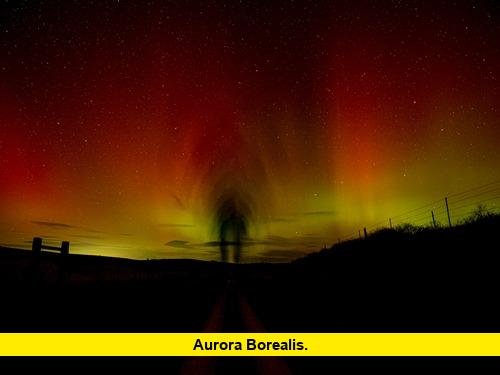

The aurora borealis is expected to make a dazzling appearance tonight, with forecasts showing it visible across Oregon and 15 other U.S. states. Energized solar activity has led to a strong geomagnetic storm alert from forecasters, meaning skywatchers in several northern and midwestern states may catch a rare glimpse of the vibrant northern lights.
This natural phenomenon, caused by charged particles from the sun colliding with Earth’s atmosphere, is typically confined to regions near the Arctic Circle. However, when solar activity intensifies, the aurora borealis can extend much farther south, giving millions more people the opportunity to witness its glow.
States Expected to See the Display
According to the latest update from the National Oceanic and Atmospheric Administration’s (NOAA) Space Weather Prediction Center, a geomagnetic storm watch is in effect. The impressive light display may be visible in the following states tonight, weather conditions permitting:
- Oregon
- Washington
- Idaho
- Montana
- North Dakota
- South Dakota
- Minnesota
- Wisconsin
- Michigan
- Iowa
- Nebraska
- Wyoming
- Colorado
- Maine
- Vermont
- New Hampshire
Residents in these areas are encouraged to check the skies between 10 p.m. and 2 a.m. local time, when auroras are typically strongest.
Why Visibility Is Unusual This Week
Normally, the aurora borealis is primarily visible in Alaska, northern Canada, Iceland, and Scandinavia. However, recent eruptions from the sun—known as coronal mass ejections—have sent waves of solar energy racing toward Earth. When these particles interact with Earth’s magnetic field, they create spectacular bursts of color in the night sky, sometimes ranging from green and yellow to purple and deep red.
The fact that states as far south as Oregon and Nebraska are predicted to see northern lights demonstrates how powerful the current solar activity is.
Tips for the Best Viewing Experience
If you live in one of the highlighted states, there are ways to maximize your chance of seeing the aurora borealis tonight:
- Seek darkness: Travel away from major cities or towns where light pollution reduces visibility.
- Check the skies frequently: The lights often appear suddenly and change rapidly in intensity.
- Use aurora forecast maps or apps: Tools provided online by NOAA, the University of Alaska Fairbanks’ Geophysical Institute, and other platforms give real-time tracking information.
- Bring a camera: Long-exposure shots on DSLR or mirrorless cameras often capture auroras even when the human eye sees only faint glows.
What if Clouds Obscure the View?
Unfortunately, cloud cover could reduce visibility in certain regions tonight. For example, parts of the Pacific Northwest and the Upper Midwest may see cloudy skies, potentially blocking the aurora. If conditions are unfavorable, photographers and skywatchers may still watch live streams hosted by observatories or aurora-chasing groups on YouTube and social media platforms.
The Science Behind the Glow
At its core, the aurora borealis is a space weather event. When the solar wind collides with Earth’s magnetic field, particles funnel toward the poles. These particles then collide with atoms and molecules in Earth’s atmosphere, releasing energy in the form of glowing light.
- Green lights: Produced when solar particles interact with oxygen at lower altitudes.
- Purple or red lights: Caused by high-altitude oxygen or nitrogen collisions.
- Blue and pink hues: Indicate intense atmospheric activity from nitrogen gases.
This week’s geomagnetic storm is classified as a G3 (strong) event, which carries the potential to extend auroral activity significantly southward.
Why This Event Is Exciting for the Lower 48 States
For many Americans outside of Alaska or the far North, opportunities to see the aurora borealis are rare. The last time such a widespread event swept the skies of the U.S. heartland was during periods of intense solar cycles in the past decade. Tonight gives skywatchers a unique chance to experience nature’s most brilliant light show without leaving their home state.
Astronomers also point out that we are approaching the peak of Solar Cycle 25, a phase of increased solar activity that happens roughly every 11 years. That means more opportunities for aurora sightings could happen through 2025.
If skies remain clear, millions of people in Oregon and beyond could be treated to one of the most breathtaking celestial events of the year. Share your sightings, photos, or experiences in the comments—because opportunities to see such an extraordinary display don’t come often.