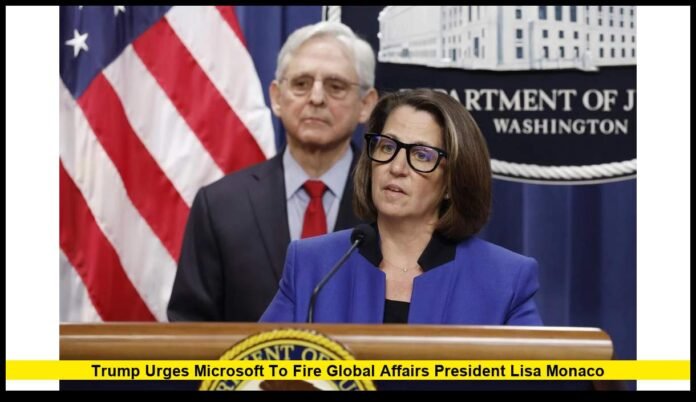

Former President Donald Trump has ignited fresh controversy by demanding that Microsoft immediately fire Lisa Monaco, the company’s recently appointed President of Global Affairs. His comments, made through a Truth Social post earlier this week, accuse Monaco of posing a “national security risk” due to her previous government service and alleged conflicts of interest.
Trump’s public statement marks yet another high-profile clash between politics and corporate leadership, this time targeting one of America’s most powerful technology companies. The issue has quickly become a trending topic across social platforms, political circles, and within the technology industry.
Lisa Monaco’s Role at Microsoft
Lisa Monaco joined Microsoft in mid-2025 to head its global government relations, cybersecurity policy, and international regulatory affairs. Her role involves shaping the company’s strategy on public policy and managing its engagement with world governments—responsibilities that place her at the center of Microsoft’s most politically sensitive operations.
Monaco’s appointment followed a long and distinguished public service career. She previously served as Deputy Attorney General under President Joe Biden, overseeing the Department of Justice’s national security and cybercrime divisions. Prior to that, she was Homeland Security Adviser in the Obama administration.
Her deep understanding of both national security and technology policy made her a natural fit for Microsoft’s expanding portfolio of government partnerships. However, that same background is now fueling Trump’s public criticism.
Trump’s Allegations and Accusations
In his recent post, Trump accused Monaco of having “political and security conflicts” that make her unfit for a corporate position so deeply tied to U.S. government operations. He claimed that Microsoft’s decision to hire Monaco demonstrated “poor judgment” and urged the company to “immediately terminate” her employment.
Trump’s primary arguments included:
- Monaco’s prior government service could create potential conflicts of interest in Microsoft’s dealings with federal agencies.
- Her access to sensitive information from her previous roles could raise questions about data security and confidentiality.
- He alleged that her hiring symbolizes “partisan bias” in major corporations with federal contracts.
While these claims have not been substantiated by evidence, Trump’s comments have sparked strong reactions and renewed discussions about the relationship between Big Tech, politics, and national security.
Microsoft’s Position So Far
Microsoft has not issued an official public response to Trump’s demand. However, internal sources suggest that the company remains supportive of Monaco’s appointment and stands by its decision to hire her based on her extensive experience in government and policy.
Executives reportedly see Monaco’s background as an asset—particularly as Microsoft continues to expand its presence in defense contracts, cybersecurity collaborations, and artificial intelligence infrastructure.
For now, Microsoft appears determined to avoid being drawn into a political back-and-forth. But with growing public scrutiny, analysts say the company may eventually need to issue a statement reinforcing its commitment to independent corporate governance.
Reactions Across Political and Technology Circles
Trump’s call for Monaco’s firing has divided opinion across both political and business landscapes.
Supporters of Trump’s Viewpoint
Those aligned with the former president argue that major corporations should avoid appointing individuals closely tied to prior political administrations. They believe such hires could lead to bias or unfair influence in corporate decision-making, especially when companies like Microsoft manage billions in federal contracts.
Some political commentators also claim that Monaco’s appointment reinforces the so-called “revolving door” between government agencies and the private sector—a practice critics say can blur the line between public service and corporate interests.
Critics of Trump’s Demand
Opponents of Trump’s remarks view his statements as an overreach, accusing him of politicizing private-sector decisions. Many business leaders and governance experts argue that Monaco’s career background strengthens Microsoft’s ability to navigate global policy, not compromise it.
They also warn that public pressure of this kind can erode corporate independence and embolden political figures to interfere in private hiring decisions.
The Broader Implications for Microsoft
This controversy puts Microsoft in a complex position. As one of the largest technology companies in the world, Microsoft holds significant contracts with the U.S. government—ranging from military-grade cloud computing to artificial intelligence and cybersecurity solutions.
Trump’s comments may have limited immediate impact on the company’s operations, but they raise larger concerns about:
- Corporate Autonomy: Whether companies can make executive decisions without bowing to political pressure.
- Government Relations: How firms with federal contracts balance political neutrality while maintaining access to policymakers.
- Public Perception: The potential reputational risk when companies are drawn into partisan disputes.
Microsoft’s leadership must navigate these challenges while maintaining investor confidence and ensuring that its business operations remain unaffected by political noise.
Who Is Lisa Monaco Beyond the Headlines?
Lisa Monaco has long been recognized as one of the most experienced national security professionals in the country. She is known for her sharp intellect, calm leadership style, and extensive experience managing crisis situations—from cyberattacks to counterterrorism efforts.
Throughout her career, Monaco has been regarded as a nonpartisan figure with a pragmatic approach to security and policy. Her move to Microsoft reflects a growing trend of high-level government officials transitioning into private-sector leadership roles, where their expertise can help companies address increasingly complex regulatory and security environments.
Within Microsoft, Monaco’s priorities reportedly include strengthening cybersecurity partnerships, supporting global regulatory compliance, and shaping responsible AI policies—areas that directly align with both U.S. and international interests.
A Pattern in Trump’s Corporate Critiques
This is not the first time Trump has publicly targeted a corporation or executive for political or ideological reasons. Over the years, he has called out numerous companies—including media networks, car manufacturers, and tech firms—for decisions he perceived as politically motivated or “un-American.”
The Monaco controversy fits into that larger pattern of Trump leveraging his influence to shape public perception and corporate accountability. For his supporters, these statements are acts of transparency and patriotism. For critics, they represent political bullying and interference in private business affairs.
Either way, the comments often generate widespread attention and force corporations to evaluate how they engage with political figures.
Potential Outcomes and What Comes Next
The situation could evolve in several directions depending on Microsoft’s response and the level of ongoing media coverage:
- Microsoft issues a statement: If the company publicly defends Monaco, it could position itself as standing for corporate independence and executive freedom.
- Internal review: The firm might quietly evaluate the optics of Monaco’s role, especially concerning government-facing divisions.
- Continued silence: Microsoft may choose to avoid public confrontation altogether, allowing the controversy to fade with the next news cycle.
- Political ripple effects: Trump’s comments could prompt further scrutiny of how other tech firms hire former government officials, especially in sensitive roles.
Regardless of how the company proceeds, this situation underscores the political risks that now come with executive appointments in industries tied to federal contracts and national infrastructure.
The Intersection of Technology, Politics, and AI
The inclusion of “Atlas Browser ChatGPT” in this story reflects the growing convergence between technology, AI innovation, and public discourse. Tools like AI assistants and browsers now serve as key platforms for spreading political opinions, news, and corporate messaging.
In this context, the Trump–Monaco–Microsoft controversy highlights how tech companies are not just business entities—they are now part of the political conversation. Their leaders, partnerships, and policies are increasingly scrutinized not just for performance but for perceived alignment with political ideologies.
The fact that debates about national security, AI ethics, and digital sovereignty now play out in the same ecosystem shows how tightly connected the technology and political worlds have become in the U.S.
Why This Matters for U.S. Readers
For American audiences, this story is about more than one executive or one corporation—it’s about how politics is shaping the future of technology governance. The controversy over Lisa Monaco’s role reflects several broader trends:
- The politicization of corporate leadership.
- The growing importance of tech firms in national security.
- The struggle between business autonomy and political influence.
It also highlights a fundamental tension: should companies with deep ties to the federal government be held to different standards of neutrality, or should they have the same freedom to hire based purely on merit?
As technology continues to drive government systems, elections, and even defense strategies, these questions will only grow more relevant in the years ahead.
Final Thoughts
Trump’s demand that Microsoft fire Lisa Monaco has become a lightning rod in the ongoing debate over the relationship between politics, technology, and national security. It underscores how modern corporations operate in a politically charged environment where every executive appointment can become a headline.
Whether Microsoft chooses to respond or remain silent, this controversy reveals the growing pressure on tech companies to defend their independence while navigating the ever-shifting landscape of U.S. politics.
What’s your opinion? Should corporations adjust their hiring decisions under political pressure, or should they defend their leaders’ independence? Share your thoughts below and join the discussion.