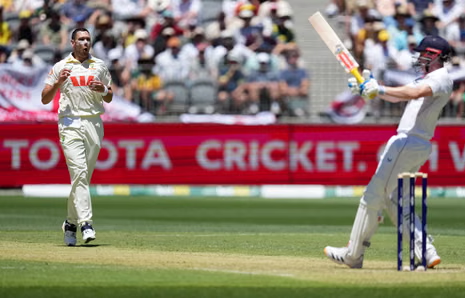

The ashes scorecard from day one of the first Test in Perth is telling: England were dismissed for just 172 as Australia seized early control of the match. Batting first at Optus Stadium, England never found rhythm and Australia’s attack, spearheaded by Mitchell Starc, delivered one of the most convincing opening displays of an Ashes Test in recent memory.
England’s Batting Under Pressure
England’s decision to bat first looked sensible given the opportunity to set the tone. But from the outset the touring side struggled to cope with the pace and bounce of the surface. An early wicket in the opening over triggered a cascade of dismissals, and England rarely recovered.
Zak Crawley was dismissed for a duck almost immediately, setting the tone of frustration. Ben Duckett and Joe Root followed in rapid succession, leaving England 33-2 and then 39-3, with the top order in tatters by the end of the morning session.
Mid-innings, there were glimpses of recovery. Harry Brook top-scored with a fifty (52) and Ollie Pope chipped in with 46, both showing resilience against a sting in the tail attack. But the partnerships were short, and the momentum swing never arrived. The tail collapsed under pressure and England were all out in 32.5 overs for 172.
Key factors contributing to the collapse included:
- Early movement off the pitch and bounce that challenged the batsmen’s timing.
- Australia’s bowlers executing tight line and length, reducing free scoring opportunities.
- England’s reliance on an aggressive mindset without enough caution early on.
- The absence of significant partnerships — only two players crossed forty, and no one went on to build a large innings.
Starc and Australia’s Attack in Business
On the flip side, the ashes scorecard becomes a narrative of Australian dominance, with Mitchell Starc’s 7-58 standing out as the cornerstone. Starc’s performance sent a message that Australia’s bowling attack remains formidable even without some of their usual frontline bowlers.
His spell combined pace, bounce and late swing — a difficult combination for any batting side. He stole early momentum by removing key batsmen, including Root and Duckett, and kept stemming the flow of runs through the middle overs. Starc’s wicket tally also marked a personal milestone, making this one of his best performances in Ashes contests.
Support bowlers complemented him well. They sharpened the pressure so that England’s batters often had to chase the ball instead of shaping their innings freely. The new ball movement and the bounce of the Perth surface worked in Australia’s favor, and their bowlers made full use of it.
Session-By-Session Breakdown
Morning Session
- England lost Crawley early for zero; the first session ended with them already deep in trouble.
- Root fell cheaply, leaving England 39-3 and prompting concern over how they’d rebuild.
Afternoon Session
- Brook and Pope formed the backbone of the innings; their fifty and 46 respectively helped England reach 105-4 at lunch.
- The partnership gave hope, but once it broke the tail offered little resistance.
Evening Session
- The collapse resumed: England lost wickets in quick succession and finished at 172 all out.
- Australia began their first innings before stumps, getting off to a start of approximately 15-1, trailing by 157.
Statistical Snapshot
| Item | Detail |
|---|---|
| England First Innings Total | 172 all out |
| Top England Scorers | Brook 52, Pope 46 |
| Best Australian Bowler | Starc 7-58 |
| Australia at Stumps | ~15-1 (beginning innings) |
| Deficit for Australia | ~157 runs |
Why the Scorecard Matters for U.S. Readers
While cricket may not be as familiar in the U.S., the ashes scorecard parallels a game-changing inning in baseball or a blowout first quarter in the NFL. It sets the tone, signals where control lies and influences strategies for the next days.
- The low total by England means they have less margin for error across the remaining four days.
- Australia’s strong bowling performance shows their dominance and confidence, turning the psychological advantage their way.
- For American audiences: Imagine a team batting first and scoring far fewer runs than expected; the other team begins next with the momentum — that’s what’s happening here.
England’s Challenges Moving Forward
England now face a number of significant issues:
- Re-thinking their batting strategy
Their aggressive game plan faltered under disciplined bowling. They may need to adopt more caution early on and rebuild their innings. - Building effective partnerships
The only two meaningful innings came from Brook and Pope. Without sustained stands, the batting lineup remains fragile. - Recovering in a long Test match format
With Australia already ahead, England must bowl well, field sharply, and hope for a batting resurgence. This innings doesn’t just affect one hour—it echoes through the entire Test.
Australia’s Advantages and What Comes Next
With day one behind them, Australia find themselves in a strong position.
- Bowling depth: Despite missing key men, they showed they are more than capable.
- Batters’ challenge: With England reeling, Australia’s batters have the opportunity to build a big total and place scoreboard pressure on England.
- Home conditions: Perth offers bounce and pace; Australia know how to use that to full effect.
Looking ahead to day two and beyond:
- Australia will look to solidify a first-innings lead. A lead of 200 or more would give them immense control.
- England must attempt to reduce the margin and not let Australia settle into an uninterrupted rhythm.
- The pitch could change as the match progresses, and England must remain resilient if they are to fight back.
Key Moments That Defined the Scorecard
- Early dismissal of Crawley for zero.
- Starc’s middle-overs storm, which removed the momentum of the Brook-Pope stand.
- England’s inability to convert starts into big scores.
- Australia’s smart use of new ball and follow-through pressure.
These moments are embedded in the ashes scorecard and tell us why the day ended so decisively in Australia’s favour.
Conclusion
The opening day’s ashes scorecard is more than a set of numbers: it’s a statement. England’s batting collapsed under pressure, while Australia’s attack struck with precision and rhythm. For U.S. readers, think of this as one team being knocked out early and the other starting with the ball in their hands.
Day one ends with Australia clearly ahead and England facing an uphill battle. The match still has four days left, but the gulf in momentum is real. If England are to recover, they’ll need an early breakthrough with the ball and a batting revival that looks far different from what we saw today.
We’ll be watching closely—stay tuned for how this series develops and let us know your thoughts on how England might bounce back or whether Australia will carry this dominance forward.