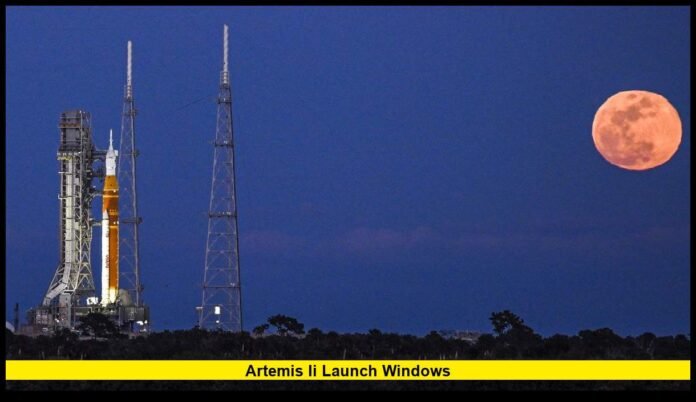

The artemis ii launch windows now center on March and April 2026 after NASA adjusted the schedule following technical work on the Space Launch System rocket at Kennedy Space Center. The agency confirmed early March as the first available opportunity for liftoff, with additional dates extending into late April if needed.
Artemis II will send four astronauts on a lunar flyby, marking the first crewed journey beyond low Earth orbit since 1972. With final testing underway, attention has shifted to the precise launch periods that meet strict safety and trajectory requirements.
Confirmed 2026 Launch Opportunities
NASA has identified specific dates when Earth-Moon alignment supports the mission’s free-return trajectory. These windows provide short daily opportunities for launch.
March 2026 Window
- March 6–9
- March 11
April 2026 Backup Window
- April 1
- April 3–6
- April 30
Each date includes a limited launch period lasting roughly one to three hours. If weather or technical issues interrupt a countdown, NASA must wait for the next available slot within the approved window.
Why the Schedule Shifted to March
NASA initially aimed for an earlier timeframe. During a wet dress rehearsal in January 2026, engineers detected a liquid hydrogen leak while loading cryogenic propellant into the rocket’s core stage. Teams halted operations and began troubleshooting.
A wet dress rehearsal simulates the entire launch countdown. Engineers fuel the rocket, run the terminal countdown sequence, and practice built-in holds without astronauts onboard. This test confirms that ground systems, propellant lines, and onboard controls function as designed.
After reviewing data, NASA determined that additional work and inspections were necessary before committing to launch. March 2026 became the earliest realistic timeframe that satisfies both readiness and trajectory requirements.
What Determines Launch Windows
Launching a crewed lunar mission demands exact timing. Several key factors shape the available windows.
Earth–Moon Geometry
Orion must enter a free-return path around the Moon. That trajectory allows the spacecraft to swing behind the Moon and return to Earth using gravitational forces if needed. This built-in safety feature restricts launch timing.
Lighting Conditions
Proper lighting supports safe navigation and splashdown operations. Orion’s return to Earth must align with daylight conditions in the Pacific recovery zone.
Abort Capability
During ascent, NASA requires viable abort paths at every stage of flight. The rocket must launch when those abort corridors remain clear and safe.
Recovery Zone Weather
The U.S. Navy and NASA recovery teams will retrieve Orion after splashdown. Sea state and weather conditions in the Pacific influence acceptable launch timing.
Because of these constraints, opportunities cluster within certain days rather than appearing daily.
Rocket and Spacecraft Readiness
The Space Launch System rocket and Orion spacecraft stand stacked at Launch Complex 39B in Florida. Engineers continue detailed inspections following the rehearsal test.
Teams are focusing on:
- Hydrogen transfer line integrity
- Valve performance and pressure readings
- Tanking procedures and venting systems
- Countdown sequencing software
- Communications between Orion and ground control
NASA leaders have emphasized that crew safety drives every decision. No launch date will be set until all systems meet performance standards.
The Crew of Artemis II
Four astronauts will fly aboard Orion:
- Reid Wiseman
- Victor Glover
- Christina Koch
- Jeremy Hansen
This diverse crew represents both NASA and the Canadian Space Agency. Artemis II will mark the first time a Canadian astronaut travels beyond low Earth orbit.
Their mission will test life-support systems, deep-space navigation, and crew operations in lunar-distance conditions.
Mission Duration and Flight Plan
Artemis II is planned to last about 10 days. After liftoff, the rocket’s core stage and boosters will propel Orion into orbit. The upper stage will then perform a translunar injection burn, sending the spacecraft toward the Moon.
The crew will travel thousands of miles beyond the lunar surface before looping back toward Earth. Orion will reenter Earth’s atmosphere at high speed and splash down in the Pacific Ocean.
This mission does not include a lunar landing. Instead, it validates spacecraft systems before Artemis III, which aims to land astronauts on the Moon.
Weather Challenges at Kennedy Space Center
Florida weather often affects launch schedules. Lightning, strong winds, or upper-level wind shear can force a delay even when the rocket and spacecraft are ready.
Cryogenic fueling adds another layer of sensitivity. Liquid hydrogen must remain at extremely low temperatures. Small temperature variations or pressure changes can interrupt fueling operations.
NASA monitors weather forecasts closely in the days leading up to each launch attempt. Final “go” decisions typically occur within hours of liftoff.
Impact of a Scrubbed Launch Attempt
If NASA scrubs a launch attempt during one of the March dates, the agency can reset for the next available day in that cluster. However, resetting the rocket requires time to drain and replenish propellant.
Should the entire March window pass without launch, the mission would move to one of the April opportunities. April 30 stands as the last currently approved date in this cycle before orbital conditions change.
Any shift beyond April would require recalculating trajectory constraints and revisiting readiness assessments.
Why Timing Matters for the Artemis Program
The Artemis campaign aims to establish a long-term human presence on and around the Moon. Artemis II serves as the bridge between the uncrewed Artemis I mission and future lunar landings.
Delays in the crewed test flight affect the broader timeline. However, NASA officials continue to stress that schedule pressure will not override safety standards.
Every milestone completed during pre-launch testing strengthens confidence in the system that will carry astronauts deep into space.
Launch Day Sequence Overview
On launch day, the countdown will follow a precise sequence:
- Propellant loading into the core stage and upper stage
- Final checks of avionics and flight computers
- Astronaut boarding and hatch closure
- Terminal countdown with planned holds
- Booster ignition and liftoff
The twin solid rocket boosters will provide the majority of thrust during the first two minutes of flight. After booster separation, the core stage engines will continue firing until main engine cutoff.
The upper stage will then complete the burn needed to send Orion toward the Moon.
Safety Reviews Before Liftoff
NASA conducts multiple readiness reviews before approving a launch attempt. These include:
- Flight Readiness Review
- Launch Readiness Review
- Mission Management Team assessments
Senior engineers and mission leaders evaluate all open technical items. Any unresolved concern can delay the countdown.
This rigorous process ensures that every system functions within strict limits.
The Role of the Free-Return Trajectory
A free-return path remains central to mission safety. If Orion’s service module engine fails during lunar operations, gravity alone can guide the spacecraft back to Earth.
This trajectory requires exact launch timing. Even small deviations could alter the return path. That requirement narrows available launch days.
The artemis ii launch windows therefore reflect careful calculations balancing trajectory accuracy, crew safety, and recovery logistics.
Public Interest and National Significance
Interest in Artemis II continues to grow across the United States. The mission symbolizes a renewed push toward deep-space exploration and future Mars missions.
Kennedy Space Center is preparing for increased public viewing as launch dates approach. NASA plans to provide live coverage of the countdown and liftoff.
For many Americans, this mission represents the next chapter in human spaceflight.
What Happens After Artemis II
Following splashdown and crew recovery, NASA will analyze spacecraft performance. Engineers will examine heat shield data, propulsion metrics, and life-support system results.
These findings will guide final preparations for Artemis III. That mission aims to return astronauts to the lunar surface for the first time in more than five decades.
Artemis II must demonstrate that Orion and the Space Launch System can safely carry humans beyond Earth orbit.
Looking Ahead to March 2026
As of early February 2026, March 6 marks the first available opportunity in the upcoming window. Final confirmation of a specific launch day will depend on technical reviews and weather forecasts.
NASA continues daily assessments at Kennedy Space Center. Engineers remain focused on ensuring that every system performs exactly as required.
The coming weeks will determine whether Artemis II begins its journey during the March window or shifts to April.
America stands on the edge of a new lunar era, and the next update on launch timing could arrive at any moment. Stay engaged as NASA moves closer to liftoff.