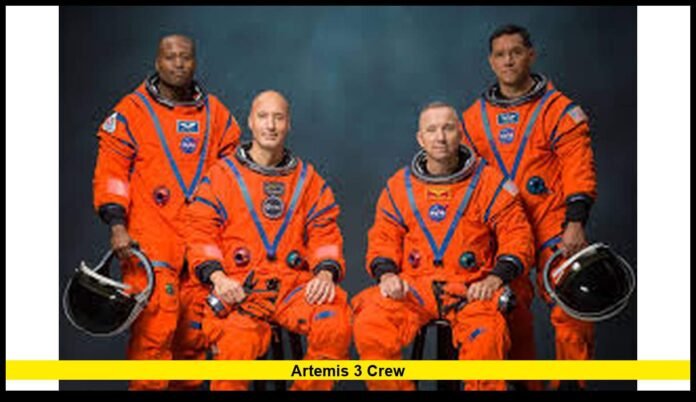

The Artemis 3 crew is now officially confirmed, giving NASA’s Moon program a major milestone as the agency prepares for its next chapter in deep-space exploration. The newly assigned astronauts will play a central role in testing systems, spacecraft operations, and mission procedures that support future lunar exploration goals. The announcement has generated strong interest across the United States because Artemis III represents one of NASA’s most important human spaceflight missions since the Apollo era.
NASA’s Artemis program has steadily moved forward over the past several years. Each mission has built upon previous achievements while helping engineers, astronauts, and mission planners prepare for increasingly complex operations beyond Earth orbit. The assignment of the Artemis III crew marks another significant step toward long-term exploration efforts that could eventually support sustained human activity on and around the Moon.
Meet the Artemis III Astronaut Team
NASA selected four astronauts for the mission:
| Astronaut | Mission Role |
|---|---|
| Randy Bresnik | Commander |
| Luca Parmitano | Pilot |
| Frank Rubio | Mission Specialist |
| Andre Douglas | Mission Specialist |
The four-member team combines extensive operational experience with new perspectives and technical expertise. Together, they bring decades of experience in aviation, engineering, military service, scientific research, and spaceflight operations.
NASA officials described the crew as uniquely qualified for the challenges expected during the mission.
Why the Artemis III Crew Announcement Matters
Crew assignments are among the most significant events in any major space program.
The selection process involves years of evaluation, training, performance reviews, and mission planning. Astronauts must demonstrate exceptional technical knowledge, physical fitness, leadership ability, and teamwork skills.
For Artemis III, the stakes are especially high.
The mission sits at the center of NASA’s long-term strategy for returning humans to the Moon and preparing for future journeys deeper into the solar system.
Every crew member will contribute to mission success through specialized responsibilities before launch, during flight operations, and throughout post-mission evaluations.
Commander Randy Bresnik Takes the Lead
Randy Bresnik will command the Artemis III mission.
His extensive NASA career includes multiple space missions, long-duration stays aboard the International Space Station, and several spacewalks.
Bresnik’s background in military aviation and spaceflight operations made him a strong candidate for command responsibilities. Over the years, he has demonstrated leadership during demanding missions and complex technical operations.
As commander, Bresnik will oversee mission execution and coordinate critical activities throughout the flight.
His responsibilities include:
- Leading the crew
- Managing operational decisions
- Supporting mission safety
- Coordinating spacecraft activities
- Working closely with Mission Control
NASA often places experienced astronauts in command positions because these missions require quick decision-making and exceptional situational awareness.
Luca Parmitano Represents International Cooperation
Italian astronaut Luca Parmitano will serve as pilot for Artemis III.
His selection highlights the growing importance of international partnerships in modern space exploration.
Parmitano has earned a reputation as one of Europe’s most accomplished astronauts. During previous missions, he accumulated extensive experience aboard the International Space Station and participated in challenging spacewalk operations.
His role on Artemis III strengthens cooperation between NASA and the European Space Agency.
The pilot position carries significant responsibility.
Parmitano will help manage spacecraft systems, support navigation activities, monitor mission operations, and assist the commander during critical phases of flight.
His experience working in international crews also provides valuable expertise for a mission involving multiple agencies and partners.
Frank Rubio Brings Long-Duration Spaceflight Experience
Mission Specialist Frank Rubio enters Artemis III with one of the most impressive records among active NASA astronauts.
Rubio became widely known after completing the longest continuous spaceflight by an American astronaut.
That achievement required extraordinary physical endurance, adaptability, and operational discipline.
Long-duration missions provide astronauts with valuable insight into:
- Human performance in space
- Crew coordination
- Equipment management
- Scientific operations
- Health monitoring
These experiences make Rubio particularly valuable for a mission designed to support future deep-space exploration.
His understanding of life-support systems and extended mission operations could help NASA refine procedures for future lunar and Mars missions.
Andre Douglas Receives His First Spaceflight Assignment
Andre Douglas will make his first journey into space as part of the Artemis III team.
Although he has not previously flown in space, Douglas brings extensive engineering expertise and technical knowledge to the mission.
Before becoming an astronaut, he worked in advanced engineering fields and contributed to projects involving complex technological systems.
His selection reflects NASA’s commitment to developing the next generation of explorers.
New astronauts often bring fresh perspectives and innovative problem-solving approaches that strengthen mission teams.
Douglas has undergone years of intensive training in preparation for assignments like Artemis III.
That training includes spacecraft systems, robotics, emergency procedures, survival exercises, flight operations, and scientific research activities.
What Is Artemis III?
Artemis III is the next major crewed mission in NASA’s Artemis program.
The mission follows previous Artemis flights that helped validate key technologies and operational procedures.
NASA designed Artemis III to advance exploration capabilities while preparing for future lunar missions.
The flight will involve several critical objectives that contribute to long-term exploration plans.
Key mission elements include:
- Orion spacecraft operations
- Deep-space navigation
- Crew systems testing
- Docking procedures
- Communications evaluations
- Mission integration exercises
Each objective helps NASA gather information needed for future exploration activities.
The mission represents another important stage in rebuilding America’s human lunar exploration capability.
The Artemis Program’s Broader Goals
NASA launched the Artemis program with goals extending far beyond a single mission.
The initiative seeks to establish a sustainable framework for exploration that can support future generations of astronauts.
Primary Artemis goals include:
- Returning astronauts to lunar missions
- Developing advanced exploration technologies
- Expanding scientific research opportunities
- Strengthening international cooperation
- Supporting commercial space development
- Preparing for eventual Mars exploration
NASA views the Moon as an ideal proving ground for technologies and operational strategies needed for longer missions.
The lessons learned through Artemis missions will influence exploration efforts for decades.
The Importance of Orion Spacecraft
The Orion spacecraft serves as the foundation of NASA’s deep-space transportation system.
Engineers designed Orion to carry astronauts farther from Earth than previous spacecraft used in low-Earth orbit missions.
The vehicle incorporates advanced systems for:
- Life support
- Navigation
- Communications
- Crew safety
- Deep-space operations
Orion has already demonstrated important capabilities through previous Artemis missions.
Artemis III will continue testing and validating the spacecraft’s performance under demanding operational conditions.
The vehicle remains central to NASA’s future exploration architecture.
Read More – Where Will Artemis 2 Launch From? NASA Reveals Historic Florida Site for Crewed Moon Mission
Space Launch System Powers the Mission
The Space Launch System, often called SLS, will provide the power necessary to send Orion and its crew into deep space.
SLS ranks among the most powerful rockets ever developed.
The rocket combines advanced engineering with decades of experience gained through previous launch programs.
Its capabilities allow NASA to transport large payloads beyond Earth orbit while supporting ambitious exploration objectives.
Future Artemis missions will continue relying on SLS to deliver astronauts and equipment needed for lunar exploration efforts.
Commercial Partnerships Play a Growing Role
One of the defining characteristics of the Artemis era is NASA’s collaboration with private industry.
Commercial partners now contribute to many aspects of exploration programs.
These partnerships support innovation while helping accelerate technological development.
Areas of cooperation include:
- Spacecraft systems
- Lunar transportation technologies
- Communications infrastructure
- Mission support services
- Engineering solutions
The partnership model has become increasingly important across the American space industry.
NASA benefits from private-sector innovation while maintaining leadership of mission planning and exploration goals.
Training for Artemis III Is Already Underway
The Artemis III astronauts face an intensive preparation schedule.
Training for missions of this scale requires years of work.
Astronauts participate in:
Spacecraft Simulations
Teams repeatedly practice mission scenarios using advanced simulators.
These exercises prepare astronauts for both routine operations and emergency situations.
Physical Conditioning
Spaceflight places unique demands on the human body.
Crew members maintain rigorous fitness programs to support mission readiness.
Technical Reviews
Astronauts spend countless hours learning spacecraft systems and operational procedures.
Every crew member must understand the mission at an exceptional level of detail.
Emergency Response Drills
Training includes preparation for unlikely but critical scenarios.
NASA emphasizes readiness and safety throughout the preparation process.
Integrated Mission Rehearsals
Large-scale rehearsals bring together astronauts, engineers, flight controllers, and support teams.
These exercises help identify challenges before launch.
International Collaboration Continues to Expand
The inclusion of Luca Parmitano highlights the international nature of Artemis.
Space exploration increasingly relies on cooperation among nations.
Partner agencies contribute resources, expertise, research, and technical capabilities.
International participation creates opportunities for:
- Shared scientific discoveries
- Joint technology development
- Operational support
- Global research initiatives
The Artemis program has become one of the largest international exploration efforts currently underway.
Future missions are expected to continue strengthening these partnerships.
Technology Demonstrations Remain a Core Objective
Testing advanced technologies remains one of Artemis III’s most important goals.
NASA engineers need reliable systems before expanding human operations beyond Earth orbit.
Areas of focus include:
- Guidance systems
- Communications networks
- Navigation tools
- Software integration
- Spacecraft interfaces
- Crew-support technologies
Every successful demonstration reduces uncertainty and improves future mission planning.
Technology testing also helps identify areas requiring additional development.
The Path Toward Future Lunar Exploration
Artemis III forms part of a larger sequence of missions.
NASA intends to use these missions to create a sustainable exploration framework rather than conduct isolated flights.
Future objectives include:
- Increased lunar operations
- Expanded scientific investigations
- Infrastructure development
- Advanced exploration technologies
- Greater international participation
The experience gained from Artemis III will directly influence these future efforts.
Mission planners continue evaluating how current missions can support long-term exploration goals.
Public Interest in Artemis Continues to Grow
Interest in lunar exploration has increased significantly across the United States.
NASA’s Artemis program has captured attention from educators, students, scientists, engineers, and space enthusiasts.
Many view the missions as a new era of American exploration.
The program also inspires future generations to pursue careers in science, technology, engineering, and mathematics.
As launch preparations continue, public attention is expected to remain high.
Major milestones often generate widespread interest because they represent tangible progress toward ambitious exploration goals.
What Comes Next for the Artemis III Crew?
Now that NASA has officially assigned the astronauts, mission preparation enters a new phase.
Engineers will continue refining systems while astronauts advance through increasingly detailed training programs.
Upcoming milestones include:
- Spacecraft readiness evaluations
- Flight hardware testing
- Crew simulations
- Integrated mission exercises
- Operational reviews
Each milestone helps ensure mission readiness.
NASA’s approach emphasizes careful preparation, extensive testing, and continuous evaluation before launch.
A Defining Moment for NASA’s Moon Program
The Artemis 3 crew announcement marks a major achievement for NASA and its exploration partners.
Commander Randy Bresnik, pilot Luca Parmitano, mission specialist Frank Rubio, and mission specialist Andre Douglas now stand at the center of one of the agency’s most significant missions of the decade.
Their work will help shape the future of lunar exploration while supporting broader goals that extend beyond the Moon. As training intensifies and mission preparations continue, Artemis III remains one of the most closely watched projects in American spaceflight.
What are your thoughts on the Artemis III astronaut team and NASA’s next steps toward lunar exploration? Share your views in the comments and follow future developments as the mission moves closer to launch.