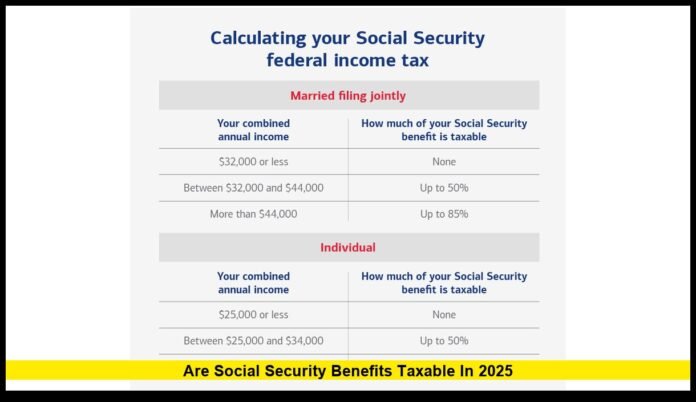

Are social security benefits taxable in 2025? Yes, they can be taxable at the federal level depending on your total income, and current IRS rules confirm that millions of Americans continue to pay taxes on a portion of their benefits this year.
As of the latest updates in 2026 reflecting the 2025 tax year, there have been no changes to the income thresholds used to determine taxation. However, higher Social Security payments and additional retirement income mean more people are now subject to taxes than in previous years.
How the IRS Determines Taxability
The federal government does not automatically tax Social Security benefits. Instead, it uses a formula called combined income to decide if taxes apply.
Combined Income Includes:
- Your adjusted gross income (AGI)
- Any tax-exempt interest (like municipal bond income)
- 50% of your Social Security benefits
This total places you into a range that determines whether your benefits are taxed and how much is taxable.
Income Limits for 2025
The income thresholds used by the IRS have stayed the same for years. They are not adjusted annually for inflation, which is a key reason taxation affects more retirees over time.
Single Filers
- Below $25,000 → No tax on benefits
- $25,000 to $34,000 → Up to 50% taxable
- Above $34,000 → Up to 85% taxable
Married Filing Jointly
- Below $32,000 → No tax
- $32,000 to $44,000 → Up to 50% taxable
- Above $44,000 → Up to 85% taxable
These limits remain in effect for the 2025 tax year.
Why More Americans Are Paying Taxes on Benefits
Even without new laws, more retirees are seeing taxes on their Social Security income. Several current factors explain this trend.
Rising Monthly Benefits
Cost-of-living adjustments increased Social Security payments again. Larger benefit checks can push combined income above the tax thresholds.
Additional Retirement Income
Withdrawals from retirement accounts such as 401(k)s and IRAs count toward combined income. Investment earnings also play a role.
Frozen Thresholds
Since the IRS has not updated income limits for inflation, even modest income increases can trigger taxation.
How Much of Your Benefits Are Taxed
A common misunderstanding is that the IRS taxes your entire benefit. That is not correct.
- Up to 50% or 85% of your benefits may be taxable
- Only that portion is included in your taxable income
- Your final tax bill depends on your overall tax bracket
Simple Example
If your annual benefit is $18,000 and you fall into the 85% category:
- Up to $15,300 may be counted as taxable income
- The actual tax owed depends on your rate
States That Tax Social Security in 2025
While most states do not tax Social Security benefits, a small number still do in some form.
States With Some Tax on Benefits
- Colorado
- Minnesota
- Montana
- New Mexico
- Rhode Island
- Utah
- Vermont
- West Virginia (currently phasing out taxes)
States With No Tax on Benefits
The majority of states, including large retirement destinations, do not tax Social Security income.
Common Errors That Increase Tax Burden
Many retirees end up paying more tax than necessary due to avoidable mistakes.
Watch Out For:
- Assuming benefits are always tax-free
- Overlooking investment or pension income
- Taking large retirement withdrawals in one year
- Not tracking combined income
Careful planning can help you stay below key thresholds.
Strategies to Reduce Taxes on Benefits
Even though the rules are fixed, you still have control over your income planning.
Helpful Approaches
- Withdraw funds gradually instead of in large amounts
- Use Roth accounts, which do not count toward combined income
- Time capital gains to avoid income spikes
- Review your income annually before year-end
These steps can reduce the portion of benefits subject to tax.
How to Report Social Security on Your Tax Return
If any of your benefits are taxable, you must report them correctly when filing.
What You’ll Receive
- Form SSA-1099 showing your total benefits for the year
Where It Goes
- Report benefits on your federal Form 1040
- Use IRS worksheets or tax software to calculate the taxable portion
Accurate reporting helps avoid penalties and ensures compliance.
Will the Rules Change After 2025?
As of now, there are no enacted federal changes to how Social Security benefits are taxed. Discussions about adjusting thresholds or eliminating taxes continue, but no updates have taken effect.
For the 2025 tax year, the existing rules remain fully in place.
Who Is Most Likely to Pay Taxes
Certain groups are more affected under current rules:
- Retirees with multiple income sources
- Married couples with combined earnings
- Individuals with investment income
- Higher-benefit recipients due to COLA increases
Lower-income retirees are less likely to owe taxes.
Quick Overview Table
| Filing Status | Income Level | Tax Impact |
|---|---|---|
| Single | Under $25,000 | No tax |
| Single | $25k–$34k | Up to 50% |
| Single | Over $34,000 | Up to 85% |
| Married | Under $32,000 | No tax |
| Married | $32k–$44k | Up to 50% |
| Married | Over $44,000 | Up to 85% |
Final Thoughts
Understanding whether your benefits are taxable can make a major difference in your retirement planning. The rules for 2025 remain unchanged, but rising income levels continue to bring more Americans into the taxable range.
Have questions about your situation or want to share your experience? Join the discussion below and stay informed.