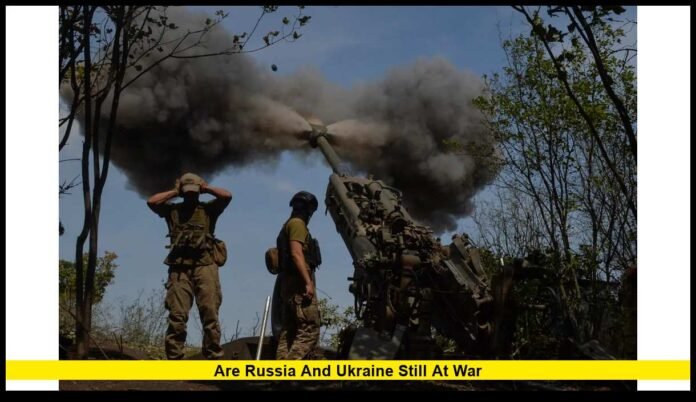

As of November 22, 2025, the question many continue to ask is: are Russia and Ukraine still at war? Despite numerous international efforts to mediate peace, the two nations remain in active conflict. Although the intensity of fighting has decreased compared to the early years of the invasion, no formal ceasefire or peace treaty has been signed. Hostilities continue along several parts of the front line, particularly in eastern and southern Ukraine, where both sides remain entrenched in a prolonged and costly war.
Current Situation on the Ground
The war between Russia and Ukraine, which began with Russia’s full-scale invasion in February 2022, has entered its fourth year. The front lines have largely stabilized since late 2024, but sporadic clashes and drone attacks continue almost daily. Russian forces maintain control over large parts of eastern Ukraine, including much of the Donetsk and Luhansk regions, as well as areas of Zaporizhzhia and Kherson. Ukraine continues to resist, carrying out targeted strikes and defending key territories with Western-supplied weapons.
In recent months, fighting has been concentrated near Avdiivka, Kupiansk, and Robotyne, where Russian troops have attempted to push forward but faced strong Ukrainian defenses. Ukraine’s counteroffensive efforts in 2023 and 2024 reclaimed some territory, but the front remains largely static in 2025, resembling a drawn-out war of attrition.
Civilian areas continue to be affected by missile and drone attacks. Ukrainian cities such as Kharkiv, Odesa, and Kyiv have experienced periodic bombardments, while Russia’s border regions have also seen Ukrainian drone strikes targeting fuel depots and infrastructure.
Diplomatic Developments and International Efforts
Throughout 2025, multiple international actors, including Turkey, China, and the United Nations, have renewed calls for negotiations. However, both Kyiv and Moscow remain firm in their positions. Ukraine insists on the restoration of its full territorial integrity, including Crimea, while Russia demands recognition of its annexed territories as part of the Russian Federation.
Western governments, particularly the United States and European Union, continue to support Ukraine both militarily and economically. The U.S. Congress approved additional military assistance earlier this year, including air defense systems and artillery ammunition. Meanwhile, the European Union is working on a new sanctions package targeting Russia’s defense and energy sectors.
Despite these efforts, no breakthrough in peace talks has occurred. Both sides accuse each other of prolonging the war. International organizations estimate that the conflict has caused hundreds of thousands of casualties and displaced millions of civilians since 2022.
Military Situation: A Stalemate With Ongoing Skirmishes
By late 2025, military analysts describe the situation as a “frozen conflict” with active combat still ongoing. Neither Russia nor Ukraine has achieved decisive territorial gains since late 2023. The front line, stretching from the northern border near Kharkiv to the southern coast near Zaporizhzhia, remains heavily fortified.
Ukraine’s armed forces continue to rely on advanced Western weapons, including long-range missiles and air defense systems, which have helped counter Russian attacks. Russia, on the other hand, has adapted by expanding domestic weapons production and importing drones and munitions from Iran and North Korea, according to Western intelligence assessments.
The air war remains a critical aspect of the conflict. Both sides use drones extensively for reconnaissance and strikes. Ukrainian drones have reached targets deep inside Russian territory, while Russia maintains a heavy missile campaign against Ukraine’s infrastructure.
Humanitarian and Economic Impact
The humanitarian toll remains severe. According to the latest data from international aid agencies, more than six million Ukrainians are living abroad as refugees, while millions more are displaced within Ukraine. Winter 2025 poses renewed challenges as energy infrastructure remains vulnerable to attacks. Ukrainian authorities have been working to repair power grids and heating systems damaged during previous missile barrages.
Russia’s economy has adapted to sanctions, but it faces ongoing challenges such as inflation, trade restrictions, and the loss of Western markets. Ukraine’s economy, though stabilized with international assistance, continues to rely heavily on foreign aid and defense spending.
International organizations have warned of the long-term impact on regional security, food supplies, and energy markets. The Black Sea remains a tense area, with Ukraine occasionally targeting Russian naval assets and grain shipments being disrupted by ongoing hostilities.
The Role of the United States
For U.S. readers, understanding Washington’s role is essential to answering whether Russia and Ukraine are still at war. The United States continues to be one of Ukraine’s most significant supporters. In 2025, the Biden administration reaffirmed its commitment to Ukraine’s sovereignty, sending additional defense packages that include air defense interceptors and humanitarian assistance.
However, political debates within the U.S. continue regarding the scale of future support. While bipartisan backing remains, some lawmakers have expressed concerns about the duration and cost of aid. Nevertheless, U.S. officials emphasize that continued support is vital to maintaining Ukraine’s defense and deterring further Russian aggression in Europe.
International Reactions and Global Implications
The ongoing war has reshaped international relations. NATO has expanded its membership since 2023, with Sweden officially joining earlier in 2024. The alliance continues to strengthen its eastern defenses, deploying additional troops and missile systems along its borders with Russia.
Meanwhile, countries like China and India maintain diplomatic neutrality, calling for peace talks but avoiding direct involvement. The conflict has accelerated global shifts in energy trade, with Europe reducing its dependence on Russian oil and gas and increasing imports from the U.S. and the Middle East.
The war also continues to influence global food prices. Ukraine, one of the world’s leading grain exporters, faces ongoing challenges exporting agricultural products through the Black Sea due to Russian blockades and naval tensions.
Are Russia and Ukraine Moving Toward Peace?
As of late 2025, there is no confirmed peace agreement or formal ceasefire between Russia and Ukraine. Both governments have expressed readiness for talks “under certain conditions,” but those conditions remain mutually unacceptable. Ukrainian President Volodymyr Zelenskyy continues to demand the withdrawal of Russian forces and the full restoration of Ukraine’s borders, while Russian President Vladimir Putin insists that Russia’s annexed territories are non-negotiable.
Recent months have seen limited prisoner exchanges and humanitarian corridors, suggesting that communication channels remain partially open. However, these measures have not translated into broader political progress.
Analysts predict that the war may continue at a lower intensity into 2026 unless one side achieves significant military or diplomatic leverage.
Impact on Civilians and Reconstruction Efforts
While the fighting continues, Ukraine has started planning for long-term recovery. Cities such as Kyiv, Lviv, and Dnipro are witnessing gradual reconstruction, with international partners providing funds for rebuilding schools, hospitals, and infrastructure. Yet, reconstruction in war-affected regions remains nearly impossible due to continued shelling and landmine contamination.
Civilian resilience remains a defining feature of the war. Despite challenges, Ukrainians continue daily life amid blackouts and economic hardship. Across Russia, public opinion remains tightly controlled, with limited dissent tolerated under new wartime laws.
Summary: Are Russia and Ukraine Still at War in 2025?
To answer directly: yes, Russia and Ukraine are still at war in 2025. The conflict has not ended, and no formal peace agreement has been signed. Although the scale of fighting has decreased in some regions, the war remains active and unresolved. International diplomacy continues, but neither side shows willingness to compromise on core issues of sovereignty and territory.
For the global community, the war remains one of the most consequential conflicts of the 21st century—affecting security, economics, and humanitarian conditions across multiple continents. The situation continues to evolve, but as of November 2025, peace remains elusive.
The war persists despite efforts toward peace, and readers are encouraged to share their thoughts on how the conflict might shape the global future.