
An anonymous donation of US$130 million was accepted by the Department of Defense (DOD) to cover military pay during the ongoing federal government shutdown, marking a rare and contentious move in the realm of U.S. defense and budget policy.
What’s Happening Now
- The DOD confirmed the acceptance of the anonymous US$130 million contribution under its “general gift acceptance authority,” with the stipulation that it be earmarked specifically for service-member salaries and benefits.
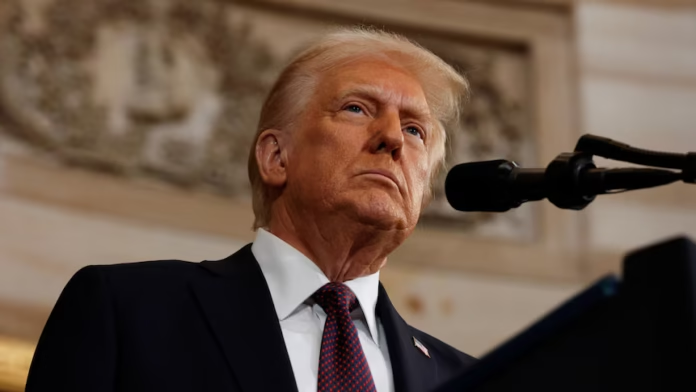
- The donation was revealed by Donald J. Trump, who described the donor simply as “a friend” motivated by patriotism—and who requested to remain unnamed.
- The funding comes amid a prolonged government shutdown, during which Congress has not approved full appropriations, thereby creating uncertainty around federal payrolls, including for military personnel.
- Although the contribution is substantial on its face, it accounts for only a small portion of what is required: a recent calculation suggested about US$6.5 billion was needed for military payroll for a half-month period, meaning the US$130 million covers roughly a third of one day’s salaries for the force.
- Key details remain undisclosed: the donor’s identity, citizenship or nationality, banking path, and whether the funds will be treated consistent with the U.S. Constitution’s Appropriations Clause remain unanswered.
Why the Donation Matters
The anonymous donation of US$130 million could represent a precedent-setting moment, forging a link between private funds and what has traditionally been a fully public obligation: paying the nation’s armed forces.
- For service members and their families, the donation provides temporary relief, helping to avoid missed paychecks amid budget gridlock.
- For taxpayers and government accountability watchers, the move raises serious questions about transparency, donor influence, and the proper channeling of funds in federal institutions.
- For policymakers, the episode highlights how budget stalemates can generate unconventional workarounds—and variants of risk in oversight, legality and ethics.
- The key concern: while the donation was accepted, federal law states that money must be appropriated by Congress before it is spent. A private donation may not alone satisfy that requirement, raising potential constitutional and statutory issues.
The Financial Context
| Item | Value / Detail |
|---|---|
| Donation Amount | US$130 million |
| Recent Military Payroll Need | ~US$6.5 billion for first half of October |
| Donation’s Coverage | Roughly one-third of one day’s pay for the force |
| Funding Status | Made under gift authority, but budget still unresolved |
Even though US$130 million is large by many standards, in the scale of the U.S. military’s payroll obligations it is modest. In effect, it buys time—but doesn’t resolve the underlying funding gap created by the shutdown.
Legal and Ethical Dimensions
The anonymous donation of US$130 million triggers multiple red-flags and points of debate:
- Under the Appropriations Clause of the U.S. Constitution, “no money shall be drawn from the Treasury, but in consequence of appropriations made by law.” That implies congressional appropriation is required before public spending.
- Federal gift rules: the DOD must review large gifts to ensure the donor doesn’t have interests “substantially affected” by the gift. If the donor is a non-U.S. citizen, additional scrutiny is required.
- This donation diverges from typical private gifts to defense services, which usually fund narrower items—scholarships, memorials, special facilities—not salaries of active duty personnel in a funding lapse.
- Transparency remains limited: neither the path of funds into federal coffers nor the donor’s background has been publicly disclosed, stirring concerns about influence, favoritism, or precedent setting.
Political and Institutional Reactions
- President Trump publicly praised the donation, calling the unnamed donor “a patriot” and stressing the gift underscores his commitment to the military.
- Legislators from both parties raised concerns—some applauding action to protect troops, others warning of sidestepping Congress and of weakening oversight on the use of public funds.
- The timing is politically charged. With the shutdown, the House and Senate are locked in budget fights, and the donation enters the debate as a wild card: helpful for troops, but potentially destabilizing for the budget process.
- Some analysts warn that if private contributions become an accepted method to cover federal salaries, it could erode the institutional boundary between public obligation and private support.
What to Watch Next
- Congress’s Response: Will lawmakers pass a funding resolution to cover military pay (and possibly other federal functions) that fully replaces the need for private donations?
- Additional Donations: Will more anonymous or private donors step in? If so, how will that alter norms around voluntarily supporting federal obligations?
- Accounting & Oversight: How the DOD and Treasury treat the US$130 million—deposit path, tracking, audit trail—may set the standard for how private funds are handled for public payrolls.
- Legal Review: Whether the donation triggers legal challenge or drives clarification about whether private gifts can legally substitute for congressional appropriations.
- Impact on Troops: On the ground, how reassuring is the donation for service members awaiting pay? Will this suffice to avoid hardship?
The anonymous donation of US$130 million is significant: a large private gift stepping into the gap left by a federal funding failure. It provides relief for troops, but does not nullify the underlying problem—a stalled budget. The real test now is whether this moment changes the relationship between private resources and public obligations, and whether the institutions charged with oversight adapt accordingly.
Let’s hear your thoughts: Is it acceptable for private donations to cover military pay in a budget crisis? Leave a comment below and stay tuned for updates.