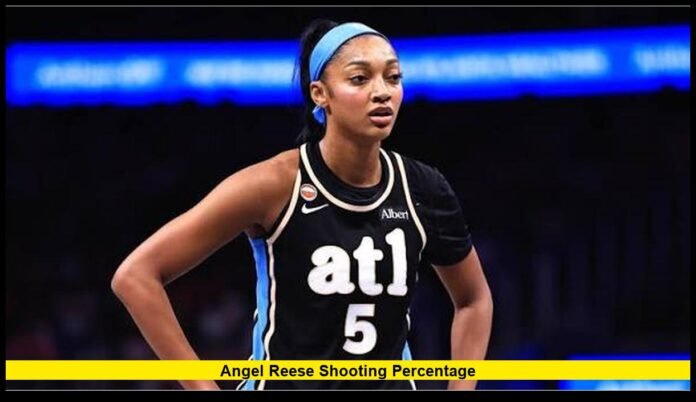

Angel Reese shooting percentage is 41.8% from the field through 33 games of the 2026 WNBA regular season, giving the Atlanta Dream forward a clear statistical profile as the season enters its final stretch. Reese has made 178 of 426 field-goal attempts while averaging 15.6 points, 12.1 rebounds and 2.5 assists per game.
The current figure is slightly below the 45.8% mark Reese recorded during her second WNBA season. However, it remains comfortably above her 39.1% rookie rate. Her 2026 production also shows that her offensive value goes well beyond the percentage attached to her field goals.
Reese has continued to create extra possessions through offensive rebounding, draw fouls and contribute as a passer. Her current season also includes a 73.4% free-throw rate and a 14.0% three-point rate.
What Is Angel Reese’s Current Shooting Percentage?
Through 33 regular-season games, Reese has converted 178 of 426 field-goal attempts.
That puts her field-goal percentage at 41.8%.
Her current 2026 statistical line includes:
| Statistic | 2026 Season |
|---|---|
| Games | 33 |
| Points per game | 15.6 |
| Rebounds per game | 12.1 |
| Assists per game | 2.5 |
| Field goals made | 178 |
| Field goals attempted | 426 |
| Field-goal percentage | 41.8% |
| Three-pointers made | 6 |
| Three-pointers attempted | 43 |
| Three-point percentage | 14.0% |
| Free throws made | 153 |
| Free throws attempted | 209 |
| Free-throw percentage | 73.4% |
| Offensive rebounds per game | 5.1 |
| Defensive rebounds per game | 7.0 |
The numbers show that Reese is still primarily an interior scorer.
She has attempted 426 total field goals but only 43 three-pointers. That means most of her offensive work comes inside the arc.
Her 383 two-point attempts demonstrate how heavily her scoring profile depends on finishing near the basket.
How the 2026 Number Compares With Her Previous Seasons
Reese’s career shooting record has changed noticeably since she entered the WNBA.
Her regular-season field-goal percentages are:
- 2024: 39.1%
- 2025: 45.8%
- 2026: 41.8%
Her rookie season produced the lowest figure of the three.
During 2024, Reese made 164 of 419 field-goal attempts. She improved significantly during her second season, making 153 of 334 attempts in 2025.
That 45.8% performance remains her career-best regular-season field-goal percentage.
Her current 41.8% mark represents a decline from last season, but it is still higher than her rookie figure. The difference between her first and third professional seasons is important because it shows that her shooting has not remained stuck at her initial level.
At the same time, the 2026 number shows that her efficiency has not yet returned to the level she reached in 2025.
Why Her Field-Goal Percentage Gets So Much Attention
Reese plays a position where finishing efficiency matters greatly.
As a 6-foot-4 forward, she frequently operates around the basket. Her offensive responsibilities include post scoring, cuts, putbacks and finishes created by offensive rebounds.
That makes missed shots particularly visible.
A missed interior attempt can sometimes lead directly to another scoring opportunity when the same player collects the rebound. Reese has developed into one of the WNBA’s most productive offensive rebounders, which is a major part of how she remains effective even when her shooting percentage falls.
Her 5.1 offensive rebounds per game in 2026 are a major part of her statistical identity.
Those rebounds give Atlanta additional possessions and create second-chance scoring opportunities.
Reese’s 2026 Shooting Is Mostly About Two-Point Attempts
The biggest detail behind Reese’s overall percentage is her shot selection.
She has attempted 383 two-point shots and 43 three-point shots through 33 games.
Her two-point percentage stands at 44.9%, while her three-point percentage is 14.0%.
That creates an important distinction.
Reese is not a perimeter-oriented scorer who takes large numbers of three-point attempts. Her overall field-goal percentage primarily reflects how effectively she converts two-point opportunities.
The 14.0% three-point rate also shows that outside shooting remains a limited part of her offensive game.
For opponents, that can influence defensive positioning. Defenders can focus more attention on the paint when Reese is outside the lane.
For Reese, improving her ability to consistently knock down shots away from the basket could eventually create additional room for her interior game.
Her Free-Throw Shooting Adds Another Layer
Field-goal percentage does not include free throws.
That matters when evaluating Reese because she frequently gets to the foul line.
She has made 153 of 209 free throws in 2026, giving her a 73.4% free-throw percentage.
Her free-throw rate has remained relatively steady throughout her professional career. She shot 73.6% during her rookie campaign and 75.6% in 2025.
The current 73.4% figure is slightly lower than last year’s number, but it remains considerably more efficient than her three-point shooting.
Free throws have also helped Reese maintain her scoring average when her field-goal production has been inconsistent.
A game in which she struggles from the floor does not necessarily result in a low scoring total if she continues drawing fouls and converting at the line.
Her Scoring Average Has Continued to Rise
One of the most interesting parts of Reese’s current season is the relationship between her shooting efficiency and scoring output.
Her scoring average has increased each season:
- 2024: 13.6 points per game
- 2025: 14.7 points per game
- 2026: 15.6 points per game
Her field-goal percentage has not followed the same upward path.
Instead, Reese has found other ways to increase her offensive production.
She is playing a major role in Atlanta’s offense and remains heavily involved on the glass. Her rebounding creates additional scoring chances, while her ability to draw fouls provides another path to points.
The result is a career-high scoring average despite a field-goal percentage below her 2025 level.
Read More – Angel Reese Turns Heads in Bold Black Outfit Before Sky vs. Fever Game
Recent Games Have Shown Both Sides of Her Shooting
Reese’s recent performances demonstrate why her season percentage does not tell the whole story.
In Atlanta’s August 16 matchup with Indiana, Reese finished with 15 points, 14 rebounds and six assists. She remained heavily involved throughout the game as the Dream and Fever played an overtime contest.
Atlanta ultimately lost 95-91.
The game attracted attention because Reese had a chance to give Atlanta the lead late in regulation. She missed a putback attempt with only seconds remaining, and the Dream could not convert the follow-up opportunity.
That single play became one of the most discussed moments of the game.
It did not, however, define her entire performance.
Reese still recorded a double-double and added six assists. Her 14 rebounds also showed how much of her impact came away from the shooting column.
A Difficult Shooting Night Against Connecticut
One of Reese’s more recent struggles came against Connecticut.
She finished that game with eight points while shooting 3-for-13 from the field. That translated to a 23.1% field-goal rate for the contest.
Despite the poor shooting night, Reese grabbed 15 rebounds and recorded four blocks.
That performance illustrates the unusual nature of her statistical profile.
A perimeter scorer who shoots 3-for-13 may have difficulty finding other ways to influence the game. Reese can remain highly active through rebounding and defense.
Her offensive rebounding also gives her opportunities to correct some missed attempts herself.
That does not make poor shooting irrelevant. It does show why evaluating her contribution requires a broader view.
The Career Trend Shows Improvement From Her Rookie Season
Reese’s professional career has now provided enough data to identify a clear trend.
Her rookie shooting percentage was 39.1%.
She increased that number to 45.8% in 2025.
The current 41.8% figure sits between those two seasons.
Her career field-goal percentage is now around 42.0%.
The numbers suggest that Reese has improved from her first WNBA season but has not maintained the same efficiency she displayed during 2025.
Her scoring, rebounding and playmaking have continued to give her a significant offensive role.
The next step is improving consistency around the basket while finding ways to become more dangerous from outside.
The Importance of Her Offensive Rebounding
Reese’s shooting numbers are closely connected to her ability to rebound her own and her teammates’ misses.
She averages 5.1 offensive rebounds per game in 2026.
That is an enormous number for a player who also carries a significant scoring workload.
Offensive rebounds create extra possessions without requiring Atlanta to run another half-court play.
They can also lead to high-percentage putbacks.
For Reese, this skill can partially compensate for nights when her first-shot efficiency is poor.
Her 12.1 total rebounds per game further establish the importance of her work on the glass.
She averages seven defensive rebounds per game in addition to those offensive boards.
This makes rebounding one of the strongest parts of her overall statistical profile.
How the Atlanta Role Has Shaped Her Numbers
Reese entered the 2026 season with a new team after moving from the Chicago Sky to the Atlanta Dream.
The trade gave her a fresh offensive environment and placed her alongside a veteran-heavy Atlanta roster.
Her role with the Dream has remained centered around frontcourt production.
She starts games, plays major minutes and contributes in several areas.
Through 33 games, she has averaged 30.9 minutes per contest.
That level of playing time gives her enough opportunities to accumulate rebounds, draw fouls and create second chances.
It also means she faces a substantial number of defensive possessions against opposing frontcourt players.
Her current statistics reflect a player who has become a central part of Atlanta’s game plan.
The Three-Point Question Remains Unresolved
The clearest weakness in Reese’s shooting profile remains her outside shot.
She has made only six three-pointers in 2026.
Her 43 attempts represent a small portion of her overall field-goal volume.
That means even a major improvement from three-point range would not immediately transform her overall field-goal percentage unless her attempts also increase.
Still, the strategic value could be significant.
A reliable outside shot would force defenders to move farther from the basket.
That could open more driving lanes.
It could also create additional space for Atlanta’s other offensive players.
For now, Reese continues to make most of her impact inside.
What Her Current Numbers Say About Her Offensive Game
The current statistics point to a player who relies on physicality, positioning and second chances rather than perimeter shooting.
Her 41.8% field-goal percentage is not the highest mark of her career, but it is above her rookie rate.
Her 44.9% two-point percentage provides a better look at the type of shots she takes.
Her free-throw percentage remains above 70%, giving her another reliable scoring method.
Her three-point percentage, meanwhile, remains the weakest part of her shooting profile.
The balance between those numbers explains much of her offensive identity.
Reese is at her best when she can establish position near the basket, attack the glass and use her physical strength to create scoring chances.
What Could Change Before the End of 2026
With the regular season moving toward its conclusion, the most important statistical development will be whether Reese can raise her efficiency.
She has already demonstrated that a field-goal percentage in the mid-40s is possible.
Returning toward that level would strengthen an already productive offensive season.
Her free-throw shooting will also remain important.
If she continues getting to the line and converts at roughly her current rate, she can maintain scoring production even when her field goals fluctuate.
The three-point shot is a longer-term consideration.
At only 43 attempts so far, it is not yet a major component of her offensive workload. But even modest improvement from outside could influence how defenders guard her.
How Her Current Number Fits Her Career
Reese’s 41.8% mark places her close to her career average.
That is significant because it prevents the 2026 figure from being viewed as an extreme outlier.
Her rookie season was less efficient.
Her second season was considerably more efficient.
The current season has landed somewhere in between.
At the same time, Reese has continued to increase her scoring average and maintain elite-level rebounding production.
That combination suggests that her offensive development cannot be measured by one percentage alone.
Her ability to impact possessions after missed shots remains one of the biggest differences between Reese and many other high-volume scorers.
The Bottom Line
The latest 2026 numbers put Reese at 41.8% from the field, with 178 makes on 426 attempts through 33 regular-season games.
Her 2-point shooting sits at 44.9%, while she has made 14.0% of her three-point attempts. She has also converted 73.4% of her free throws.
Her current field-goal rate is below the 45.8% career-best mark she posted in 2025, but it remains above the 39.1% figure from her rookie season.
The bigger picture is more encouraging than the headline percentage might suggest.
Reese is averaging 15.6 points and 12.1 rebounds while playing more than 30 minutes per game. Her 5.1 offensive rebounds per contest continue to create extra opportunities, and her 2.5 assists show that she is contributing beyond scoring.
The 2026 season has therefore produced a mixed shooting profile but a highly productive overall statistical line.
Her biggest offensive strengths remain inside scoring, rebounding and free-throw opportunities. Her biggest shooting challenge remains consistency, particularly from outside the paint and beyond the three-point line.
As Atlanta continues its playoff push, Reese’s ability to turn more of her interior opportunities into points could become increasingly important.
What do you think of Angel Reese’s latest shooting numbers? Share your thoughts and stay tuned for the latest updates from her 2026 WNBA season.