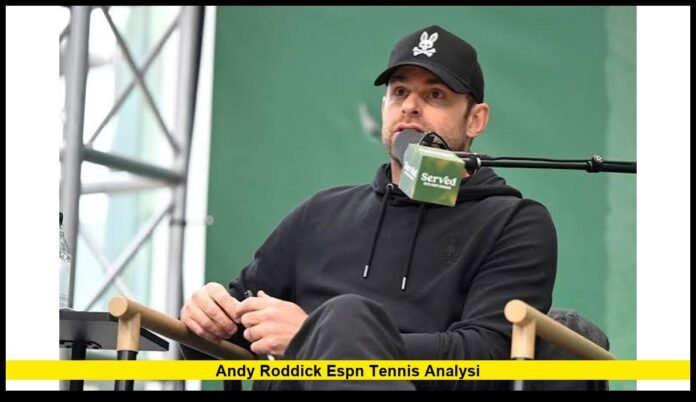

Andy Roddick has built an impressive second career away from the tennis court, earning widespread recognition as one of the sport’s most respected television analysts. Andy Roddick ESPN tennis analysis has become a favorite among fans because it blends championship-level experience with clear, engaging explanations that make even the most technical aspects of tennis easy to understand. Whether breaking down Grand Slam matches, evaluating emerging talent, or discussing major developments across the ATP and WTA Tours, Roddick offers viewers a perspective that few commentators can match.
Key Points Summary
╔════════════════════════════════════════════════════════════════════╗
║ – Andy Roddick has become one of ESPN’s leading tennis analysts after his successful playing career. ║
║ – His commentary combines technical expertise, player experience, and straightforward communication. ║
║ – He is especially recognized for his insightful coverage of Grand Slam tournaments. ║
║ – Fans appreciate his honest opinions, tactical breakdowns, and balanced analysis of today’s top players. ║
║ – Beyond television, Roddick continues influencing tennis conversations through podcasts, interviews, and digital platforms. ║
╚════════════════════════════════════════════════════════════════════╝
From Grand Slam Champion to Television Expert
Andy Roddick’s transition from professional athlete to broadcaster has been remarkably successful. During his playing career, he established himself as one of the world’s elite competitors, highlighted by winning the 2003 US Open singles title and reaching the No. 1 ranking in the world.
Throughout more than a decade on the professional tour, Roddick competed against many of the greatest players in tennis history. His matches against Roger Federer, Rafael Nadal, Novak Djokovic, Andy Murray, and numerous other top stars provided him with firsthand knowledge of what separates elite champions from the rest of the field.
Rather than stepping away from tennis after retirement, Roddick chose to remain connected to the sport through broadcasting. His experience competing under the brightest lights has helped him become one of television’s most credible tennis analysts.
Why ESPN Turned to Andy Roddick
Modern sports broadcasting demands more than simply describing what viewers are watching. Fans increasingly want experts who can explain strategy, predict adjustments, and provide insight into what athletes are thinking during competition.
Roddick fits that role naturally.
His years competing at the highest level allow him to recognize subtle tactical decisions that casual viewers might never notice. Instead of offering generic observations, he explains why a player changes serving patterns, adjusts court positioning, or approaches critical points differently.
This ability has made him a valuable part of ESPN’s tennis coverage during many of the sport’s biggest events.
A Style That Appeals to Every Tennis Fan
One of the biggest reasons Roddick has become so popular as an analyst is his communication style.
Former athletes occasionally rely on technical language that can overwhelm casual viewers. Roddick takes a different approach by simplifying complex concepts without sacrificing accuracy.
His broadcasts often feel conversational rather than scripted. He explains advanced strategies using examples that viewers can immediately understand, making his analysis enjoyable for longtime tennis enthusiasts and newcomers alike.
That balance has helped broaden tennis coverage for audiences of varying experience levels.
Breaking Down the Serve Like Few Others Can
Among all areas of tennis analysis, serving remains Roddick’s greatest specialty.
Known during his playing career for one of the fastest and most effective serves in professional tennis, he frequently shares insight into aspects of serving that statistics alone cannot explain.
These include:
Reading Opponents
Roddick often discusses how elite players study returners before choosing serve locations. He explains how small adjustments can force weak returns or create immediate offensive opportunities.
Mixing Pace and Spin
Rather than simply serving as hard as possible, top professionals constantly vary speed, spin, and placement.
Roddick frequently illustrates why changing pace can sometimes be even more effective than hitting the fastest serve available.
Pressure Moments
Grand Slam matches often come down to a handful of important service games.
Roddick explains how players prepare mentally before serving to stay in a set, defend break points, or close out championships.
These observations help viewers appreciate just how much planning goes into every point.
Tactical Analysis That Goes Beyond Statistics
Television broadcasts regularly display data such as first-serve percentages, winners, and unforced errors.
Roddick adds another layer by explaining the reasons behind those numbers.
For example, when a player suddenly begins making more mistakes, he explores possible causes such as:
- Fatigue
- Court positioning
- Changes in opponent strategy
- Loss of confidence
- Weather conditions
- Shot selection
This deeper level of analysis helps transform simple statistics into meaningful stories about how matches develop.
Understanding the Mental Side of Tennis
Professional tennis is often described as one of the most mentally demanding sports in the world.
Every point matters, momentum changes quickly, and players frequently compete without coaching during matches.
Roddick regularly discusses psychological factors that influence performance, including:
Handling Expectations
Top-ranked players enter tournaments carrying enormous pressure.
Roddick explains how external expectations can influence decision-making during critical moments.
Recovering After Mistakes
Every player misses routine shots.
What separates champions is often their ability to immediately move on to the next point.
Roddick frequently highlights body language and emotional control as key indicators of future success during matches.
Confidence During Long Matches
Five-set contests require remarkable concentration.
Roddick explains how experienced players manage energy while maintaining focus over several hours of competition.
Grand Slam Coverage Remains a Highlight
Much of Roddick’s broadcasting work centers on tennis’s four biggest tournaments.
Each event presents unique challenges that he discusses in detail.
Australian Open
The season’s first major often introduces new storylines.
Roddick analyzes preseason preparation, fitness levels, and how players adjust after the offseason.
Heat, scheduling, and hard-court conditions frequently become major talking points.
French Open
Clay courts create entirely different tactical battles.
Roddick explains how movement, patience, and rally construction become more important than pure power.
He often discusses how players adapt their serving and return strategies on the slower surface.
Wimbledon
Grass remains the fastest surface in professional tennis.
Because Roddick reached multiple Wimbledon finals during his career, he offers valuable insight into serving, movement, and the unique pressure of competing at the All England Club.
His analysis often focuses on how players adjust to the lower bounce and quicker points that define grass-court tennis.
US Open
As America’s most recent men’s singles US Open champion, Roddick brings special perspective to ESPN’s coverage of the tournament.
He frequently discusses:
- Playing under the lights in New York
- Managing loud crowds
- Balancing expectations for American players
- Recovering during the demanding two-week event
These experiences allow viewers to understand the tournament from the perspective of someone who has successfully navigated its challenges.
Honest Opinions Without Unnecessary Drama
Sports commentary sometimes becomes overly dramatic in pursuit of headlines.
Roddick generally avoids that approach.
Instead, he focuses on thoughtful analysis supported by experience.
When criticizing performances, he typically explains the reasoning behind his opinions rather than relying on sensational statements.
Likewise, when praising players, he identifies specific improvements or tactical decisions that earned success.
This balanced approach has strengthened his reputation among tennis fans.
Covering Both the ATP and WTA Tours
Another strength of Roddick’s broadcasting is his willingness to discuss both men’s and women’s tennis with equal attention.
He regularly analyzes:
- Rising young stars
- Established champions
- Veteran comebacks
- Coaching changes
- Playing styles
- Tournament performances
His commentary recognizes the high level of competition across both tours while highlighting the unique strengths of individual players.
How Andy Roddick Connects With Modern Audiences
Television is only one part of today’s sports media landscape.
Fans increasingly consume interviews, podcasts, and short-form digital content throughout the year.
Roddick has embraced these platforms by participating in long-form discussions that allow him to explore topics beyond match coverage.
His conversations often include:
- Career reflections
- Equipment changes
- Rule discussions
- Behind-the-scenes tournament stories
- Player development
- The future of professional tennis
These appearances have helped him build an audience beyond traditional television broadcasts.
Andy Roddick ESPN Tennis Analysis Continues to Grow
As professional tennis enters a new generation of stars, Andy Roddick ESPN tennis analysis remains an important part of how many fans experience the sport.
His commentary evolves alongside changing playing styles, technological advances, and the emergence of young champions.
Whether discussing powerful baseline hitters, creative all-court players, or tactical innovations, Roddick consistently explains not only what viewers are seeing but why those developments matter.
This educational approach continues to distinguish him from many sports commentators.
Looking Ahead
Tennis continues to evolve with faster athletes, improved equipment, and increasingly competitive tournaments.
Analysts who can interpret these changes in an engaging and understandable way are more valuable than ever.
Andy Roddick has established himself as one of those trusted voices. His championship experience, thoughtful preparation, and ability to communicate complex ideas clearly have made him an essential part of major tennis broadcasts.
As future Grand Slam tournaments introduce new champions and unforgettable rivalries, viewers can expect Roddick to remain a familiar presence, offering insight that only someone who has competed at the very highest level can provide.
His broadcasting career demonstrates that success in sports does not always end with retirement. Instead, it can evolve into a new opportunity to educate, entertain, and deepen fans’ appreciation for the game. Through knowledgeable analysis and an authentic passion for tennis, Andy Roddick continues making a lasting impact on the sport—this time from behind the microphone rather than across the net.
Do you enjoy Andy Roddick’s tennis commentary? Share your thoughts in the comments and stay updated for more tennis news, expert analysis, and Grand Slam coverage.