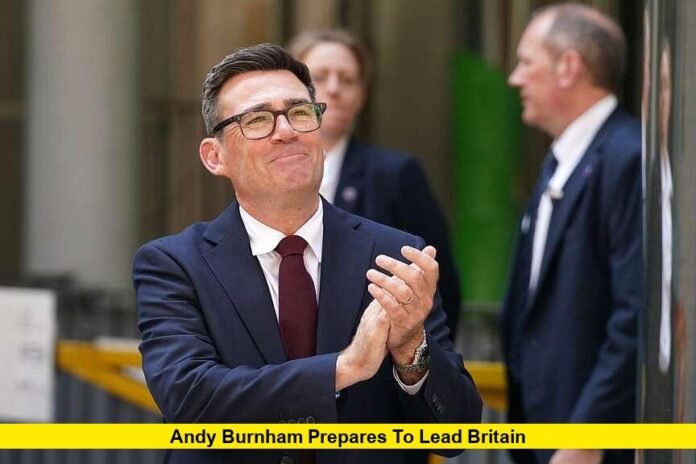

Andy Burnham prepares to lead Britain at one of the most turbulent moments in recent political history, stepping into Downing Street after a swift and dramatic rise that few observers predicted just months ago. The former Mayor of Greater Manchester, long nicknamed the “King of the North,” was confirmed as Leader of the Labour Party on July 17, 2026, after receiving nominations from an overwhelming majority of Labour MPs. He is expected to be formally appointed prime minister within days, becoming the seventh person to hold the office in the past decade and the first Labour and Co-operative Party member to do so.
Burnham’s path to power has been unusual by modern standards. Rather than rising through the ranks of a sitting government, he returned to Westminster only weeks before taking the party’s top job, following a career that took him away from national politics for nearly a decade. His emergence as Labour’s new standard-bearer reflects both the party’s anxiety over its sliding poll numbers and a broader appetite within Labour ranks for a leader seen as more instinctively connected to voters outside London.
Background and Early Career
Andrew Murray Burnham was born on January 7, 1970, in Aintree, Liverpool, and grew up in the Cheshire village of Culcheth near Warrington. He was raised in a working-class household, the son of a BT engineer and a GP receptionist, and attended a Roman Catholic comprehensive school before studying English at Fitzwilliam College, Cambridge, where he also met his wife, Marie-France van Heel. Before entering politics, he worked briefly for trade publications covering the tank and freight industries.
Burnham entered Parliament in 2001 as the MP for Leigh, a former mining and manufacturing constituency in Greater Manchester. His rise through Labour’s ranks was steady and substantial. Under Tony Blair, he held junior ministerial roles at the Home Office, including posts overseeing immigration and counterterrorism policy. When Gordon Brown became prime minister in 2007, Burnham was promoted into the Cabinet, serving successively as Chief Secretary to the Treasury, Secretary of State for Culture, Media and Sport, and finally Secretary of State for Health from 2009 until Labour lost power in 2010.
As health secretary, Burnham championed a publicly funded system of care for elderly and disabled adults, an initiative that was ultimately shelved after political opponents criticized its funding model. His tenure also coincided with the emergence of serious concerns about care standards at Stafford Hospital, an issue that continued to shape debate around NHS accountability long after he left the role.
From Westminster to Manchester
After Labour’s 2010 general election defeat, Burnham remained a prominent figure in the shadow cabinets of Ed Miliband and Jeremy Corbyn, holding the shadow health and shadow home secretary briefs at various points. He also ran for the Labour leadership twice during this period, finishing fourth in 2010 and second to Corbyn in 2015. Neither bid succeeded, but both campaigns established him as one of the party’s most recognizable and durable figures.
In 2017, Burnham left Westminster to become the first directly elected Mayor of Greater Manchester, a newly created role with authority over transport, housing, and policing budgets across ten boroughs. He won that contest decisively and was re-elected in 2021 and again in 2024. During his time as mayor, Burnham built a reputation as a combative advocate for the North of England, most notably through the creation of the Bee Network, Greater Manchester’s franchised and re-regulated public transport system, and through his long-running campaign for justice for victims of the 1989 Hillsborough disaster. These efforts, combined with his willingness to publicly clash with central government over funding and COVID-19 restrictions, cemented the “King of the North” nickname and gave him a national profile that many MPs never achieve.
The Road Back to National Leadership
Speculation about Burnham’s national ambitions never fully disappeared, even as he insisted for years that his focus remained on Greater Manchester. He repeatedly declined to rule out a return to Westminster, telling interviewers that his “full intention” was to serve out his mayoral term while acknowledging that political circumstances could change. That ambiguity persisted through much of 2025 and into 2026, as Keir Starmer’s government struggled with sluggish economic growth, a cost-of-living squeeze, and a sustained surge in support for the populist Reform UK party.
Because Labour’s leadership rules require candidates to be sitting MPs, Burnham could not challenge for the top job while serving as mayor. An initial attempt to secure a route back to Parliament through the Gorton and Denton by-election in February 2026 was blocked by Labour’s National Executive Committee. However, momentum built again when Makerfield MP Josh Simons resigned his seat, triggering a by-election that Burnham won on June 18, 2026. His victory intensified pressure on Starmer, and just four days later, Starmer announced his resignation as Labour leader on the same day Burnham was formally sworn in as an MP.
Nominations for the resulting leadership contest opened on July 9 and closed on July 16, 2026. Burnham secured backing from 379 of Labour’s 403 MPs, or more than 94 percent of the parliamentary party, making him the only eligible candidate by the close of nominations. That level of support exceeded even Gordon Brown’s uncontested nomination total in 2007, making it the largest endorsement recorded in a modern Labour leadership race. He was formally declared leader at a special party conference in London on July 17, 2026.
Public Interest and Political Reaction
Public and media interest in Burnham’s ascent has been considerable, driven partly by the speed of his return to frontline politics and partly by uncertainty over how his more informal, communicative style will translate to the demands of national leadership. Analysts and commentators have noted that his appeal has often stemmed from operating outside Westminster, and some have questioned whether that popularity will hold now that he is back inside it. Polling expert John Curtice has suggested that Burnham may represent Labour’s best chance of preventing Reform UK leader Nigel Farage from reaching Downing Street, a view that has been widely discussed but is not universally shared among commentators or Labour’s own membership.
Within the party, Burnham is generally associated with Labour’s soft left, though his long career has seen him described as adaptable across the party’s ideological factions, having served under Blairite, Brownite, and Corbynite leaderships alike. Supporters argue that this adaptability, combined with his reputation as one of Labour’s most effective communicators, positions him well to reconnect with voters who feel alienated from Westminster politics. Critics, meanwhile, point out that his policy platform as prime minister has not yet been fully detailed, and that he inherits many of the same structural challenges that undermined Starmer’s premiership.
What Comes Next as Burnham Prepares to Lead Britain
Burnham is expected to be formally appointed prime minister within days of his confirmation as Labour leader, a transition that would make him the first sitting Mayor-turned-national-leader in recent British political memory. In his first speech as party leader, Burnham pledged to bring “hope back” to the country and spoke of building “a new politics,” language that closely echoes commitments Starmer made upon entering office in 2024. Whether Burnham can deliver a meaningfully different governing style, rather than simply a different tone, is likely to be one of the defining questions of his early premiership.
He takes charge of a government facing a difficult economic backdrop, including a persistent cost-of-living squeeze linked in part to ongoing conflicts in Ukraine and the Middle East, alongside strained public services and a Labour Party that has consistently trailed Reform UK in national polling. There is no official confirmation yet of Burnham’s full policy programme as prime minister, including his specific plans for the economy, immigration, or the National Health Service, and any reporting on these areas should be treated as provisional until his government sets out its formal agenda.
Final Thoughts
Andy Burnham’s journey from Liverpool-born backbench MP to Health Secretary, from a runner-up in two Labour leadership contests to Mayor of Greater Manchester, and finally to Labour leader and presumptive prime minister, reflects one of the more unusual political trajectories in recent British history. As Andy Burnham prepares to lead Britain, the country will be watching closely to see whether his reputation for straight-talking, regionally rooted politics can translate into effective national governance at a moment of economic strain and political fragmentation. His early days in office are likely to set the tone for how both Labour MPs and the wider public judge his leadership in the months ahead.
Stay tuned for more updates on Andy Burnham’s premiership, and share your thoughts in the comments below.