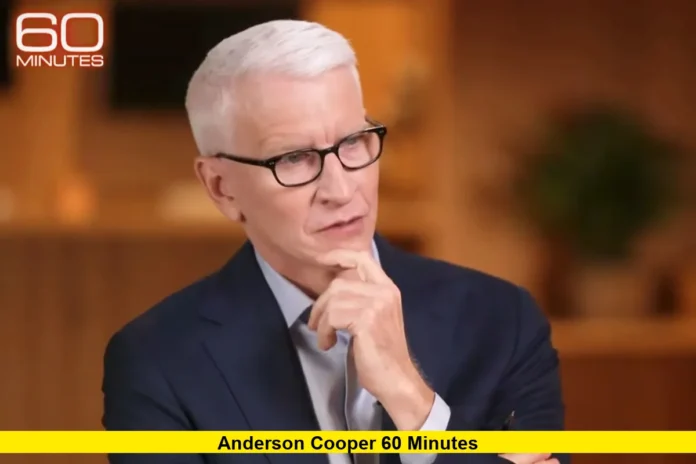

After nearly two decades as one of the most trusted faces on American television, Anderson Cooper has made a decision that is sending shockwaves across the broadcast journalism world — he is leaving 60 Minutes, and the story behind that choice is far bigger than a simple career change.
The announcement came in February 2026, catching many inside CBS News completely off guard. Cooper, who built a rare dual career anchoring CNN’s primetime lineup while simultaneously reporting for the legendary Sunday newsmagazine, chose not to renew his contract with CBS. For millions of American viewers who grew up watching him deliver hard-hitting, long-form investigations every Sunday night, the news landed like the closing of a chapter they did not want to end.
If you’ve been following the growing tension inside CBS News, this is the story you need to read in full — share it with someone who still cares about real journalism.
Twenty Years, One Extraordinary Run
Cooper joined 60 Minutes in the 2006–2007 television season through a unique job-sharing arrangement between CNN and CBS. That kind of dual-network deal was virtually unheard of in broadcast journalism. It allowed him to bring the depth and patience of long-form storytelling to his work at 60 Minutes while maintaining his high-speed breaking news presence at CNN, where he has hosted Anderson Cooper 360° since 2003.
Over the course of his tenure at the Sunday newsmagazine, he traveled to war zones, disaster areas, and politically complex corners of the world. He interviewed world leaders, investigated powerful institutions, and gave voice to stories that cable news simply did not have the runway to tell properly. His work earned him a level of credibility that very few television journalists of his generation can claim.
The 58-year-old journalist is also a father to two young sons, Wyatt and Sebastian, whom he co-parents with his former partner Benjamin Maisani. In recent years, Cooper spoke openly about how fatherhood fundamentally reshaped his sense of priorities. That personal transformation is central to understanding why he ultimately walked away.
Family First — But the Full Picture Is More Complicated
In his public statement, Cooper was clear about his primary reason for leaving. He said that for nearly two decades he had been able to balance his responsibilities at both CNN and CBS, but that having young children changed the equation entirely. He wanted to be present for his sons during the years when they still wanted him around.
CBS News responded graciously, praising his two decades of work and leaving the door open for a potential return. The network acknowledged the depth of his contribution — the journeys to distant places, the consequential investigations, the unforgettable interviews — and expressed genuine understanding for his decision to prioritize family.
That is the official version of events. But those paying close attention to what has been happening inside CBS News understand that the full story is considerably more layered.
A News Institution Under Siege
Cooper’s departure did not happen in isolation. It is the latest and arguably most dramatic development in a prolonged period of turbulence at 60 Minutes — a program that has been the gold standard of American broadcast journalism since it first aired in 1968.
In October 2025, CBS News appointed a new editor-in-chief following the acquisition of her media company by Paramount Skydance. Her arrival set off a chain of events that fundamentally altered the culture and editorial direction of the network. High-profile journalists began leaving. Buyouts were offered. Editorial decisions that once would have been routine became flashpoints of controversy.
One of the most discussed incidents involved a completed 60 Minutes report by a veteran correspondent about the Trump administration’s immigration enforcement practices. The segment was finished, factually airtight, and ready to air — but it was held back at the last minute by CBS leadership. The stated reason was a desire to include on-camera comment from administration officials. The correspondent involved privately expressed that the decision felt political rather than journalistic. That incident reverberated through the newsroom and across the broader media industry.
CBS News also offered buyouts to dozens of employees in early 2026. Several of those who accepted used their departures as an opportunity to publicly criticize what they described as a culture of self-censorship and a drift toward what one group of staffers characterized as editorial cowardice.
The Investigation That Nearly Didn’t Air
Perhaps the most revealing episode of this entire period involved a 60 Minutes segment that Cooper himself reported — an on-the-ground investigation into claims made by President Trump about violence against white farmers in South Africa.
Cooper traveled to South Africa to examine whether those claims held up to scrutiny. The report was completed, but it then went through what people inside CBS described as an abnormal editing process, and it was delayed from its originally scheduled broadcast date. The delay sparked serious concern among journalists inside and outside the network about whether editorial independence at 60 Minutes was being compromised.
The segment eventually aired on the February 22, 2026 edition of the program, days after Cooper had publicly announced he was leaving. Its findings contradicted the White House narrative. The timing — a serious investigative report airing almost simultaneously with the anchor’s farewell — struck many observers as deeply symbolic.
What CBS Loses When the Lights Go Down
It is difficult to quantify what Anderson Cooper’s presence meant to 60 Minutes beyond the obvious metrics of name recognition and ratings. He was not simply a correspondent who showed up with a camera crew. He was the living embodiment of what the program had always aspired to be — serious, curious, courageous, and committed to telling the truth even when it was uncomfortable.
His departure was described internally as blindsiding CBS leadership, who had apparently expected him to renew his deal. There had even been discussions about building a new chapter of the program around him and elevating his role further. Instead, Cooper’s agents informed CBS that their client was walking away, and the network was left to absorb the shock.
For CBS, losing its biggest star in newsmagazine television at a moment when the program is already navigating enormous internal and external pressures is a genuinely serious blow. Cooper had also served as a promotional engine for the show — running his 60 Minutes segments on CNN, giving the Sunday newsmagazine exposure to a weeknight cable audience that might not otherwise tune in.
Where Things Stand Now
Cooper is completing his remaining stories for 60 Minutes before the current broadcast season ends in May. He is not disappearing from television. He remains fully committed to CNN, where he recently signed a new contract and continues to anchor his primetime program while hosting additional projects including a Sunday newsmagazine format of his own and a podcast series.
The question of what 60 Minutes becomes without him is one that the television industry is actively debating. The program has survived the departures of legendary figures before. It adapted when Mike Wallace stepped back. It endured when other giants of the format moved on. But those transitions happened during periods of relative institutional stability. This one is happening in the middle of a storm.
There are real questions about the editorial direction of the program going forward — whether it will continue to pursue the kind of difficult, long-form investigative journalism that built its reputation, or whether it will shift toward softer content that corporate management believes performs better on social media. Cooper, by his very presence, served as a kind of gravitational anchor toward serious journalism. Without him, that center of gravity becomes less certain.
His two decades on anderson cooper 60 minutes represent some of the finest long-form television journalism of the past generation. Whatever comes next for the program, that legacy is not going anywhere.
The future of 60 Minutes — and what it stands for — is one of the biggest stories in American media right now. Tell us what you think in the comments below, and keep watching this space as the story continues to develop.