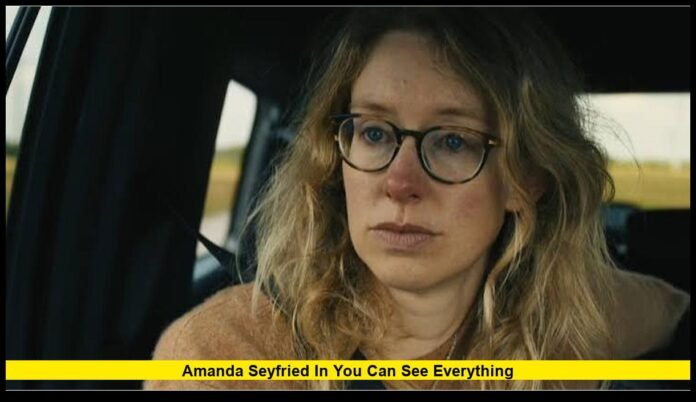

Amanda Seyfried in You Can See Everything has emerged as a major talking point among movie fans following the actress’s unexpected appearance in the documentary about Elizabeth Holmes. Seyfried secretly joined the project directed by Nathan Fielder and Lance Oppenheim, returning to the role of Holmes after her acclaimed performance in The Dropout. Her participation was deliberately hidden from the film’s early promotional campaign, making her appearance one of its biggest surprises.
The documentary takes an unconventional approach to Holmes’ story. It combines real footage, intimate conversations, and recreated scenes to explore the former Theranos executive’s life before and after she began serving her prison sentence. Seyfried’s involvement adds a unique element because she appears both as herself and as Holmes.
Now that her participation is public, Seyfried has begun discussing how she became involved, why she agreed to reprise the controversial character, and how the filmmakers kept the production secret.
Amanda Seyfried’s Surprise Appearance in You Can See Everything
Amanda Seyfried’s participation was not revealed during the documentary’s initial marketing campaign. The filmmakers and distributor kept her role secret to preserve the surprise for audiences.
Viewers encounter Seyfried as the documentary shifts into a different storytelling approach. After the film follows Holmes and the documentary filmmakers through real-life footage, Seyfried becomes part of the story through reenactments.
Her appearance is especially significant because she already has a strong connection to Holmes. Seyfried played the former Theranos founder in Hulu’s The Dropout, a dramatized series about the rise and collapse of the biotechnology company.
That earlier performance made Seyfried a natural choice for the documentary’s unusual reconstruction scenes. She had already studied Holmes extensively and understood many of her mannerisms, speech patterns, and public behaviors.
Who Does Amanda Seyfried Play in You Can See Everything?
Seyfried reprises her role as Elizabeth Holmes, the founder of Theranos who was convicted of fraud involving investors.
However, the documentary does not simply cast Seyfried as Holmes in a conventional scripted movie. Instead, she participates in reenactments designed to help the filmmakers recreate conversations and situations they could no longer film directly.
Seyfried also appears as herself. This dual role creates a distinctive dynamic because viewers see the actress reacting to documentary footage, asking questions, and then returning to the character she previously portrayed.
Her involvement gives the documentary another perspective on Holmes’ story. Seyfried’s experience playing Holmes in The Dropout becomes part of the film’s broader exploration of identity, performance, and how people present themselves to others.
How Amanda Seyfried Became Involved in the Documentary
Seyfried initially did not expect to portray Elizabeth Holmes again. Nathan Fielder contacted her because he wanted to discuss her previous performance and hear her thoughts about Holmes.
Their first conversations centered on Seyfried’s experience with The Dropout. Fielder wanted to learn more about how she approached the character and what she understood about Holmes after spending time researching her.
The discussion eventually moved beyond acting. Fielder and co-director Lance Oppenheim had filmed Holmes before she entered prison, but the documentary needed a way to continue presenting certain conversations and experiences after that access changed.
Seyfried became interested in the project after viewing footage. Her curiosity grew, and the filmmakers eventually asked her to participate more directly.
What began as an opportunity to share her perspective developed into a role that placed her back in Holmes’ character. The process was unusual, and Seyfried has described how her involvement grew organically rather than following a typical acting arrangement.
Why Seyfried Returned to Elizabeth Holmes
Playing Holmes again was not initially part of Seyfried’s plans. The actress had already completed her work on The Dropout, and she did not expect to revisit the character in a documentary.
However, the filmmakers’ approach presented a different creative challenge. Instead of repeating a scripted performance, Seyfried would participate in recreations based on the directors’ experiences and recollections.
Holmes had spent years in the public eye, providing Seyfried with extensive material to study. Still, the documentary’s present-day footage offered a different challenge because she had to recreate situations based on limited access to contemporary images and information.
Seyfried’s familiarity with Holmes helped her understand how to approach the reenactments. Yet the documentary was not a conventional production in which the actress received a complete script and prepared every scene in advance.
That unpredictability became part of the experience.
The Secretive Production Process
The filmmakers took extraordinary precautions to protect Seyfried’s involvement. Her role was not announced during the film’s early publicity, and the production restricted access to information about her scenes.
Seyfried has discussed how the script was kept secure. She explained that she could not freely access the material in advance and described a system involving highly restricted digital access.
The secrecy extended to the footage itself. Seyfried said she was not able to watch certain contemporary footage until she arrived on set, which helped preserve her reactions and the filmmakers’ desired approach.
The unusual process also meant she did not always know exactly what she would be filming beforehand. That created an environment unlike a typical scripted movie or television production.
Her experience demonstrates how carefully the filmmakers managed the documentary’s surprise elements.
What Makes Seyfried’s Performance Unique
Seyfried’s return to Holmes is different from her performance in The Dropout. The Hulu series followed a scripted dramatic narrative, while You Can See Everything combines nonfiction footage with reconstructed moments.
The documentary places Seyfried in situations where the boundaries between acting and reality become less clear. She recreates conversations and experiences based on the filmmakers’ memories, but she also appears as herself.
That combination makes her role particularly unusual.
Rather than simply performing a scene written by a screenwriter, Seyfried must respond to the documentary’s circumstances. The reenactments draw from Fielder’s memories and the production’s footage, while Seyfried brings her existing knowledge of Holmes.
The result is a performance that operates within a documentary rather than a traditional fictional story.
Amanda Seyfried’s Interaction With Billy Evans
One of the documentary’s most discussed sequences involves Seyfried meeting Billy Evans, Holmes’ partner, during a tense dinner conversation.
Seyfried has spoken about her interest in meeting Evans after watching the filmmakers’ footage. She wanted to understand more about Holmes’ personal circumstances and the relationship portrayed in the documentary.
The dinner reportedly became uncomfortable as the conversation developed. Seyfried questioned Evans about subjects that had raised concerns for her after watching the footage.
The interaction attracted attention because it was not a conventional interview. The participants were sharing a meal, and the conversation moved into personal and contentious territory.
Seyfried later described the exchange as intense and said she felt Evans became aggressive during parts of the discussion. The scene has become one of the documentary’s most talked-about moments because of its unpredictable nature.
It also highlights the film’s approach to placing people in situations where their reactions become part of the story.
Amanda Seyfried’s Comments About Joining the Film
Seyfried has described the experience as unusual and exciting. She explained that she was initially approached to discuss her previous portrayal of Holmes rather than immediately being asked to reprise the role.
As the project developed, she became more interested in the footage and the filmmakers’ experiences. Her participation gradually expanded into reenactments.
The actress has also acknowledged that joining the documentary involved professional risks. The subject remains controversial, and the film’s unpredictable format meant she did not have complete control over how her participation would be presented.
Seyfried did not have creative approval over the documentary. That distinction is important because her involvement was different from taking a conventional acting job in which performers may have more clarity about their scripts, scenes, and final presentation.
Despite the uncertainties, she has expressed excitement about the project and has indicated that she does not regret participating.
How You Can See Everything Uses Reenactments
The documentary’s use of reenactments is central to its storytelling. Fielder and Oppenheim had filmed Holmes before she entered prison, but the filmmakers could not continue capturing every conversation after her imprisonment.
Seyfried became part of the solution. She recreated Holmes in scenes that helped the directors continue exploring their experiences and questions.
The film’s reenactments differ from those used in a traditional historical documentary. Seyfried is not simply recreating an event from years ago using a conventional screenplay.
Instead, the scenes connect to the filmmakers’ firsthand experiences and recollections. The production uses the actress’s familiarity with Holmes to explore conversations and moments that could not be filmed in the same way.
The approach creates a documentary that continually asks viewers to consider what is real, what is reconstructed, and how the act of filming can shape a story.
The Connection Between You Can See Everything and The Dropout
Seyfried’s earlier role in The Dropout is one of the most important reasons her participation attracted so much attention.
In the Hulu series, she portrayed Holmes during the rise and collapse of Theranos. Her performance received significant critical recognition, including an Emmy award.
The documentary uses that connection in a different way. Seyfried’s previous portrayal is not merely background information. It becomes part of the film’s story, with the actress’s understanding of Holmes influencing the reenactments.
The two projects have very different formats:
| The Dropout | You Can See Everything |
|---|---|
| Scripted television drama | Documentary |
| Presents Holmes through a dramatic narrative | Uses real footage and reconstructed scenes |
| Seyfried plays Holmes throughout her scripted storyline | Seyfried appears as Holmes and as herself |
| Based on the Theranos scandal | Focuses on Holmes and the documentary filmmakers’ experiences |
The relationship between the two productions helps explain why Seyfried was such an unexpected but fitting participant.
Why Amanda Seyfried’s Appearance Was Kept Secret
The secrecy surrounding Seyfried’s role was intentional. The filmmakers wanted audiences to experience her appearance without knowing beforehand that she would be involved.
She was absent from the early marketing materials, and her participation remained hidden until viewers began seeing the documentary in theaters.
That strategy created a genuine surprise for moviegoers. It also generated additional interest after the reveal because Seyfried’s return to Holmes was not a typical casting announcement.
The actress has since discussed the experience publicly, including the unusual script-access restrictions and how her involvement developed from an initial conversation into a much larger role.
Where Can Americans Watch You Can See Everything?
U.S. viewers can now watch You Can See Everything through digital platforms following its theatrical release.
The film is available for digital rental and purchase through services such as Prime Video. Availability and pricing may vary by platform, format, and account.
The documentary runs for nearly three hours and combines real footage, interviews, reenactments, and unconventional storytelling. Viewers interested in Seyfried’s surprise appearance can now watch the film at home rather than waiting for another release window.
A subscription-streaming release may be announced separately, but viewers should check individual platforms for the most current availability.
Is Amanda Seyfried in the Entire Documentary?
No. Seyfried is not featured throughout the entire documentary.
The film initially focuses on Elizabeth Holmes, her partner, and the documentary filmmakers’ experiences. Seyfried appears later as the story moves into reenactments and a different approach to storytelling.
Her appearance is significant, but she is not the film’s only central figure. The documentary remains focused on Holmes and the filmmakers’ attempt to understand her story.
Frequently Asked Questions
Is Amanda Seyfried in You Can See Everything?
Yes. Amanda Seyfried appears in the documentary and reprises her role as Elizabeth Holmes in reenacted scenes. She also appears as herself.
Why does Amanda Seyfried play Elizabeth Holmes again?
Nathan Fielder initially contacted Seyfried to discuss her previous portrayal of Holmes in The Dropout. Their conversations and her interest in the documentary eventually led to her participation in reenactments.
Was Amanda Seyfried’s appearance a surprise?
Yes. Her involvement was kept secret during the film’s early marketing, so audiences did not know she would appear.
Does Amanda Seyfried have creative control over the documentary?
No. Seyfried has explained that she did not have creative approval over the project or the final film.
What is Amanda Seyfried’s role in the documentary?
She plays Elizabeth Holmes in reconstructed scenes and also participates as herself, reacting to footage and interacting with people connected to the story.
Is You Can See Everything available to stream at home?
The film is available through digital rental and purchase platforms in the United States. Platform availability and pricing can vary.
Is Amanda Seyfried’s role connected to The Dropout?
Yes. Seyfried’s earlier portrayal of Elizabeth Holmes in The Dropout was the reason Nathan Fielder initially approached her to discuss Holmes.
Final Thoughts
Amanda Seyfried’s appearance in You Can See Everything gives the documentary an unexpected connection to The Dropout while introducing a new and unusual way of telling Elizabeth Holmes’ story. Her return to the role is not simply another dramatic portrayal. It combines her acting experience, her understanding of Holmes, and the documentary filmmakers’ recollections into a distinctive experiment with nonfiction storytelling. The secrecy surrounding her participation, her reenactments, and her interactions with people connected to Holmes have made her role one of the film’s most talked-about elements.
Have you watched You Can See Everything yet? Share your thoughts on Amanda Seyfried’s surprise return as Elizabeth Holmes and keep following the latest entertainment updates.