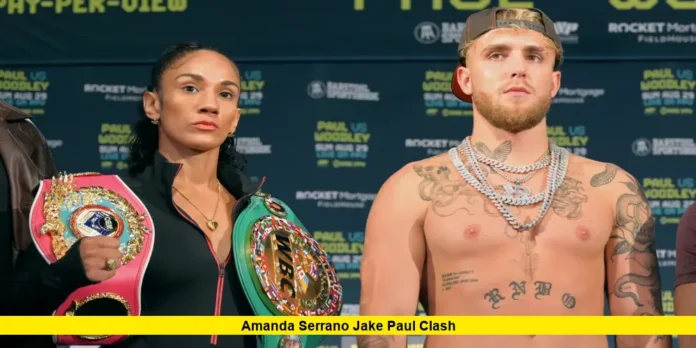

Amanda Serrano Jake Paul found herself at the center of a culture clash after Jake Paul urged fans to boycott Bad Bunny’s Super Bowl halftime performance and labeled the Puerto Rican superstar a “fake American.” Serrano — one of Puerto Rico’s most prominent athletes — pushed back forcefully, defending Puerto Rican identity and urging respect for the island’s relationship with the United States.
If you follow sports figures weighing in on cultural debates, this exchange is a clear example of how athletes shape public conversation and push back when identity is questioned.
Tell us what you think in the comments below and follow the conversation as it unfolds.
What Jake Paul said and why it sparked outrage
Jake Paul used social media in the hours around the Super Bowl to tell followers he would “purposefully turn off the halftime show” and to criticize the choice of Bad Bunny as the headline performer. In his posts, Paul described the artist as un-American and urged a boycott, words that immediately drew pushback from fans, fellow athletes, and public figures.
Paul’s comments landed on sensitive ground for two reasons. First, they targeted an artist who identifies strongly with Puerto Rico and who performed largely in Spanish. Second, they came amid a national conversation about cultural inclusion and what it means to be American. For many observers, attacking an artist’s nationality or cultural expression crossed a line.
Amanda Serrano’s response: pride and a correction
Amanda Serrano responded directly and without equivocation. As a Puerto Rican and a world-class boxer, Serrano framed her reply as a defense of both cultural pride and civic reality. She reminded critics that people from Puerto Rico are U.S. citizens by birth and that denigrating someone’s national identity based on language or heritage is unacceptable.
Serrano’s words resonated because they came from someone with a platform and a clear connection to the island. She highlighted Puerto Rico’s contributions across the military, the arts, sports, and public life — making the point that identity is complex, and citizenship is a legal and civic fact, not a matter of personal preference.
How fans and fellow athletes reacted
The online reaction was fast and polarized. Many fans and commentators criticized Jake Paul’s remarks as factually incorrect and culturally insensitive. Others defended Paul’s right to express his view of the halftime show itself while still rejecting his dismissal of someone’s nationality or heritage.
Notably, the reaction extended into Paul’s own circle. His brother, Logan Paul, publicly pushed back on the boycott narrative and explicitly affirmed that Puerto Ricans are Americans. That intra-family disagreement highlighted how even those close to Paul saw the line he crossed.
Bad Bunny’s performance and the message onstage
Bad Bunny delivered a halftime performance that leaned into Spanish-language music and Puerto Rican cultural references. The set closed with a unifying moment: the artist used a prop football to deliver a message of togetherness and visibly signaled solidarity with multiple countries across the Americas, underscoring a theme of inclusion rather than division.
That finale — and the mix of praise and critique that immediately followed — crystallized the broader debate: how national identity, language, and cultural heritage should be represented on the biggest entertainment stages.
Why the issue matters beyond a single tweet
This clash is part cultural debate and part civic correction. For many Americans, Puerto Rico’s status remains misunderstood. The island is a U.S. territory; people born there are U.S. citizens. When a public figure suggests otherwise, it invites confusion and harms the dignity of a community.
Athletes like Amanda Serrano matter in these moments because their voices bring attention to facts and lived experience. They also remind audiences that public influence carries responsibilities. Statements about identity can reverberate far beyond the person who posts them.
Political and cultural ripples
The comments did not stay confined to sports or entertainment pages. They drew reaction from political voices and commentators who framed the halftime show debate as part of larger cultural fights. Some conservative voices criticized the halftime choice and said they preferred alternatives. Those counter-programming efforts and critiques highlighted how the Super Bowl halftime can quickly become a cultural battleground.
At the same time, many observers viewed the backlash against Paul as a necessary corrective — a reminder that public platforms should not be used to marginalize entire communities.
The role of social media in amplifying the dispute
Social media amplified every line, retort, meme, and rebuttal. Posts circulated exposing factual points about Puerto Rican citizenship, reminding audiences that the status of the island and its residents is not a matter of opinion. Memes and threads also shone a light on Paul’s own ties to Puerto Rico, which some critics framed as ironic given his calls for a boycott.
The speed and reach of these platforms meant the dispute moved from a handful of posts into mainstream attention within hours. That rapid spread pushed public figures to respond quickly — sometimes creating a cascade of contradictory takes, corrections, and clarifications.
What Amanda Serrano’s stance signals for athletes and public life
Serrano’s intervention is more than a single statement. It signals a pattern: athletes are increasingly stepping into conversations about identity and social issues. When they do, their interventions can help correct misinformation and press for respectful discourse.
For young athletes and fans watching the exchange, Serrano’s message offered a model of measured but firm pushback. She used her platform to assert identity and to challenge what she called a harmful narrative.
Where things stand now
As the dust settles after the Super Bowl, the core facts remain unchanged: Bad Bunny performed, Paul urged viewers to turn off the set and used language many saw as dismissive of Puerto Rican identity, and Amanda Serrano publicly rejected that framing. The conversation continues across social platforms and in sports and cultural commentary, with voices on all sides weighing the balance between artistic expression, patriotism, and respect for identity.
What to watch next
Going forward, expect cultural commentators and athletes to revisit the discussion about representation at major national events. Look for continued debate around how performers who sing in other languages or foreground their cultural heritage are discussed on national stages.
Fans will likely keep responding, too — and athletes with Puerto Rican roots may use their platforms to shape the narrative further. What remains clear is that a few social media posts can trigger wide conversation when they touch on nationality, identity, and respect.
Share your view below and keep following for updates as athletes and public figures continue to weigh in.