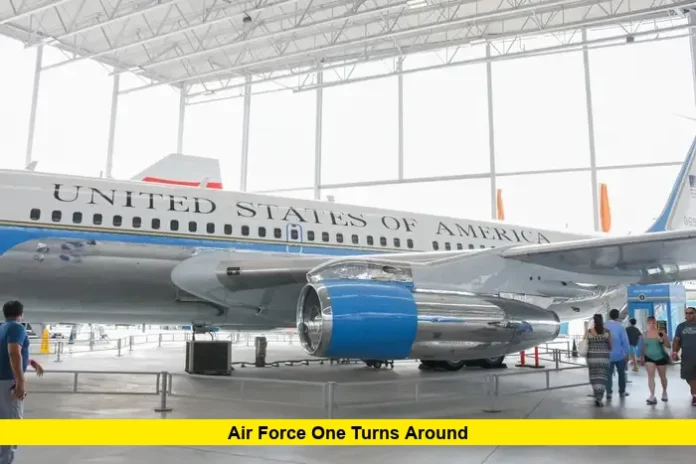

In a rare and closely watched aviation event, air force one turns around shortly after departure and returned to Washington, D.C., forcing an unexpected delay in the president’s international travel. The decision was made after a technical issue was detected on board the aircraft, prompting flight crews to follow strict safety procedures and bring the plane back to its departure base. The aircraft landed safely, no injuries were reported, and alternative arrangements were immediately put in place so the president could continue with his scheduled overseas visit.
The incident drew widespread attention because such turnarounds involving the presidential aircraft are highly uncommon. Every movement of the plane is planned with precision, and any change to its course signals that safety protocols have been activated at the highest level. While the issue was described as minor, the response underscored the zero-risk approach taken when the commander in chief is in the air.
What Triggered the Turnaround
Shortly after takeoff, crew members identified an electrical irregularity in one of the aircraft’s systems. The issue did not affect flight control, cabin pressure, or navigation, but standard operating procedures require that even small technical anomalies be taken seriously when the president is on board.
After a brief assessment, the flight crew and security officials agreed that the safest course of action was to return to base. The aircraft executed a controlled turn and headed back to Joint Base Andrews in Maryland, where it landed without incident. Ground crews were already in position to inspect the plane and determine the exact cause of the malfunction.
What Happened on the Ground
Once the aircraft touched down, the president and accompanying staff disembarked and were transported to a secure area of the base. The press pool traveling with the president was also safely escorted off the plane. White House officials confirmed that the issue was technical in nature and that the turnaround was precautionary.
Within hours, preparations began for an alternate aircraft to be readied for the continuation of the president’s international trip. The travel delay affected arrival timing but did not cancel any scheduled diplomatic meetings or appearances.
Why Safety Comes First for Presidential Flights
The aircraft commonly referred to as Air Force One is not just a mode of transportation. It is a flying command center equipped with advanced communications, defensive systems, and multiple layers of redundancy. These planes are designed to operate in almost any environment, but even with this level of engineering, no system is ignored when something behaves outside normal parameters.
For the president, safety standards are even higher than those applied in commercial aviation. Any unusual reading, system alert, or electrical inconsistency is enough to justify returning to base. The goal is not only to protect the occupants but also to ensure that the aircraft is fully mission-ready before continuing a long-distance flight, especially one that crosses international airspace.
How Rare Are Air Force One Turnarounds?
Mid-flight returns involving the presidential aircraft are extremely rare. The planes undergo constant maintenance and pre-flight checks that are far more extensive than those required for civilian airliners. Crews are trained to identify and respond to even the smallest deviation from expected performance.
When a turnaround does occur, it usually means that caution has prevailed over convenience. The schedule of the president, no matter how important, never outweighs the need for absolute safety.
The Current Air Force One Fleet
The aircraft currently serving as Air Force One are heavily modified Boeing 747-200 models that have been in service since the early 1990s. Though meticulously maintained and upgraded over the years, they are among the oldest active 747s still flying.
These aircraft feature:
- Secure, encrypted communications systems
- In-flight refueling capability
- Hardened electrical and electronic networks
- Defensive countermeasures
- Medical facilities
- Redundant navigation and control systems
Despite their age, the planes remain among the most sophisticated aircraft in the world. However, the recent incident has once again highlighted the challenges of operating an aging fleet, even one maintained to the highest military standards.
Plans for Next-Generation Presidential Aircraft
The U.S. Air Force is in the process of preparing next-generation aircraft to eventually replace the current Air Force One fleet. These future planes are based on newer wide-body platforms and are being modified to meet the unique security and operational needs of the presidency.
The modernization program has faced delays due to technical complexity, supply chain constraints, and the extensive customization required. Until the new aircraft enter service, the existing planes will continue to operate under strict maintenance and inspection schedules.
Impact on the President’s International Trip
At the time of the turnaround, the president was en route to Europe for a major international economic summit. The delay required adjustments to the travel timeline, but the overall itinerary remained intact. A backup aircraft was prepared, and the president continued the journey later the same day.
Such contingency planning is standard for presidential travel. Multiple aircraft, crews, and flight paths are always available to ensure continuity of operations in the event of mechanical, weather-related, or security-related issues.
How Flight Crews Handle Technical Alerts
Pilots and engineers assigned to Air Force One are among the most experienced in the U.S. military. They train specifically for high-pressure scenarios and complex decision-making. When an alert appears, it is immediately cross-checked, analyzed, and discussed with ground-based technical teams.
In this case, the electrical issue did not escalate into an emergency, but the crew followed protocol by returning to base rather than continuing across the Atlantic. This approach minimizes risk and allows for a full inspection by maintenance specialists on the ground.
Public Reaction and Transparency
News that the president’s plane had turned around spread quickly, raising questions across the country. Officials moved swiftly to clarify that the situation was under control and that there was no danger to those on board.
The event served as a reminder of the complexity involved in presidential travel and the layers of planning that operate behind the scenes. While the public often sees only the arrival and departure of the aircraft, every flight involves detailed coordination among the Air Force, the Secret Service, air traffic control, and diplomatic security teams.
Why Even “Minor” Issues Matter
In everyday aviation, a minor electrical issue might be addressed at the next scheduled maintenance stop. For a presidential aircraft, the threshold for action is much lower. The plane must be capable of performing its mission under any circumstance, including emergencies that require immediate and secure communication with military and government leaders.
Returning to base ensures that no unresolved issue, however small, accompanies the aircraft on a long-range international flight. This philosophy reflects a broader principle in aviation safety: early action prevents larger problems later.
Looking Ahead
After inspections and repairs, the aircraft that turned back will undergo additional testing before being cleared for future missions. Meanwhile, the president’s travel continues using alternate equipment and crews, ensuring that national and international commitments remain on schedule.
The incident, while unusual, demonstrated that established safety systems and decision-making protocols worked exactly as intended. The ability to detect, assess, and respond to a technical anomaly within minutes is a testament to the training and professionalism of everyone involved in presidential air operations.
What are your thoughts on how the situation was handled, and do you think the aging Air Force One fleet needs faster modernization? Join the conversation and stay updated as more details emerge.