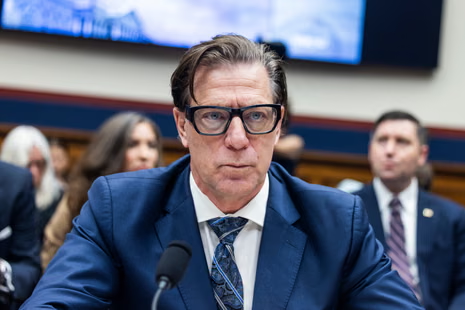

The appointment and rapid departure of acting FEMA Director David Richardson mark one of the most turbulent chapters in federal disaster-management leadership in recent years. Appointed in May 2025, Richardson stepped into the role of Senior Official Performing the Duties of Administrator at the Federal Emergency Management Agency (FEMA) amid sweeping policy shifts and internal upheaval. His resignation was confirmed on November 17, 2025, after roughly six months on the job.
Background: From Marine Corps to FEMA
David Richardson entered the public-service spotlight having served as a lieutenant colonel in the United States Marine Corps, with deployments to Iraq and Afghanistan. He later took a policy role at the Department of Homeland Security (DHS) as Assistant Secretary for the Countering Weapons of Mass Destruction Office. In May 2025, he was installed as acting head of FEMA, replacing his predecessor following a dismissal. Richardson’s appointment came as the administration signalled a desire to overhaul FEMA’s mission and reduce its size.
Key Early Actions and Stance
On assuming the role, Richardson reportedly adopted a very direct leadership message: he told staff he would “speak for FEMA alone,” and that anyone standing in the way would be “run right over.” This tough-tone approach aligned with the administration’s broader agenda of cutting federal workforce and shifting more responsibility to states. He began by canceling FEMA’s existing strategic plan, launching an internal effort to identify redundancies, and framing cost-sharing with states as a key priority.
Internal Turbulence and Staffing Shifts
Under Richardson’s watch, FEMA underwent significant internal disruption. The agency lost thousands of employees through buyouts or resignations. Training programs for emergency managers were cut, and an internal review early in his term reportedly found that FEMA was “not ready” for the 2025 Atlantic hurricane season. These moves triggered concern among state and local emergency-management officials about FEMA’s readiness to respond to major disasters.
Crisis Response Under Scrutiny
One of the most consequential events during his tenure was the deadly flooding in Central Texas in July 2025, which claimed more than 130 lives. During Congressional hearings, legislators criticised Richardson’s absence and lack of visibility during the disaster. Officials said he remained out of reach for hours during the early hours of response, and that FEMA’s coordination with state and local partners appeared slow and opaque. At the same time, during a staff meeting in June he apparently joked—or at least stated—that he was unaware of the U.S. “hurricane season,” a comment that underscored concerns about his preparedness for disaster-response operations.
Policy Shift: Redefining FEMA’s Role
Much of Richardson’s tenure was defined by the push to redefine FEMA’s role in domestic disaster management. He emphasized shrinking the federal footprint, increasing cost-sharing with states, and eliminating what he termed “waste and inefficiency.” While this echoed the administration’s stated goal of streamlining federal agencies, critics warned that reducing capacity at FEMA amid growing climate risks and more intense disasters could leave communities more vulnerable.
Leadership Style & Agency Culture
Observers inside FEMA described a top-down leadership style under Richardson. He emphasised that he alone would set direction, bypassing traditional collaborative approaches with regions and states. Staff morale reportedly dropped as regional leaders felt cut off from decision-making. In an environment where rapid response, coordination, and trust are critical, that shift raised alarms among career emergency-management professionals.
The Resignation
On November 17, 2025, DHS announced that Richardson would step down as acting FEMA head, effective immediately, with his successor starting December 1. The official statement offered appreciation for his service, particularly during hurricane season and for directing historic funding to several states. No detailed reason for the departure was given beyond a return to the private sector. Richardson’s exit adds to the leadership churn at FEMA: his predecessor was dismissed in May, meaning two changes in six months.
Immediate Ramifications
Richardson’s departure carries several short-term implications for FEMA and U.S. disaster preparedness:
- Leadership vacuum: Rapid turnover can undermine clarity of mission and weaken internal morale.
- Operational continuity risks: On-going reforms, staff cuts and shifting priorities may hamper response readiness in the 2026 disaster season.
- State-federal dynamics: With the policy emphasis on shifting responsibility to states, resources and coordination may become more fragmented during large-scale disasters.
- Public confidence: High-profile absence and delayed responses have eroded trust in FEMA leadership at a time when crisis communications are vital.
Longer-Term Questions
Beyond the immediate disruptions, Richardson’s tenure raises broader strategic questions:
- Can FEMA maintain its core capacity while undergoing structural reductions?
- How will the agency balance federal coordination with increased state control?
- Will future leadership adopt a more collaborative, less confrontational style to rebuild internal cohesion and external partnerships?
- In an era of intensifying disasters, is cost-cutting and workforce reduction compatible with resilience and rapid response?
A Look Ahead: What to Watch
In the coming months, several developments will be key to tracking FEMA’s trajectory post-Richardson:
- Release of the review council’s report on FEMA’s mission and structure.
- Appointment of a permanent FEMA administrator and whether that individual comes from emergency-management ranks or policy/structural reform.
- Whether FEMA restores training programs and reengages with state/local partners or continues the downsizing trend.
- Changes in how FEMA communicates during disasters and the degree of public transparency in response operations.
Profile Summary: Acting FEMA Director David Richardson
- Marine Corps graduate, deployed in Iraq/Afghanistan; academic background in biology.
- Appointed Assistant Secretary for DHS’s Countering Weapons of Mass Destruction Office, early 2025.
- Named acting head of FEMA in May 2025, replacing previous acting leader.
- Oversaw FEMA during 2025 hurricane season, directed internal restructuring, cut training and staff programs.
- Faced criticism for low visibility and coordination during major Texas flooding event.
- Resigned November 17, 2025; replacement begins December 1.
Conclusion
The brief tenure of Acting FEMA Director David Richardson underscores the immense challenge of steering a major federal agency through reform while maintaining readiness for disasters. His departure marks a turning point for FEMA, as the agency must now rebuild stability, reaffirm its mission, and restore trust at a time when every hurricane, flood or wildfire demands a swift and coordinated federal response.
What do you think the future holds for FEMA’s leadership and its role in disaster management? Share your thoughts or questions below—stay tuned for more updates.