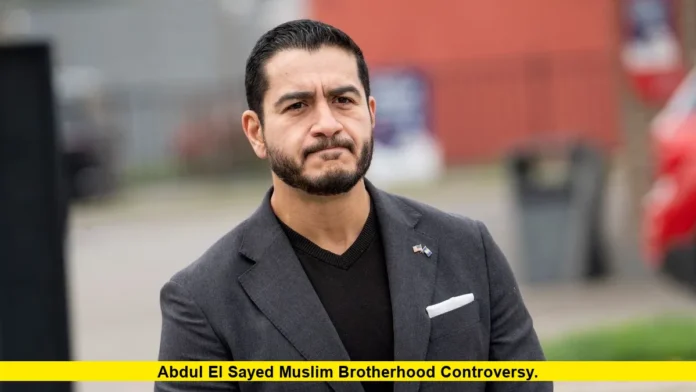

The Abdul El Sayed Muslim Brotherhood controversy has become a major issue in Michigan’s closely watched 2026 U.S. Senate race. The Democratic nominee has repeatedly denied having ties to the Muslim Brotherhood, while Republican candidate Mike Rogers and other political figures have continued to question his connections to the organization. On October 25, President Donald Trump intensified the dispute at a rally in Port Huron, Michigan, using inflammatory language to attack El-Sayed and questioning his loyalty to the United States. El-Sayed has rejected allegations of extremist affiliations, and publicly available reporting has not established that he belongs to the Muslim Brotherhood.
The controversy has placed religion, family history, political identity and national security rhetoric at the center of an important Senate campaign. It has also prompted renewed questions about who Abdul El-Sayed is, whether he is a medical doctor, who his wife and family are, and what evidence supports the allegations surrounding his name.
Understanding the facts requires separating documented events from political accusations. The distinction matters as Michigan voters prepare for the November 3 midterm elections.
What Is the Latest Update on Abdul El-Sayed and the Muslim Brotherhood?
The latest political news centers on renewed attacks against El-Sayed during the final stretch of the 2026 election campaign.
At a rally in Port Huron on October 25, Trump called El-Sayed a “jihadist,” questioned his loyalty to America and suggested he posed a national security threat. Trump also connected the candidate to the Muslim Brotherhood, repeating allegations that have become a prominent Republican line of attack.
El-Sayed has denied having ties to the organization. The available evidence has not established that he is a member or that he pledged support to the Muslim Brotherhood itself.
The remarks have generated criticism from Arab American advocates and Democratic politicians. Critics argue that portraying a Muslim candidate as a security threat without substantiated evidence risks encouraging religious prejudice.
The dispute has also drawn attention to Republican Mike Rogers, El-Sayed’s opponent in the Senate race. Rogers has argued that El-Sayed should answer questions about his past statements, political associations and family background.
However, examining those claims requires looking at the underlying evidence rather than treating campaign statements as established facts.
Who Is Abdul El-Sayed?
Abdul El-Sayed, whose full name is Abdulrahman Mohamed El-Sayed, is a Michigan public health professional, author and Democratic politician. Born in Rochester Hills, Michigan, in 1984, he grew up in southeastern Michigan and built his career around public health, healthcare policy and government service.
He first gained significant statewide political attention in 2018, when he ran for the Democratic nomination for Michigan governor. Although he did not win that primary, his campaign established him as a progressive political figure with a strong interest in healthcare access, economic inequality and government accountability.
El-Sayed subsequently served as executive director of the Detroit Health Department. In that role, he worked on public health initiatives involving lead exposure, access to essential services and other health challenges affecting Detroit residents.
His experience in government and healthcare policy became central to his later political campaigns. He has also advocated changes to the American healthcare system and written about healthcare reform.
In 2026, El-Sayed became the Democratic nominee for the U.S. Senate in Michigan. His candidacy has attracted national attention because of the competitive nature of the race and the controversy surrounding his religious identity and alleged connections to the Muslim Brotherhood.
What Is the Muslim Brotherhood?
The Muslim Brotherhood is an Islamist movement founded in Egypt in 1928. It has influenced political and religious movements across parts of the Middle East and North Africa.
The organization has participated in political activity and social-service programs in some countries. Its history, ideology and relationships with different political movements have also generated significant controversy.
The Muslim Brotherhood should not be treated as identical to every Muslim organization or every political movement associated with Islam. Its branches and affiliated groups have different histories, activities and legal statuses.
The organization has also been linked historically to political movements that have faced restrictions or terrorism-related designations in particular jurisdictions. Those circumstances do not automatically establish a connection between the organization and an individual who practices Islam or discusses Middle Eastern politics.
In El-Sayed’s case, the central question is whether evidence demonstrates a personal or organizational affiliation. His opponents have raised allegations, but reporting on the controversy has not established that he is a member of the Muslim Brotherhood.
Why Is Abdul El-Sayed Being Linked to the Muslim Brotherhood?
The allegations have several origins, including El-Sayed’s earlier commentary about Egyptian politics, a statement signed by Egyptian Americans in 2012 and social media posts attributed to his half-sister.
These items have been cited by political opponents as reasons to question his relationship with the organization. However, each requires examination in its original context.
In 2011, El-Sayed wrote an opinion article supporting protesters challenging Egypt’s government under then-President Hosni Mubarak. He argued that concerns about the Muslim Brotherhood gaining political influence should not prevent the United States from supporting democratic aspirations.
His argument addressed the political consequences of Egypt’s uprising. It did not amount to a declaration of membership in the Muslim Brotherhood.
In 2012, El-Sayed also signed a statement with other Egyptian Americans expressing support for Mohamed Morsi, who had won Egypt’s presidential election. Morsi was associated with the Muslim Brotherhood.
Critics have used the statement to question El-Sayed’s political sympathies. However, supporting an elected president is not automatically equivalent to joining or pledging allegiance to the organization associated with that president.
The distinction is important because the allegations against El-Sayed concern a claimed personal affiliation, not simply whether he has expressed opinions about Egyptian politics.
What Did Abdul El-Sayed Say About His Alleged Muslim Brotherhood Ties?
El-Sayed has repeatedly denied having personal or family connections to the Muslim Brotherhood.
During an NBC interview in October 2026, he rejected the allegations and questioned why his mother’s alleged activities decades earlier should determine how voters evaluate him.
His parents divorced when he was three years old. His biological mother, Fatten Elkomy, subsequently left Michigan, and his father and stepmother raised him.
El-Sayed has said that he was not raised by his biological mother and had not discussed the alleged activities with her. He characterized the reliance on social media posts as hearsay rather than evidence of his own affiliation.
His position has remained consistent: he denies ties to the organization and argues that voters should judge his political record and stated positions.
The controversy resurfaced during a campaign event on October 17. An audience member asked whether El-Sayed would disavow the Muslim Brotherhood.
“Sure. Yeah, absolutely,” El-Sayed responded.
He then challenged the premise behind the question, arguing that the exchange reflected an assumption that his Muslim faith could make him less loyal to the U.S. Constitution.
The encounter spread widely online and became another source of debate during the campaign. Some viewers supported his response, while his Republican opponent argued that the exchange did not adequately address concerns about his past associations.
A subsequent fact-check by PolitiFact rated Rogers’ claim that El-Sayed had not disavowed the organization as false, noting that El-Sayed had explicitly agreed to disavow it.
What Do the Allegations About His Family Actually Show?
Family history has become one of the most contentious parts of the Abdul El Sayed Muslim Brotherhood debate.
Republican critics and conservative media outlets have highlighted older social media posts attributed to El-Sayed’s half-sister, Eman Abdelhadi. In posts from 2012 and 2013, she appeared to describe the family as having a historical connection to the Muslim Brotherhood and referred to their biological mother’s alleged activism during the early 1970s.
Those posts have been used to question whether El-Sayed’s family had a relationship with the organization.
However, a relative’s social media statements do not independently establish another person’s membership or political allegiance. Nor do they demonstrate that El-Sayed personally participated in any organizational activities.
El-Sayed has disputed the allegations and said that, to the best of his knowledge, his family was not affiliated with the organization. He has also emphasized that he was raised by his father and stepmother rather than his biological mother.
The distinction between an allegation about a family member and evidence about a candidate is essential. No publicly established evidence cited in the current controversy demonstrates that El-Sayed personally belongs to the Muslim Brotherhood.
The available information also does not justify presenting the allegations about his mother as independently verified fact.
Is Abdul El-Sayed a Medical Doctor?
Yes, El-Sayed holds a medical degree, but there is an important distinction between earning an M.D. and being a licensed practicing physician.
He earned his medical degree from Columbia University and a doctorate in public health from the University of Oxford, where he studied as a Rhodes Scholar.
His professional career has focused primarily on epidemiology, public health administration, research and healthcare policy.
El-Sayed did not complete a medical residency after medical school and has not been licensed to practice medicine or treat patients. As a result, he does not meet the legal definition of a licensed physician in Michigan.
The distinction became a separate political issue during the 2026 Senate campaign, when Rogers challenged how El-Sayed described his medical qualifications.
The accurate description is that El-Sayed has an M.D. and a public health doctorate but has not practiced as a licensed physician.
His education and professional experience remain relevant to his healthcare policy positions, but voters should distinguish academic qualifications from medical licensure.
Who Is Abdul El-Sayed’s Wife?
Abdul El-Sayed is married to Sarah El-Sayed. The couple lives in Ann Arbor, Michigan, and has two daughters, Emmalee and Serene.
El-Sayed generally keeps his family’s private life separate from his political career. His wife and children are not responsible for the allegations concerning the Muslim Brotherhood, and claims about his political affiliations should not be extended to family members without evidence.
His upbringing is also relevant to the current controversy. His Egyptian immigrant parents separated when he was young, and his father, Mohamed, and stepmother, Jacqueline Johnson, raised him in Michigan.
These biographical details help explain his personal background, but they do not establish a connection to the organization at the center of the political dispute.
How Tall Is Abdul El-Sayed?
A reliably verified height for Abdul El-Sayed has not been established in the information available for this article.
Although searches about his physical appearance and personal biography may include questions about his height, an unconfirmed number should not be presented as fact.
His height also has no demonstrated connection to the Muslim Brotherhood allegations or the issues shaping his Senate campaign.
For readers seeking accurate biographical information, his education, public health career, political experience and family background are better documented than this particular personal detail.
How the Controversy Is Affecting the Michigan Senate Race
The Muslim Brotherhood allegations have become part of a wider political struggle over El-Sayed’s candidacy, his religious identity and his suitability for national office.
Republicans have argued that his past statements and associations warrant scrutiny. El-Sayed and his supporters have countered that the accusations rely on selective interpretations of old statements and unverified claims about his family.
The October 25 rally added a new dimension to the dispute when Trump escalated his rhetoric against the Democratic nominee. The remarks brought additional national attention to the race and intensified criticism from people who believe the accusations cross the line from political opposition into anti-Muslim rhetoric.
The controversy also raises a broader question about the standards applied to political candidates. Scrutiny of a candidate’s statements, affiliations and record is a normal part of democratic elections. However, allegations of extremist ties require evidence rather than assumptions based on religion, ethnicity or relatives’ statements.
Michigan voters will ultimately decide between El-Sayed and Rogers at the ballot box. The Senate race is significant to both parties because its outcome could influence control of the chamber.
For El-Sayed, the immediate challenge is to keep the campaign focused on his healthcare positions, economic proposals and public service while responding to the controversy. For Rogers, the challenge is to demonstrate that his criticisms are supported by evidence and relevant to voters’ decisions.
What Voters Should Know About Abdul El-Sayed and the Muslim Brotherhood
The most important facts are straightforward:
- El-Sayed denies affiliation: He has repeatedly stated that he has no ties to the Muslim Brotherhood and has explicitly agreed to disavow the organization.
- The allegations remain unproven: Public reporting has not established that he is a member or that he pledged support to the organization itself.
- His past political statements have been scrutinized: His commentary about Egypt and his support for a statement defending President Mohamed Morsi have been cited by critics, but neither fact alone establishes membership.
- Family allegations require caution: Social media posts attributed to his half-sister have fueled the controversy, but they do not independently establish El-Sayed’s personal affiliations.
- He has medical and public health qualifications: He holds an M.D. and a doctorate in public health, but he is not a licensed practicing physician.
- The issue remains politically active: Trump’s October 25 remarks have renewed national attention on the controversy shortly before the midterm elections.
These points provide a clearer picture than campaign rhetoric alone. They also show why distinguishing between verified information, political interpretations and unsubstantiated accusations is essential when evaluating candidates for public office.
Conclusion: What Comes Next in the Abdul El-Sayed Muslim Brotherhood Debate?
The Abdul El-Sayed Muslim Brotherhood controversy has become a defining feature of Michigan’s 2026 Senate campaign, bringing questions about religion, political accountability and evidence into the national spotlight. El-Sayed continues to deny any connection to the organization, while Republican critics maintain that his past statements and family history deserve scrutiny. The available evidence, however, does not establish that he personally belongs to the Muslim Brotherhood. As Election Day approaches, voters will have to weigh the documented record, the candidates’ policy positions and the credibility of the claims made during the campaign.
What do you think about the Muslim Brotherhood allegations against Abdul El-Sayed? Share your views in the comments and follow the latest political news for verified developments in Michigan’s Senate race.