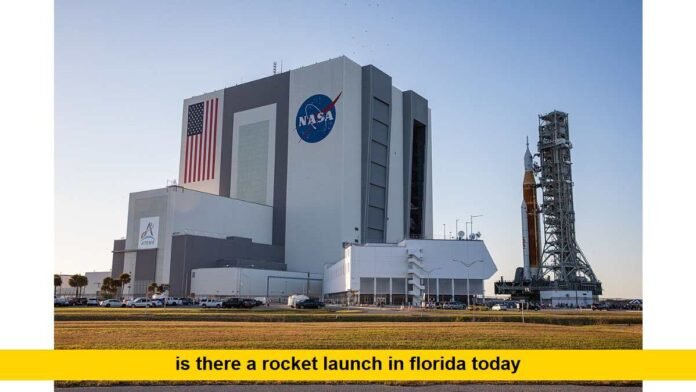

Florida’s Space Coast remains one of America’s busiest gateways to space, and people searching is there a rocket launch in Florida today are looking for the latest schedule, launch location, mission details, and whether the event can be seen from nearby communities. A Falcon 9 mission carrying a Cygnus cargo spacecraft is scheduled to launch from Cape Canaveral Space Force Station as part of NASA’s commercial cargo transportation program.
The mission is designed to deliver essential supplies, research materials, equipment, and other cargo to astronauts aboard the International Space Station (ISS). It represents the continuing partnership between NASA and commercial aerospace companies that helps maintain the station and support scientific work in orbit.
Because rocket launch schedules are subject to last-minute changes, the scheduled time should not be treated as confirmation that liftoff has already occurred. Weather, technical readiness, ground operations, and range safety requirements can all affect the final countdown.
Florida Rocket Launch Schedule for November 29
The November 29 launch is scheduled to take place from Space Launch Complex 40, a launch facility at Cape Canaveral Space Force Station used for SpaceX Falcon 9 missions. The launch site is positioned along Florida’s Atlantic coastline, providing access to orbital flight paths over the ocean.
The mission’s primary launch opportunity is scheduled for Sunday morning. A backup opportunity has also been identified in case the Sunday attempt cannot proceed.
Launch Schedule and Mission Information
| Mission detail | Latest information |
|---|---|
| Launch date | Sunday, November 29, 2026 |
| Target liftoff | 10:47 a.m. EST |
| Backup launch opportunity | Monday, November 30 |
| Backup target time | 10:24 a.m. EST |
| Launch site | Cape Canaveral Space Force Station |
| Launch complex | Space Launch Complex 40 |
| Rocket | Falcon 9 |
| Spacecraft | Cygnus XL |
| Mission designation | NG-25 / CRS-25 |
| Destination | International Space Station |
| Cargo | Approximately 11,000 pounds |
| Launch provider | SpaceX |
| Cargo spacecraft operator | Northrop Grumman |
The schedule is a target and remains subject to launch-day conditions. The presence of a backup opportunity means the mission team has another planned window if the primary attempt is postponed.
SpaceX Falcon 9: The Rocket Behind Today’s Mission
The rocket selected for this cargo mission is SpaceX’s Falcon 9. It is a two-stage launch vehicle that has become a major component of the company’s commercial and government launch operations.
Falcon 9 is designed to transport payloads into orbit using a combination of powerful engines, guidance systems, and staged propulsion. Its first stage provides most of the initial energy required to lift the vehicle away from Earth. After the first stage separates, the second stage continues the flight and helps place the spacecraft into its target orbital trajectory.
One of Falcon 9’s defining characteristics is its reusable first-stage booster technology. Instead of treating the entire rocket as disposable, SpaceX can recover and reuse certain first-stage boosters after missions when the flight profile permits.
This approach has helped the company increase its launch frequency and reduce the time required to prepare hardware for subsequent flights.
What Happens During the Falcon 9 Flight?
The launch process involves several major milestones:
- Final countdown: Launch teams complete vehicle checks and monitor weather, equipment, and ground systems.
- Liftoff: The rocket’s engines ignite and generate the thrust required to leave the launch pad.
- Atmospheric ascent: Falcon 9 climbs through the atmosphere while following its programmed flight path.
- Stage separation: The first stage separates after completing its primary flight duties.
- Second-stage flight: The upper stage continues accelerating toward the spacecraft’s orbital destination.
- Spacecraft separation: Cygnus XL separates from the rocket once it reaches the planned orbital conditions.
- Booster recovery: The first stage may attempt a controlled return and landing, depending on the mission’s recovery profile.
Each stage of the mission is carefully monitored by launch teams. If an unexpected issue occurs, the countdown can be stopped or the launch attempt postponed.
What Is Northrop Grumman’s Cygnus XL Spacecraft?
The payload for the November 29 mission is Cygnus XL, an uncrewed cargo spacecraft developed by Northrop Grumman. The spacecraft is part of NASA’s commercial cargo transportation program, which relies on private aerospace companies to transport materials and supplies to the International Space Station.
Cygnus is not designed to carry astronauts. Instead, it serves as a cargo vehicle capable of delivering essential items that astronauts need for everyday life and research activities aboard the orbital laboratory.
The spacecraft will travel to the International Space Station after being deployed from the Falcon 9 rocket. Once it reaches the station’s vicinity, the crew will use the station’s robotic arm to capture the vehicle and guide it into position for attachment.
The cargo spacecraft provides a transportation link between Earth and the ISS, helping ensure that the crew receives supplies and research equipment on a regular basis.
Why the Cygnus XL Cargo Mission Matters
The International Space Station is a complex scientific facility operating hundreds of miles above Earth. Astronauts aboard the station require a steady supply of food, water-related equipment, clothing, research materials, replacement hardware, and other necessities.
Cargo transportation missions help maintain the station’s operations and allow astronauts to continue experiments without interruption.
The Cygnus XL spacecraft is expected to deliver approximately 11,000 pounds of material, including scientific investigations, supplies, and equipment. The cargo is intended to support a range of research projects and daily station activities.
What Is Inside the Cygnus XL Cargo Shipment?
The cargo aboard the spacecraft is expected to include a combination of research materials, equipment, supplies, and items required for station operations.
NASA’s research conducted aboard the ISS covers a wide range of scientific fields. The microgravity environment provides opportunities to study biological systems, physical processes, materials, and technology in ways that are difficult to reproduce on Earth.
Scientific Research and Technology Demonstrations
The Cygnus XL mission is expected to support investigations involving several areas of research, including:
- Human health and medical research
- Studies involving cancer-related research and treatment approaches
- Research into muscle loss and health challenges associated with spaceflight
- Radiation measurement and monitoring technologies
- Food production and systems for future long-duration missions
- Biological experiments
- Materials science
- Technology demonstrations
Research aboard the International Space Station can contribute to knowledge that may eventually have applications on Earth. Scientists use the orbital laboratory to investigate how biological systems and materials behave under microgravity conditions.
Not every experiment produces immediate practical results. Many investigations are designed to collect data, test scientific hypotheses, or evaluate technologies that may be useful for future space missions.
Supplies for Astronauts
In addition to research equipment, cargo missions carry everyday items required by astronauts.
The station’s crew needs food, personal supplies, maintenance materials, medical equipment, and replacement components. These items are essential because astronauts cannot simply leave the station to obtain materials when they are needed.
Commercial cargo missions help maintain a predictable supply system that supports the station’s crew and operational requirements.
NASA’s Commercial Resupply Services Program Explained
The Cygnus XL mission is part of NASA’s Commercial Resupply Services program. This initiative allows NASA to purchase cargo transportation services from private companies rather than relying exclusively on government-developed vehicles.
The program supports commercial spaceflight development while helping NASA maintain access to the International Space Station.
Private companies are responsible for developing spacecraft, rockets, mission operations, and transportation capabilities under their respective contracts. NASA provides mission requirements, coordinates cargo priorities, and oversees the station-related operations.
Why Commercial Cargo Flights Are Important
Commercial cargo flights provide NASA with additional transportation capacity and help reduce dependence on a single system.
Multiple cargo providers create greater flexibility for scheduling, mission planning, and supply management. They also encourage technological development and competition within the aerospace industry.
The commercial resupply program is an important part of NASA’s broader strategy to support low-Earth-orbit activities while developing capabilities for future exploration beyond Earth.
The International Space Station continues to serve as a platform for scientific research, technology testing, astronaut training, and international cooperation.
Where Is the Rocket Launch Taking Place?
The November 29 mission is scheduled to launch from Space Launch Complex 40 at Cape Canaveral Space Force Station in Florida.
Cape Canaveral is one of the most important space launch locations in the United States. It has supported satellite launches, scientific missions, commercial flights, military payloads, and human spaceflight operations for decades.
The Florida Space Coast includes multiple launch facilities and aerospace organizations. The region’s infrastructure, experienced workforce, transportation networks, and coastal location make it a major center for spaceflight.
Why Cape Canaveral Is Ideal for Rocket Launches
Florida’s Atlantic coastline provides access to launch trajectories over the ocean. Many rockets launching from Cape Canaveral travel eastward, taking advantage of Earth’s rotation and following routes that help reduce risks associated with flying over populated areas.
The region also has extensive infrastructure supporting launch operations, including tracking systems, launch complexes, engineering facilities, and logistical support.
These resources help make Cape Canaveral a major hub for commercial and government spaceflight.
Can You See Today’s Rocket Launch From Florida?
A rocket launch from Cape Canaveral may be visible from a large area of Florida’s Space Coast, depending on weather conditions and the flight trajectory.
People near the launch site may have a clearer view of liftoff, while those farther away may see the rocket as a bright point moving across the sky or observe its exhaust trail.
Clouds, rain, haze, and other atmospheric conditions can affect visibility. Even when a launch takes place successfully, spectators may not be able to see it if the sky is overcast.
Popular Rocket Launch Viewing Areas
Several communities and public areas along Florida’s eastern coast are popular with launch spectators.
- Cape Canaveral: Offers locations relatively close to the launch facilities.
- Cocoa Beach: A popular coastal destination for watching launches.
- Titusville: Provides several locations with views toward Cape Canaveral.
- Jetty Park: A well-known destination near Port Canaveral.
- Space View Park: A popular launch-viewing location in Titusville.
- Indian River waterfront areas: Some locations offer open views across the water toward the launch region.
Visitors should check parking availability, local regulations, access restrictions, and crowd conditions before traveling to a viewing area.
A rocket launch may attract thousands of spectators, especially when the mission involves a major spacecraft or an important scientific payload.
How to Watch the Rocket Launch Live
People outside Florida can follow the mission through online launch coverage. NASA provides live coverage for many of its commercial cargo missions, including launch preparations and important flight milestones.
Coverage may include countdown updates, weather information, launch commentary, liftoff footage, and spacecraft deployment.
The planned NASA coverage for this mission begins before the target launch time, allowing viewers to follow the final countdown and learn about the mission’s objectives.
What Live Coverage May Include
Viewers can expect coverage of major mission events, such as:
- Rocket and spacecraft preparations
- Countdown milestones
- Weather updates
- Engine ignition and liftoff
- Rocket ascent
- Stage separation
- Spacecraft deployment
- Mission commentary
- Updates about the spacecraft’s journey toward the ISS
NASA coverage can be particularly useful for viewers who want more than just launch footage. Commentary provides explanations of the mission, the cargo, and the significance of the flight.
What Happens After Cygnus XL Reaches Orbit?
The mission does not end when Falcon 9 releases the cargo spacecraft. Cygnus XL must continue through a series of orbital maneuvers before it reaches the International Space Station.
The spacecraft uses its propulsion and navigation systems to adjust its orbit and approach the station. These operations are carefully coordinated with ground controllers and the ISS crew.
Arrival at the International Space Station
After reaching the station’s vicinity, Cygnus XL will approach the ISS under controlled conditions.
The spacecraft is expected to be captured by the station’s robotic arm, known as Canadarm2. Astronauts operating the robotic system will guide the cargo vehicle into position and attach it to the station.
The arrival and capture process is an important mission milestone because it allows the cargo to be transferred to the ISS.
Unloading the Cargo
Once Cygnus XL is securely attached, astronauts will begin unloading its supplies and research materials.
Cargo operations can take time because the crew must carefully organize the materials and coordinate the transfer of equipment into the station’s storage and research areas.
The supplies may be used immediately, stored for later operations, or incorporated into scientific investigations scheduled to take place during the station’s ongoing mission.
How Long Will Cygnus XL Stay at the ISS?
The spacecraft is expected to remain attached to the International Space Station for several months.
During that period, astronauts will unload the cargo and use the vehicle for station operations as appropriate. When the mission is complete, Cygnus is expected to depart from the ISS carrying items no longer needed aboard the station.
The spacecraft will eventually re-enter Earth’s atmosphere, where it is designed to burn up during its controlled disposal process.
Could Today’s Rocket Launch Be Delayed?
Yes. Rocket launch schedules can change even when a mission has been cleared for a launch attempt.
The launch team must continuously monitor weather conditions, rocket systems, spacecraft readiness, ground equipment, and range safety requirements.
A countdown may be paused if an issue needs additional attention. In some circumstances, the launch may be postponed to a later opportunity.
Common Reasons for Launch Delays
Launch delays may occur because of:
- Unfavorable weather
- Thick cloud layers
- Strong winds
- Lightning concerns
- Technical problems
- Equipment checks
- Ground-system issues
- Range safety restrictions
- Unexpected countdown holds
Weather is particularly important because rocket launches require specific atmospheric conditions. A forecast may initially appear favorable but change as the launch window approaches.
A delay does not necessarily mean the mission has failed. It may simply mean that the launch team needs more time or that conditions are not suitable for a safe launch attempt.
What Is the Backup Launch Date?
A backup launch opportunity is scheduled for Monday, November 30, at 10:24 a.m. Eastern Standard Time if the Sunday attempt does not proceed.
The backup opportunity provides the mission team with another planned window. However, a backup date is not an unconditional guarantee that the launch will take place on that day. Additional changes may occur depending on the reason for the delay and the readiness of the rocket, spacecraft, launch site, and mission systems.
Spectators planning to travel to Florida should be aware that launch schedules can change quickly. It is advisable to monitor the latest updates before making travel decisions.
Why Florida Rocket Launches Continue to Attract Attention
Rocket launches have become an increasingly important part of Florida’s tourism and aerospace economy. The Space Coast regularly attracts visitors who want to see rockets launch, visit space-related attractions, or learn more about the history and future of space exploration.
The region is also home to engineers, aerospace workers, researchers, launch operations teams, and companies involved in the commercial space industry.
The Growth of Commercial Spaceflight
The expansion of commercial launch services has increased the frequency of rocket launches from Florida. SpaceX, NASA, and other aerospace organizations use the region’s launch facilities for a variety of missions.
Launches may involve:
- Satellite deployments
- Cargo missions to the International Space Station
- Scientific spacecraft
- Government and military payloads
- Commercial communications satellites
- Space exploration technology
As launch activity grows, Florida’s Space Coast continues to develop as an important center for aerospace operations and space-related tourism.
Educational Opportunities
Rocket launches also inspire interest in science, technology, engineering, and mathematics.
Students and families watching a launch can learn about propulsion, orbital mechanics, spacecraft design, atmospheric science, and the engineering systems required to transport payloads into space.
The International Space Station itself is an important educational and research platform. Experiments conducted in orbit may contribute to scientific understanding and future technologies.
What Is the Next Rocket Launch in Florida?
Following the November 29 Cygnus cargo mission, the Florida launch calendar currently lists a Falcon 9 mission carrying the CHORUS payload for December 4, 2026.
CHORUS is an Earth-observation mission involving radar satellite technology. Its planned satellite constellation is intended to support Earth observation and provide data for different applications.
However, future launch dates and times are subject to change. Missions may be moved, delayed, or rescheduled based on launch readiness, weather, technical requirements, and operational considerations.
Florida’s launch calendar may also include additional missions that receive confirmed dates as preparations progress.
Final Thoughts
The November 29 rocket launch is an important mission for Florida’s Space Coast and NASA’s commercial cargo program. A SpaceX Falcon 9 rocket is scheduled to carry Northrop Grumman’s Cygnus XL spacecraft toward the International Space Station, delivering approximately 11,000 pounds of supplies, scientific investigations, and equipment.
The mission highlights the role commercial aerospace companies play in maintaining the ISS and supporting scientific research in orbit. Falcon 9 provides the transportation capability, while Cygnus XL serves as the cargo vehicle carrying materials needed by astronauts and researchers.
For people wondering is there a rocket launch in Florida today, the scheduled answer is yes. The launch target is 10:47 a.m. EST from Space Launch Complex 40 at Cape Canaveral Space Force Station. A backup launch opportunity is scheduled for November 30 at 10:24 a.m. EST.
Because launch schedules are subject to change, the final status should be confirmed through the latest mission updates. Whether watching from Florida or following online, the Cygnus XL cargo mission is another important step in the continuing work of supplying and operating the International Space Station.
Share your thoughts in the comments and stay tuned for the latest updates on Florida rocket launches, SpaceX missions, and NASA spaceflight news.