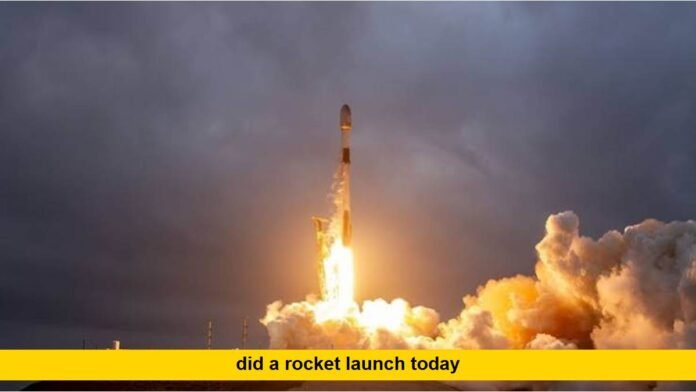

Did a rocket launch today is a question many space enthusiasts, skywatchers, and readers are asking as launch activity continues across the United States. November 29, 2026, features a scheduled SpaceX Falcon 9 mission carrying a Northrop Grumman Cygnus XL cargo spacecraft toward the International Space Station, along with another launch opportunity involving a United States Space Force mission from California.
Rocket launch schedules can change quickly, so it is important to distinguish between a mission scheduled for launch, a launch attempt that has begun, and a confirmed successful liftoff. The November 29 schedule includes a major cargo mission designed to transport scientific research, equipment, and supplies to astronauts aboard the orbital laboratory.
The day’s launch activity also highlights the increasing role of commercial companies in America’s space program. Reusable rockets, commercial cargo spacecraft, and partnerships between NASA and private aerospace companies have made orbital transportation more frequent and accessible than in previous decades.
Today’s Rocket Launch Schedule and Latest Updates
The most significant publicly announced launch opportunity for November 29 involves the SpaceX Falcon 9 rocket carrying Northrop Grumman’s Cygnus XL spacecraft. The mission is part of NASA’s Commercial Resupply Services program and is intended to deliver cargo to the International Space Station.
The launch was scheduled for 10:47 a.m. Eastern Time from Space Launch Complex 40 at Cape Canaveral Space Force Station in Florida.
The cargo mission is expected to carry approximately 11,000 pounds of materials, including supplies for astronauts, scientific equipment, research hardware, and other items required to support station operations.
Another launch opportunity has also been listed for later in the day from Vandenberg Space Force Base in California. The SpaceX Falcon 9 mission, designated USSF-380, is associated with the United States Space Force. Public information about the mission is limited because it is classified.
Launch schedules remain subject to changes caused by weather, technical inspections, spacecraft readiness, range restrictions, and other operational considerations.
SpaceX Falcon 9 and the Cygnus Cargo Mission
The Falcon 9 rocket is one of the most widely used orbital launch vehicles in the United States. SpaceX developed the rocket to transport satellites, spacecraft, and other payloads into orbit.
The vehicle uses two stages. The first stage provides the majority of the initial thrust required to lift the rocket from the launch pad and accelerate it through the lower atmosphere. After completing its portion of the flight, the first stage separates.
The second stage continues toward the planned orbital destination, carrying the payload until the spacecraft can be deployed.
For the NG-25 cargo mission, the Falcon 9 is expected to transport the Cygnus XL spacecraft into orbit. Following separation from the rocket, Cygnus will use its own propulsion and navigation systems to travel toward the International Space Station.
The mission is an example of how commercial launch providers and spacecraft operators work together to support NASA’s space transportation requirements.
What Is the NG-25 Mission?
The NG-25 mission is a Northrop Grumman commercial cargo delivery flight associated with NASA’s Commercial Resupply Services program. It is also referred to as CRS-25.
The mission is designed to transport essential supplies and research materials to the International Space Station. The station operates continuously, and astronauts need regular deliveries to maintain their living environment, complete scientific investigations, and conduct maintenance.
Cargo spacecraft provide a transportation link between Earth and the orbital laboratory. They carry materials that cannot be produced aboard the station in sufficient quantities or that must be replaced as equipment ages.
The NG-25 mission is expected to deliver approximately 11,000 pounds of cargo. The shipment may include food, crew necessities, spare parts, scientific instruments, experimental hardware, and materials for ongoing research.
The cargo delivery is part of the broader effort to maintain the International Space Station as a functioning research facility while supporting astronauts who live and work in orbit.
The Launch Was Successful: What Happened on November 29?
The Falcon 9 launch took place at the scheduled time, with liftoff at 10:47 a.m. EST on November 29 from Cape Canaveral Space Force Station. The rocket carried the Cygnus XL spacecraft into space for its cargo delivery mission to the International Space Station.
The mission also included a successful return of the rocket’s first stage. The booster, designated B1096, completed its flight and landed at Landing Zone 40 near the launch site. The recovery marked the ninth flight for the booster.
The launch and recovery demonstrate the operational advantages of SpaceX’s reusable rocket system. Rather than treating the first stage as a single-use component, the company designed Falcon 9 boosters to return after launch and potentially fly again after inspection and refurbishment.
The Cygnus spacecraft separated from the Falcon 9 upper stage as planned, beginning the next phase of its mission toward the International Space Station.
What the Cygnus XL Spacecraft Is Carrying
The Cygnus XL spacecraft, named the S.S. James “Jim” A. Lovell, is carrying approximately 11,000 pounds of cargo for the space station.
The cargo is important for several reasons. Astronauts need regular deliveries of food, personal supplies, maintenance equipment, replacement components, and research materials. The station also serves as a laboratory where experiments can be conducted in an environment that is different from Earth’s gravity.
The mission’s cargo includes materials supporting research into medicine, tissue engineering, radiation detection, and technologies that may benefit future space missions.
Some of the research is designed to explore potential improvements to medical treatments. Investigations involving engineered tissue and biological systems may help scientists better understand how certain processes behave in microgravity.
Other equipment supports the station’s continued operation. Spaceflight hardware must be maintained, replaced, and upgraded over time, and resupply spacecraft provide a way to deliver the materials required for those tasks.
The Cygnus XL’s larger cargo capacity is particularly useful because it allows Northrop Grumman to transport a substantial amount of equipment and supplies on a single mission.
Why the Mission Is Called NG-25 and CRS-25
The cargo flight is identified by two different mission designations: NG-25 and CRS-25. Both refer to the same mission.
NG-25 is Northrop Grumman’s flight designation for the Cygnus cargo mission. CRS-25 is NASA’s designation under the Commercial Resupply Services program.
NASA works with commercial aerospace companies to provide transportation services to the International Space Station. Northrop Grumman operates Cygnus cargo spacecraft, while SpaceX supplies the Falcon 9 launch vehicle for this mission.
Using commercial transportation services allows NASA to maintain cargo delivery operations while working with private companies that develop and operate their own spacecraft and launch systems.
The mission’s dual designation is therefore not an indication of two separate launches. It is simply the result of the different numbering systems used by the commercial operator and NASA.
How Falcon 9’s Reusable Booster Works
One of the most notable features of the Falcon 9 is its reusable first stage.
During launch, the first stage provides the thrust needed to lift the rocket away from the ground and accelerate it through the atmosphere. After the first stage completes its primary task, it separates from the second stage.
The booster then begins a return sequence. Depending on the mission, it may perform a boostback burn, an entry burn, and a landing burn to control its trajectory and reduce its speed before touchdown.
For the NG-25 mission, the booster returned to Cape Canaveral and landed at Landing Zone 40.
Recovery is an important part of SpaceX’s launch operations. Reusing boosters can reduce the need to manufacture an entirely new first stage for every mission. The company inspects, maintains, and refurbishes recovered hardware before deciding whether it is ready for another flight.
B1096’s ninth flight shows how a booster can support multiple missions over time. Reuse is a central part of SpaceX’s approach to increasing launch frequency and reducing operational costs.
How Cygnus Will Reach the International Space Station
Although the rocket launch is complete, the cargo mission continues after the spacecraft reaches orbit.
Cygnus must travel toward the International Space Station and perform orbital maneuvers to approach the laboratory safely. The spacecraft does not simply fly directly toward the station. Instead, it uses carefully planned navigation and propulsion operations to gradually reach the appropriate position.
The arrival process requires coordination between ground controllers and astronauts aboard the station.
NASA’s astronauts use the Canadarm2 robotic arm to capture Cygnus when the spacecraft reaches the designated position near the International Space Station. After capture, ground controllers maneuver the spacecraft toward its planned attachment point.
The spacecraft is then installed at the station, where astronauts can begin unloading the supplies and equipment.
The process is an important demonstration of the coordination required for cargo transportation in space. A launch is only the first major milestone; spacecraft navigation, capture, installation, cargo transfer, and eventual departure are all part of the mission.
Why Commercial Cargo Missions Matter to NASA
Commercial cargo missions are an essential part of the International Space Station’s supply system.
The station is continuously occupied by astronauts conducting experiments, maintaining equipment, and performing research. These activities require a dependable supply chain from Earth.
Cargo spacecraft transport items that are essential for daily operations, including:
- Food and crew provisions
- Clothing and personal supplies
- Scientific equipment
- Research samples and experimental materials
- Spare parts and replacement hardware
- Tools for maintenance and repair
- Technology demonstrations
Without regular resupply missions, the station would have difficulty maintaining its research activities and supporting its crew.
Commercial partnerships also provide NASA with flexibility. By working with companies that operate different spacecraft and launch systems, the agency can use multiple transportation options to support the station.
The commercial model has helped develop a broader space transportation industry, with private companies providing services that were once largely handled through government-owned systems.
Could There Be More Rocket Launches Today?
Rocket launch activity is not limited to one mission or one launch site. The United States maintains multiple spaceports, and launch providers frequently schedule missions from Florida and California.
A separate SpaceX Falcon 9 mission associated with the United States Space Force, designated USSF-380, has also been listed in the launch schedule. Its launch timing may change, and the mission involves classified payload information.
Classified space missions generally provide limited public information. Launch announcements may identify the rocket, launch location, and broad mission designation without revealing the specific payload or operational objectives.
For readers following launch activity throughout the day, it is important to check the latest schedule rather than assume every listed mission will launch on its original date or time.
The successful NG-25 launch is a confirmed event, while other launch opportunities may still be subject to changes in their schedules.
What People Want to Know About Rocket Launches
Search interest in rocket launches often increases around launch day because people want to know whether a mission has lifted off, whether it was visible from their location, and what the rocket was carrying.
Some readers follow launches because they are interested in NASA missions. Others watch SpaceX launches because of reusable rocket technology or satellite deployment. Still others may have seen a bright trail or heard a sonic boom and want to determine whether it was connected to a rocket.
The November 29 launch is particularly significant because it involved an International Space Station resupply mission. It was not a satellite deployment or a crewed flight, but a cargo mission designed to support astronauts and scientific research in orbit.
For people who searched did a rocket launch today, the confirmed launch of Falcon 9 and Cygnus XL provides the answer: the November 29 cargo mission launched successfully, and the booster returned to its designated landing location.
What Happens to Cygnus After It Leaves the Station?
Cygnus spacecraft are designed to perform more than one function during their missions. After arriving at the International Space Station, the spacecraft is attached to the station and used as a cargo storage and transfer vehicle.
Astronauts unload the supplies and equipment carried from Earth. During its time connected to the station, Cygnus may also support planned mission activities and station operations.
Eventually, the spacecraft is scheduled to depart the International Space Station. Before departure, astronauts and ground teams prepare it for its final mission phase.
Cygnus typically carries waste and unwanted materials away from the station when it leaves. The spacecraft is then directed toward atmospheric reentry, where it burns up as it travels through Earth’s atmosphere.
This disposal process allows the spacecraft to remove materials that are no longer needed aboard the station.
How Rocket Launches Can Be Delayed or Rescheduled
Even when a launch is successfully completed, the preparation process illustrates how many factors must be considered before a rocket can leave the ground.
Launch teams evaluate weather conditions, rocket systems, spacecraft readiness, range safety, and mission requirements. A problem with any one of these factors can lead to a delay.
Weather is one of the most common reasons for a launch postponement. Strong winds, lightning, thick cloud layers, precipitation, and other conditions can affect launch safety or violate mission restrictions.
Technical issues can also cause a countdown to stop. Rockets contain complex propulsion, guidance, electrical, communications, and structural systems that must work together.
Launch windows may also be limited by the mission’s destination. A spacecraft traveling to the International Space Station must launch at a time that allows it to reach the station’s orbital path.
These requirements explain why launch schedules are frequently updated and why a mission may move from one day to another.
Final Thoughts
November 29, 2026, delivered an important spaceflight milestone with the successful launch of SpaceX’s Falcon 9 carrying Northrop Grumman’s Cygnus XL cargo spacecraft toward the International Space Station.
The mission transported approximately 11,000 pounds of supplies, equipment, and scientific materials designed to support station operations and research. The Falcon 9’s first stage also completed its return and landed at Landing Zone 40, highlighting the continued use of reusable rocket technology.
The mission demonstrates the importance of commercial companies in supporting NASA’s spaceflight operations. SpaceX provides the launch vehicle, Northrop Grumman operates the cargo spacecraft, and NASA coordinates the mission’s role in maintaining the International Space Station.
While the rocket’s liftoff and booster recovery are completed, the Cygnus spacecraft still has important mission milestones ahead, including its journey to the station, robotic capture, cargo unloading, and eventual departure.
Rocket launches remain a major part of America’s space program, and commercial transportation systems are helping make missions to orbit more frequent and efficient.
Stay updated on the latest spaceflight news, rocket launch developments, NASA missions, and SpaceX updates, and share your thoughts in the comments.