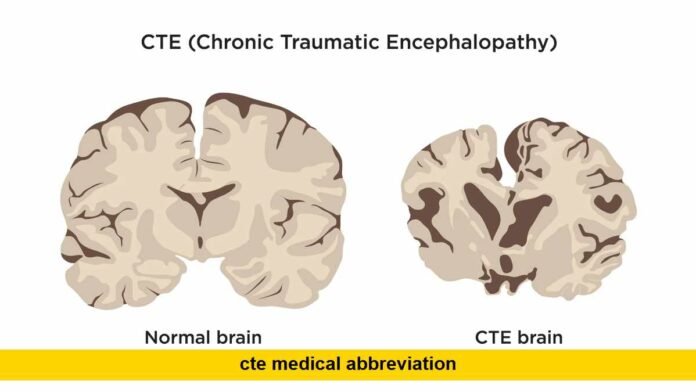

The CTE medical abbreviation refers to chronic traumatic encephalopathy, a progressive neurological condition associated with repeated head impacts over time. The condition has become an important subject in medical research and public discussion, particularly because of concerns about long-term brain health among athletes, military personnel, and others who may experience repetitive head trauma. Although scientists have learned more about CTE in recent years, questions remain about how it develops, why some people are affected, how symptoms relate to brain changes, and whether the disease can eventually be diagnosed during life.
CTE is often discussed alongside concussion, dementia, memory loss, depression, and other neurological problems. However, these conditions are not interchangeable. Understanding the differences is important for anyone researching brain injuries, evaluating health concerns, or trying to understand the medical information appearing in news coverage.
What Does CTE Stand for in Medical Terms?
CTE stands for chronic traumatic encephalopathy. Each part of the medical name describes an aspect of the condition:
- Chronic refers to a condition that develops or continues over an extended period.
- Traumatic relates to physical injury or trauma.
- Encephalopathy refers broadly to a disorder affecting the brain.
Chronic traumatic encephalopathy is associated with repeated head impacts and a characteristic pattern of abnormal tau protein accumulation in brain tissue. It is considered a neurodegenerative disease because the pathological changes involve processes that can affect the health and functioning of brain cells.
The condition has historically been studied in boxers and other athletes who experienced repeated blows to the head. Research has increasingly examined former football players, hockey players, rugby athletes, military personnel, and other populations with potential repetitive head-impact exposure.
CTE is not simply another name for a concussion. A concussion is a type of traumatic brain injury that may produce temporary neurological symptoms. CTE refers to a distinct pattern of brain pathology associated with repeated head impacts.
What Is Chronic Traumatic Encephalopathy?
Chronic traumatic encephalopathy is a brain disease associated with repeated exposure to head impacts over time. Neuropathologists examining donated brain tissue have identified abnormal tau protein deposits in a distinctive pattern associated with CTE.
Tau is a protein normally found in brain cells. Under healthy conditions, it helps maintain the internal structure of neurons. In certain neurological diseases, tau may become abnormal and accumulate in brain tissue. These changes can interfere with normal cellular processes and are associated with neurodegeneration.
In CTE, researchers have identified a particular distribution of abnormal tau-related pathology. This finding is important because it helps distinguish CTE from other neurological diseases that may also involve tau abnormalities.
Scientists continue to investigate the biological mechanisms behind CTE, including how repetitive impacts may contribute to changes in brain tissue, how pathological changes progress, and why people with similar exposure histories may experience different outcomes.
What Causes CTE?
Repeated head-impact exposure is the primary factor associated with CTE research. These impacts may occur during sports, military activities, accidents, or other circumstances involving repeated trauma to the head.
Researchers have studied people exposed to repeated impacts through activities such as:
- American football
- Boxing
- Rugby
- Ice hockey
- Other contact sports
- Military-related head-impact exposure
- Certain occupational or accident-related circumstances
Not every head impact causes a concussion. Some impacts may be classified as subconcussive because they do not produce the symptoms or clinical signs typically associated with a concussion. Researchers are investigating whether repeated exposure to these impacts may contribute to neurological changes over time.
The relationship between head impacts and CTE is complex. Scientists continue to examine the importance of exposure frequency, impact intensity, duration, age at exposure, individual biological differences, genetics, and other potential influences.
Having a history of concussion or participating in a contact sport does not automatically mean a person will develop CTE.
How CTE May Affect the Brain
The brain controls memory, concentration, language, emotional regulation, movement, decision-making, and many other functions. Neurological changes associated with CTE may affect different aspects of these abilities.
Research has focused on abnormal tau accumulation and its relationship to brain-cell dysfunction. Scientists are investigating whether the disease process may involve changes in the structure and function of neurons, communication between brain cells, and other biological mechanisms.
The exact progression of CTE remains under investigation. Researchers are working to determine how pathological changes develop, whether they progress at different rates among individuals, and how those changes may relate to symptoms during life.
CTE Symptoms and Possible Warning Signs
CTE symptoms are an important area of research, but there is no single symptom pattern that reliably identifies the condition in a living person. Reported symptoms may involve cognition, behavior, emotions, sleep, and movement.
Cognitive Symptoms
Cognitive problems affect a person’s ability to think, remember, learn, organize, and process information. Reported difficulties may include:
- Memory problems
- Trouble concentrating
- Difficulty learning new information
- Slower thinking
- Confusion
- Challenges with planning and organization
- Problems with decision-making
- Difficulty completing familiar tasks
Research has examined cognitive performance in people whose brains were later found to have CTE pathology. Some studies have reported difficulties involving learning, memory, and executive functioning, particularly among individuals with more advanced pathological changes.
However, cognitive symptoms can also occur because of sleep disorders, depression, anxiety, medications, other neurological conditions, and previous traumatic brain injuries.
Behavioral and Emotional Changes
Some families and caregivers of people later found to have CTE have reported changes in personality, mood, or behavior.
Possible reported symptoms include:
- Irritability
- Depression
- Anxiety
- Emotional instability
- Impulsivity
- Anger-control difficulties
- Reduced motivation
- Changes in personality
- Behavioral problems
These changes may be difficult for individuals and their families to manage. Nevertheless, they are not specific to CTE. Mental-health conditions, chronic pain, sleep problems, substance-related issues, stress, and other medical conditions may produce similar symptoms.
Physical and Motor Symptoms
Some people experiencing neurological problems may also report movement-related difficulties. These can include balance problems, coordination difficulties, slowed movement, tremors, muscle stiffness, or changes in walking.
Physical symptoms are not necessarily caused by CTE. They may be related to other neurological diseases, previous injuries, medications, or medical conditions. A professional evaluation is important when symptoms persist or interfere with daily activities.
Who May Be at Risk of CTE?
CTE research has focused primarily on people who experienced repeated head impacts over an extended period.
Contact-Sport Athletes
Athletes in sports involving frequent collisions or head contact have been a major focus of research. Football, boxing, hockey, rugby, and other contact sports may involve repeated impacts during competition or training.
Participation in these sports does not mean an individual will develop CTE. Researchers are still working to understand individual risk and the relationship between exposure patterns and disease.
Former Professional Football Players
Former professional football players have received considerable attention in CTE studies. Researchers have examined donated brain tissue to investigate the prevalence of pathology, the relationship between pathological severity and symptoms, and possible risk factors.
Brain-donation studies have contributed important knowledge, although donated-brain research may not represent every athlete or person exposed to repetitive head impacts.
Boxers and Combat-Sport Participants
Boxers have historically been among the populations associated with long-term neurological effects of repeated head trauma. The historical term dementia pugilistica was used to describe certain neurological problems observed among some former boxers.
Research into chronic traumatic encephalopathy developed from investigations of repeated head trauma in boxing and has expanded to other sports and populations.
Military Personnel
Military personnel may experience head injuries or repeated head-impact exposure in training, accidents, or other circumstances. Researchers continue to investigate neurological symptoms and brain changes associated with military-related traumatic brain injuries.
The relationship between military exposure and CTE is complex because individuals may also experience sleep disturbances, psychological stress, other injuries, and medical conditions that can affect cognition and mood.
Is CTE the Same as a Concussion?
No. CTE and concussion are different conditions.
A concussion is generally classified as a mild traumatic brain injury. It may occur after a direct blow to the head or a force affecting the brain. Symptoms can include headache, dizziness, nausea, confusion, sensitivity to light or sound, and difficulty concentrating.
CTE is associated with repeated head impacts and a distinct pattern of abnormal tau accumulation in brain tissue.
Many people recover from concussions, although some experience prolonged symptoms. A concussion does not automatically lead to CTE, and the available evidence does not establish that every single concussion causes the disease.
The distinction is important because concussion symptoms may require medical attention even when there is no reason to conclude that CTE is present.
How Is CTE Diagnosed?
CTE currently cannot be definitively diagnosed in a living person using an established routine clinical test. Confirmed diagnosis requires examination of brain tissue after death.
Postmortem Examination
Neuropathologists use specialized techniques to examine brain tissue and identify the characteristic pattern of abnormal tau accumulation associated with CTE.
The examination may involve microscopic analysis, specialized staining, and assessment of the distribution of pathological changes. Researchers may also examine the brain for other neurological diseases that could contribute to symptoms.
Clinical Evaluation During Life
Although CTE cannot currently be confirmed during life, healthcare professionals can evaluate a person’s symptoms and medical history.
An evaluation may include a history of head injuries, neurological examination, cognitive testing, mental-health assessment, sleep evaluation, and brain imaging when appropriate.
Doctors may also investigate other conditions that could explain symptoms, including depression, anxiety, sleep disorders, medication effects, other traumatic brain injuries, and neurological diseases.
Traumatic Encephalopathy Syndrome
Traumatic encephalopathy syndrome, or TES, is a clinical framework developed for research involving people with histories of repetitive head impacts and certain symptoms.
TES is not the same as CTE. It does not establish that a person has the specific pathological changes associated with CTE. Symptoms and exposure history may support clinical investigation, but they cannot independently confirm the disease.
Latest Research Into CTE
Research continues to explore ways to better understand CTE and potentially identify it during life.
Scientists are investigating blood-based biomarkers that may provide information about tau-related changes or other neurological processes. Some early research has produced promising findings, but these approaches remain under investigation and are not established as routine diagnostic tests.
Researchers are also studying specialized brain-imaging techniques that may eventually help identify changes associated with CTE. Routine MRI scans cannot currently provide definitive confirmation of the condition.
Another important area involves examining how the severity of pathological changes relates to cognitive impairment, dementia, behavior, and everyday functioning. Studies have reported associations between more advanced CTE pathology and greater cognitive or functional problems, although outcomes vary among individuals.
These findings are helping researchers develop better questions and study designs. They do not mean that every person with CTE develops dementia or that symptoms can reliably predict the disease.
Is There a Treatment or Cure for CTE?
There is currently no established cure for CTE and no treatment proven to reverse its underlying pathological changes.
Medical care focuses on evaluating and managing symptoms. Depending on a person’s needs, treatment may address depression, anxiety, sleep problems, headaches, cognitive difficulties, pain, behavioral changes, or other medical conditions.
Because symptoms associated with CTE may have different causes, identifying potentially treatable conditions is an important part of care.
Researchers continue to investigate possible treatments, but experimental therapies should not be considered proven cures.
Can CTE Be Prevented?
There is no guaranteed way to prevent CTE, but reducing exposure to repeated head impacts is an important prevention strategy.
Sports organizations, schools, coaches, medical professionals, and athletes have increasingly focused on reducing unnecessary head contact, improving training techniques, following concussion protocols, and allowing appropriate recovery after injuries.
Protective equipment may help reduce certain injuries, but helmets cannot eliminate all forces affecting the brain during an impact.
Prevention efforts are especially important for children and adolescents, as researchers continue to investigate the long-term effects of repetitive head impacts during development.
CTE vs. Alzheimer’s Disease
CTE and Alzheimer’s disease are distinct neurological conditions, although both may involve cognitive decline.
Alzheimer’s disease is associated with amyloid plaques and tau-related changes. CTE is associated with a characteristic tau pathology linked to repeated head impacts.
Both conditions may affect memory and thinking, but they have different pathological features and risk factors. Some people may have more than one neurological condition at the same time, making accurate evaluation important.
Frequently Asked Questions About CTE
Can CTE cause memory loss?
Memory difficulties have been reported among individuals with CTE pathology, but memory loss can have many causes. Symptoms alone cannot establish a CTE diagnosis.
Does CTE always cause dementia?
No. More advanced CTE pathology has been associated with cognitive impairment and dementia in research, but not everyone with CTE necessarily develops dementia.
Can one concussion cause CTE?
A single concussion does not mean someone will develop CTE. The disease has primarily been associated with repetitive head-impact exposure, and researchers continue to study risk factors.
Can CTE be detected through an MRI?
Routine MRI scans cannot definitively diagnose CTE. Researchers are studying specialized imaging methods, but they are not currently established as diagnostic tests.
Is there a blood test for CTE?
Researchers are investigating blood-based biomarkers, but no established routine blood test currently confirms CTE in living people.
Can CTE occur without playing football?
CTE research includes people exposed to repeated head impacts through boxing, other contact sports, military-related circumstances, and other situations. Football is not the only area of research.
Can CTE be reversed?
There is currently no established treatment that reverses CTE pathology. Medical care focuses on symptoms, supportive treatment, and other potentially treatable conditions.
Final Thoughts
Chronic traumatic encephalopathy is a complex brain disease associated with repeated head impacts and abnormal tau protein accumulation. Research has improved understanding of its pathology, possible symptoms, risk factors, and relationship to cognitive impairment, but important questions remain.
Scientists continue to investigate diagnostic biomarkers, imaging techniques, disease progression, prevention, and potential treatments. Until reliable diagnostic methods become available for living patients, symptoms such as memory loss, depression, irritability, or cognitive difficulties should not automatically be attributed to CTE.
Anyone experiencing persistent neurological or behavioral changes after head injuries should seek medical evaluation. Understanding the condition, reducing repeated head-impact exposure, and supporting continued research remain important steps in protecting long-term brain health.
Share your thoughts or questions in the comments, and stay updated on the latest developments in brain health and neurological research.