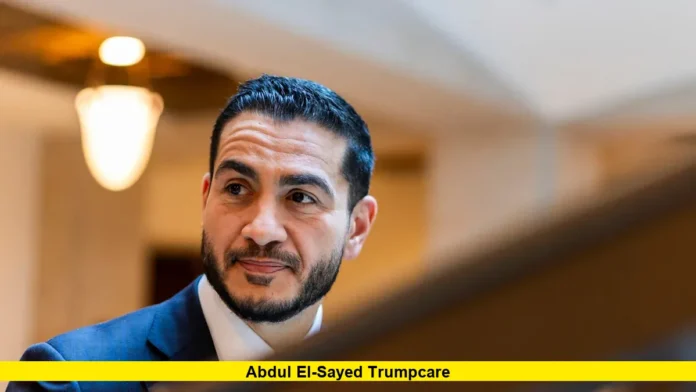

The Abdul El-Sayed TrumpCare proposal is drawing national attention after Michigan senator-elect Abdul El-Sayed offered President Donald Trump an unusual political deal: support universal healthcare, and the program could carry Trump’s name. The progressive Democrat is trying to turn the president’s interest in branding and political legacy into an opening for a major healthcare reform initiative that would guarantee coverage for Americans from birth through the end of life.
The idea is more than a provocative political slogan. El-Sayed is proposing a serious conversation about Medicare for All, universal healthcare coverage, healthcare affordability, and bipartisan cooperation at a time when Democrats are preparing to take control of Congress and healthcare remains one of the country’s most contentious policy issues.
Trump’s recent response to El-Sayed’s proposal has given the idea additional visibility, although the president has not endorsed the senator-elect’s universal healthcare plan. The question now is whether the attention can translate into a genuine policy discussion—or whether TrumpCare will remain an unconventional political pitch.
What Is Abdul El-Sayed’s TrumpCare Proposal?
Abdul El-Sayed’s TrumpCare proposal is essentially an offer to rebrand a progressive universal healthcare plan under President Donald Trump’s name if the president is willing to support legislation guaranteeing healthcare coverage to every American.
El-Sayed has repeatedly argued that the name of the program matters less than the outcome. His central objective is to establish a healthcare system that provides reliable coverage without leaving people vulnerable to unaffordable medical bills, insurance gaps, deductibles, copayments, or premiums.
The proposal is closely connected to Medicare for All, a progressive healthcare policy that would establish a broader publicly financed healthcare system for Americans.
El-Sayed’s political strategy is unusual because he is not approaching Trump primarily through criticism or opposition. Instead, he is attempting to appeal to the president’s interest in recognition, branding, and the opportunity to leave a lasting political legacy.
His message is straightforward: If Trump wants his name associated with a major achievement, guaranteeing healthcare for every American could become one of the most significant accomplishments of his presidency.
Why Abdul El-Sayed Is Calling It TrumpCare
El-Sayed’s suggestion reflects a deliberate political calculation.
Trump has frequently attached his name to buildings, businesses, projects, initiatives, and political accomplishments. El-Sayed has openly acknowledged this characteristic while suggesting that it could become an opportunity to advance a policy he has supported throughout his political career.
Rather than insisting that the program retain the name Medicare for All, El-Sayed has indicated that he would be willing to accept the name TrumpCare if the president helped make universal healthcare a reality.
The senator-elect has made clear that his priority is not the branding of the legislation. It is whether Americans would receive guaranteed healthcare coverage.
His approach represents a form of political pragmatism that may appear unusual coming from a progressive Democrat who has been sharply critical of Trump.
The strategy essentially asks whether political incentives can overcome ideological disagreements.
Trump Has Given the Proposal Unexpected Attention
The TrumpCare idea received a significant boost when Trump shared a screenshot of El-Sayed’s proposal on social media.
The original pitch included mock-up images of a gold healthcare card bearing the TrumpCare name. The imagery was designed to capture attention while making the political offer unmistakable.
Trump’s repost brought the proposal into the national conversation and gave El-Sayed an opportunity to argue that the president may be open to discussing healthcare cooperation with Democrats.
However, Trump’s repost should not be interpreted as an endorsement of Medicare for All or the TrumpCare proposal itself. Sharing the post amplified the message but did not establish that the president supports the proposed healthcare system or intends to work toward legislation.
That distinction is particularly important because the two politicians have substantial disagreements about healthcare policy.
Trump has historically opposed the Affordable Care Act and has advocated alternative approaches emphasizing private insurance, competition, prescription-drug costs, and changes to federal healthcare spending.
El-Sayed, meanwhile, wants a more fundamental restructuring of the American healthcare system.
What Would TrumpCare Actually Provide?
Although TrumpCare is currently a political proposal and not an enacted program, El-Sayed’s description points toward a universal healthcare model inspired by Medicare for All.
The broad goals include:
- Universal healthcare coverage for every American.
- Coverage that would not depend on employment status.
- Reduced financial barriers to receiving medical care.
- Greater protection against medical debt.
- Healthcare coverage from birth through the end of life.
- A system designed to reduce the burden of premiums, copayments, and deductibles.
- Greater public responsibility for financing and guaranteeing healthcare.
El-Sayed has described the vision as healthcare that follows people throughout their lives rather than being tied to an employer, private insurance plan, or changing eligibility requirements.
The details, however, remain a major part of the debate.
There is currently no finalized TrumpCare bill associated with El-Sayed’s proposal establishing eligibility rules, financing mechanisms, implementation timelines, reimbursement rates, or the future role of private insurers.
Those questions would need to be resolved through legislation before the proposal could become an actual healthcare program.
How TrumpCare Is Connected to Medicare for All
Medicare for All is the foundation of El-Sayed’s healthcare agenda.
The traditional Medicare program primarily serves Americans aged 65 and older and certain younger people with disabilities or qualifying conditions. Medicare for All proposals would significantly expand the federal government’s role in providing health insurance, potentially extending public coverage to the entire population.
El-Sayed has spent years advocating for healthcare reform and has written about the system’s problems, including high costs, fragmented coverage, medical debt, and the influence of corporations in healthcare.
His previous public policy work and congressional testimony demonstrate that his support for universal coverage predates the TrumpCare branding proposal.
Readers can learn more about the policy debate through the official Senate Budget Committee hearing on Medicare for All: Protecting Health, Saving Lives, Saving Money, which included testimony from El-Sayed.
The TrumpCare proposal therefore represents a new political strategy for advancing an existing healthcare policy goal rather than an entirely new healthcare concept.
Who Is Abdul El-Sayed?
Abdul El-Sayed is a Michigan Democrat, physician, epidemiologist, public health expert, and former government health administrator who won Michigan’s 2026 U.S. Senate election.
He is expected to take office in January 2027, becoming the first Muslim elected to the U.S. Senate.
His professional background has heavily influenced his political priorities. Before entering the Senate, El-Sayed held senior public health positions in Detroit and Wayne County, where he worked on healthcare access, environmental health, medical debt, and public health programs.
He has consistently argued that healthcare should be treated as a fundamental guarantee rather than a benefit available primarily through employment, private insurance, or individual financial resources.
El-Sayed’s healthcare advocacy also includes criticism of pharmaceutical companies, insurance corporations, healthcare costs, and the financial barriers patients face when seeking treatment.
His experience in public health is one reason Medicare for All has been central to his political identity.
Why El-Sayed Is Willing to Work With Trump
El-Sayed’s TrumpCare pitch reflects a broader argument that political disagreements should not automatically prevent cooperation when the two sides may be able to deliver something beneficial to the public.
The senator-elect has stated that he is willing to work with Trump when the president is serious about addressing issues affecting Americans.
His approach does not mean that he has abandoned progressive politics or changed his support for Medicare for All. Instead, he is arguing that political cooperation could potentially create opportunities to advance policies that would otherwise face significant opposition.
Healthcare is particularly important because the issue affects Americans across political, economic, and geographic boundaries.
People in Republican and Democratic states alike face rising medical costs, insurance premiums, deductibles, prescription-drug expenses, and concerns about access to care.
El-Sayed believes that the president’s influence over congressional Republicans could potentially make bipartisan healthcare legislation more achievable if Trump genuinely supports a major reform effort.
Trump’s Healthcare Agenda and the Differences Between the Two Approaches
Trump has also discussed healthcare reform and has promoted his administration’s healthcare priorities, including efforts involving prescription-drug prices and insurance affordability.
The administration’s healthcare agenda has included proposals aimed at lowering drug prices, changing how certain healthcare subsidies are distributed, and encouraging competition in the healthcare marketplace.
The administration’s broader healthcare policy priorities are outlined in official government materials, including the Department of Health and Human Services’ discussion of President Trump’s Great Healthcare Plan.
The differences between the two approaches are significant.
El-Sayed’s Medicare for All vision would substantially expand publicly financed healthcare coverage. Trump’s healthcare proposals have generally emphasized different mechanisms, including consumer choice, private insurance, competition, and reducing certain healthcare costs.
The two politicians may agree that Americans need more affordable healthcare, but agreement on the problem does not necessarily mean agreement on the solution.
For TrumpCare to become a serious legislative initiative, negotiations would need to address the fundamental differences between these approaches.
Would TrumpCare Eliminate Private Health Insurance?
This remains one of the most important unanswered questions.
Medicare for All proposals generally envision a substantially expanded public insurance system. Depending on the specific legislative design, private insurance could have a reduced role in providing coverage for services included in the public program.
El-Sayed has emphasized the guarantee of universal public coverage as the central feature of Medicare for All.
However, because the TrumpCare proposal has not been introduced as a finalized legislative bill, the exact treatment of private insurance has not been established.
Questions that would need to be answered include:
- Would Americans continue receiving employer-sponsored insurance?
- Would private insurers provide supplemental coverage?
- Would the federal government become the primary healthcare payer?
- How would hospitals, physicians, and other providers be reimbursed?
- What would happen to existing Medicare, Medicaid, and Affordable Care Act programs?
- How would healthcare financing change for employers and households?
These details would determine whether TrumpCare would represent a complete restructuring of the healthcare system or a more incremental expansion of public coverage.
How Would TrumpCare Be Paid For?
Financing is likely to become one of the most contentious parts of any universal healthcare proposal.
Medicare for All supporters argue that Americans already spend enormous amounts of money on healthcare through insurance premiums, employer contributions, taxes, deductibles, copayments, prescription medications, and other expenses.
They contend that a universal public system could reduce administrative waste, improve negotiating power, and redirect existing healthcare spending toward a more comprehensive coverage system.
Opponents, however, question whether a federal program covering the entire population could be financed without substantial tax increases, major changes to existing insurance arrangements, or significant pressure on federal spending.
A complete TrumpCare proposal would need to explain its financing structure and estimate its effects on households, employers, federal spending, healthcare providers, and the broader economy.
The financial details would be critical for determining whether the proposal could gain support beyond progressive Democrats.
Why the Proposal Could Become a Major Political Test
The TrumpCare proposal is emerging at a politically significant moment.
Democrats are preparing to take control of Congress in January, and lawmakers will face pressure to demonstrate that they can translate their electoral victories into legislation.
Healthcare is one of the issues that could potentially attract attention from both parties because Americans frequently identify affordability and access to medical care as major concerns.
El-Sayed’s strategy also reflects a broader political debate inside the Democratic Party about whether lawmakers should primarily confront Trump or seek opportunities to negotiate with him.
Some Democrats believe cooperation could produce practical policy results. Others argue that the party should focus on challenging the administration and advancing its own legislative agenda without relying on Trump’s support.
TrumpCare sits directly in the middle of that debate.
If the president genuinely engages with the proposal, it could become an example of an unusual bipartisan policy negotiation. If he does not, El-Sayed may still use the idea to highlight the differences between his healthcare agenda and the administration’s approach.
What the Proposal Could Mean for American Families
For American households, the most important question is not what the healthcare program would be called. It is how a new system would affect everyday healthcare costs and access to treatment.
A universal healthcare program could potentially offer greater financial security to people who lose their jobs, change employers, become self-employed, retire early, or experience major medical problems.
Supporters argue that guaranteed coverage could reduce the anxiety associated with losing health insurance and help prevent medical bills from creating long-term financial hardship.
The proposal could also become particularly relevant to families with children, people with chronic illnesses, workers in jobs that do not provide insurance, and individuals who currently purchase coverage through the Affordable Care Act marketplace.
However, the actual effects would depend on the final program’s coverage rules, funding structure, provider network arrangements, implementation timeline, and ability to maintain adequate healthcare capacity.
Americans who currently rely on Medicare, Medicaid, employer-sponsored coverage, or ACA marketplace insurance should not assume that the TrumpCare proposal will change their coverage. It remains a political proposal, not an enacted healthcare program.
For information about the current federal health insurance system, readers can review the official Medicare program information and the existing healthcare coverage options available through the federal government.
What Happens Next With Abdul El-Sayed TrumpCare?
The immediate next step is determining whether Trump’s attention to El-Sayed’s proposal develops into a substantive conversation.
El-Sayed has continued to express willingness to work with the president and other lawmakers on healthcare reform. His pitch is designed to make the proposal politically attractive to Trump while maintaining the underlying objective of universal healthcare.
Several developments will be worth watching:
- Whether Trump publicly comments on the substance of El-Sayed’s universal healthcare proposal.
- Whether the White House or administration officials engage in discussions with the senator-elect.
- Whether El-Sayed or other Democrats introduce legislation outlining a specific healthcare framework.
- Whether Republican lawmakers express support for any elements of universal coverage.
- Whether Democrats use their upcoming congressional majority to advance Medicare for All or a related healthcare reform proposal.
- How lawmakers address healthcare financing, private insurance, provider payments, and implementation.
At this stage, there is no confirmed TrumpCare legislation, no finalized implementation plan, and no official commitment from Trump to support El-Sayed’s Medicare for All proposal.
The idea has nevertheless attracted attention because it represents an attempt to use political branding and negotiation to bridge a major ideological divide.
The Bigger Picture
Abdul El-Sayed’s TrumpCare proposal illustrates how political strategy can sometimes become as important as policy itself. By offering to put Trump’s name on a universal healthcare program, the Michigan senator-elect is attempting to create an incentive for the president to consider a policy traditionally associated with progressive Democrats.
Whether the strategy succeeds remains uncertain. Universal healthcare would require substantial legislative negotiations, detailed financing plans, and potentially major changes to the existing American healthcare system.
But El-Sayed’s offer has placed a new question at the center of the healthcare debate: Could a president known for his branding ambitions become part of an effort to guarantee healthcare for every American?
The coming months will reveal whether TrumpCare becomes a serious bipartisan healthcare discussion or remains an ambitious political proposal that captured the president’s attention without producing legislation.
What do you think—could putting Trump’s name on universal healthcare help bring Republicans and Democrats together, or is TrumpCare unlikely to become a reality? Share your thoughts and stay tuned for the latest developments.