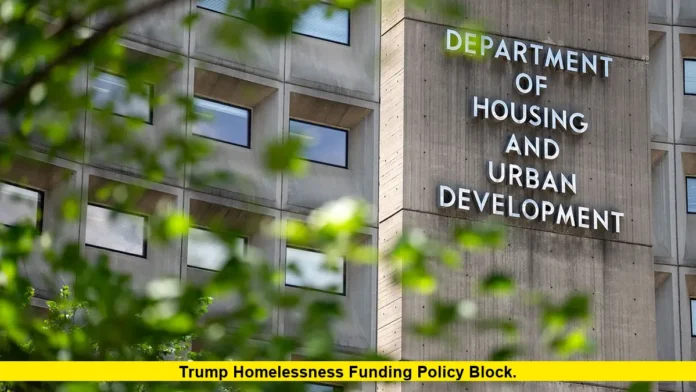

The Trump homelessness funding policy block is drawing renewed attention after a federal judge rejected the Trump administration’s latest attempt to overhaul federal homelessness funding, creating another major setback for the Department of Housing and Urban Development (HUD). The ruling comes amid a broader administration effort to redirect homelessness funding toward transitional housing, addiction treatment, behavioral health services, and policies emphasizing accountability and public safety.
The dispute centers on the federal Continuum of Care (CoC) program, a multibillion-dollar initiative that supports permanent housing, rental assistance, supportive services, and homelessness prevention programs nationwide. The Trump administration has sought to change how these funds are distributed, while housing advocates and several states argue that the proposed changes could threaten existing housing programs and leave vulnerable Americans without stable housing.
As the legal battle continues, communities across the United States are watching closely because federal homelessness grants support thousands of local programs serving families, veterans, people with disabilities, and individuals experiencing chronic homelessness.
The latest development is particularly significant: a federal court ruled on November 20, 2026, that HUD’s attempt to redirect funding under the Continuum of Care program exceeded its legal authority.
What Is the Trump Homelessness Funding Policy Block?
The Trump homelessness funding policy block refers to legal and political challenges surrounding the administration’s efforts to change federal funding rules for homelessness assistance programs.
The administration has proposed moving away from policies traditionally associated with Housing First, which prioritize getting people into stable housing without requiring them to complete treatment, maintain sobriety, or meet employment conditions before receiving housing assistance.
Instead, the administration wants federal funding to support a greater emphasis on:
- Transitional housing
- Addiction treatment and recovery services
- Mental health treatment
- Sober living arrangements
- Employment and self-sufficiency programs
- Public safety and law enforcement partnerships
- Greater accountability for federally funded organizations
However, the administration’s efforts to implement significant changes to HUD’s homelessness grant programs have encountered legal challenges, including rulings that restrict or reject portions of its funding overhaul.
Federal Judge Blocks Trump’s Latest Homelessness Funding Overhaul
The latest major development occurred on November 20, 2026, when a federal judge ruled that the Trump administration had unlawfully attempted to restructure the federal Continuum of Care homelessness program.
The court found that HUD exceeded its authority by directing a significant portion of federal homelessness funding toward transitional housing and supportive-service programs while changing criteria governing how grants are awarded.
The administration had proposed reserving approximately $1.3 billion from more than $4 billion in federal homelessness funding for transitional housing and supportive-service-only grants.
The judge concluded that the changes conflicted with statutory requirements governing the program, including provisions requiring HUD to evaluate existing projects and prioritize efforts to help people move into permanent housing.
The ruling also struck down certain restrictions involving activities aimed at drug users and a provision allowing HUD to disqualify applicants based on whether they sufficiently promoted self-sufficiency.
The court ordered HUD to allow applicants to amend and resubmit their applications through December 1, 2026, and directed the department to award grants by December 31, 2026.
The ruling represents another important legal setback for the administration’s attempt to reshape federal homelessness assistance.
Why the Continuum of Care Program Matters
The Continuum of Care program is one of the federal government’s principal funding mechanisms for addressing homelessness.
It supports communities through grants that can help finance:
- Permanent supportive housing
- Rental assistance
- Transitional housing
- Housing-focused services
- Case management
- Support for people with disabilities
- Services for homeless veterans
- Programs serving families and children
- Housing assistance for people experiencing chronic homelessness
The program operates through local and regional systems involving nonprofit organizations, state and local governments, housing providers, and community service agencies.
For many organizations, Continuum of Care funding is essential to maintaining housing programs and providing ongoing assistance to individuals who may have difficulty securing housing without long-term support.
A major change in how these grants are distributed could therefore affect local homelessness systems well beyond the federal level.
Trump Administration Wants to Move Away From Housing First
The Trump administration has criticized the Housing First approach, arguing that simply providing housing without addressing addiction, mental illness, or other underlying problems does not adequately solve homelessness.
Housing First generally prioritizes immediate access to permanent housing while offering supportive services on a voluntary basis.
The administration’s proposed alternative places greater emphasis on treatment, recovery, accountability, and public safety.
Under the administration’s policy direction, homelessness programs could place greater emphasis on connecting individuals with:
- Substance-use treatment
- Mental health services
- Recovery programs
- Transitional housing
- Employment assistance
- Supportive services designed to promote self-sufficiency
The administration argues that federal resources should be directed toward approaches that address the underlying causes of homelessness rather than maintaining programs that it believes may fail to produce lasting outcomes.
Housing advocates, however, argue that stable housing is often the foundation that makes treatment, employment, and recovery possible.
This disagreement is at the center of the broader federal homelessness funding debate.
Trump’s 2025 Executive Order on Homelessness
The administration’s homelessness funding policy is closely connected to Executive Order 14321, signed by President Donald Trump on July 24, 2025.
The order, titled Ending Crime and Disorder on America’s Streets, directed federal agencies to take steps toward changing how homelessness, public disorder, addiction, and mental illness are addressed.
Among its provisions, the order directed federal agencies to consider grant priorities for jurisdictions that enforce laws involving:
- Open illicit drug use
- Urban camping
- Loitering
- Squatting
- Public safety concerns involving individuals with serious mental illness or substance-use disorders
It also directed federal agencies to redirect resources toward treatment-oriented approaches and increase accountability within homelessness assistance programs.
The order specifically called for changes to policies supporting Housing First approaches when they were considered insufficiently focused on treatment, recovery, and self-sufficiency.
Read the official Trump executive order on homelessness and public disorder.
However, an executive order does not automatically authorize the administration to disregard funding laws passed by Congress. That legal distinction has become central to the ongoing court challenges.
Why the Trump Homelessness Funding Policy Is Facing Legal Challenges
The administration’s funding changes have faced opposition from states, local governments, housing organizations, and homelessness advocacy groups.
Critics argue that HUD cannot substantially change the structure of a congressionally authorized program simply by changing grant criteria or introducing new conditions.
The legal challenges have focused on several questions:
1. Does HUD have authority to redirect funding?
Congress established the Continuum of Care program and outlined requirements governing how funding should be allocated. Critics argue that HUD’s proposed changes conflict with those statutory requirements.
2. Can existing housing programs lose funding under new criteria?
Housing organizations are concerned that projects previously eligible for federal support could face new requirements or lose funding because of changes in the grant competition.
3. Can federal agencies impose new policy conditions on grant recipients?
The administration wants greater flexibility to prioritize treatment, recovery, law enforcement cooperation, and other policy objectives. Opponents argue that some of these conditions exceed the authority granted to federal agencies.
4. Can funding changes be implemented without additional rulemaking?
Courts have also examined whether major changes to federal funding criteria require formal administrative procedures and opportunities for public comment.
These legal issues could determine how much flexibility the administration ultimately has to restructure federal homelessness assistance.
Trump’s Homelessness Funding Block Grant Proposal
Another major element of the administration’s housing agenda involves restructuring homelessness assistance into a more targeted block-grant system.
The administration’s budget proposals have sought to consolidate certain homelessness programs under a modified Emergency Solutions Grants (ESG) block grant structure.
Under the proposed approach, funding would be distributed through a more consolidated system, potentially giving states and local governments greater flexibility in deciding how to use federal resources.
The proposal would significantly change the existing funding structure, which currently includes separate programs such as:
- Continuum of Care grants
- Emergency Solutions Grants
- Youth Homelessness Demonstration Program
- Permanent supportive housing initiatives
- Certain homelessness research and data programs
The administration’s budget proposals have sought to eliminate or restructure some of these programs while placing greater emphasis on targeted emergency assistance and transitional housing.
A block-grant structure could give local governments additional flexibility, but critics worry it could weaken dedicated funding streams for permanent supportive housing and specialized homelessness programs.
What Trump’s 2027 Budget Proposes for Homelessness Funding
The administration’s fiscal year 2027 budget proposal continues to reflect its effort to restructure federal homelessness assistance.
HUD’s budget request proposes approximately $4.024 billion for Homeless Assistance Grants, representing a reduction compared with the enacted funding level for fiscal year 2026.
The proposal would consolidate homelessness assistance into a revised Emergency Solutions Grants block-grant structure.
It also proposes eliminating or not funding certain existing programs, including:
- Continuum of Care funding as a separate program
- Construction of new permanent supportive housing
- Youth Homelessness Demonstration Program funding
- Certain homelessness data and research initiatives
The proposed structure would place greater emphasis on emergency shelter, transitional housing, supportive services, and treatment-oriented approaches.
However, the president’s budget is a proposal, not final congressional appropriations law. Congress controls federal spending and can reject, modify, or approve budget proposals through the appropriations process.
The administration’s proposed restructuring therefore should not be confused with an enacted nationwide funding change.
Congressional Funding Decisions Could Change the Outcome
Congress continues to play a critical role in determining the future of homelessness assistance.
The federal appropriations process determines how much money HUD receives and which programs receive funding.
Congressional lawmakers can maintain existing funding structures, increase funding, reduce funding, or approve a proposed restructuring.
A Senate appropriations recommendation released in November 2026 proposed $4.688 billion for Homeless Assistance Grants for fiscal year 2027, above the fiscal year 2026 enacted amount.
The Senate recommendation also rejected the administration’s proposed consolidation into a modified ESG block grant and included funding to support the Continuum of Care program, including renewal of existing projects.
That contrast illustrates the ongoing disagreement between the administration’s budget priorities and congressional appropriators.
Until final appropriations legislation is enacted, the future funding structure remains uncertain.
How the Policy Could Affect States and Cities
The Trump homelessness funding policy block could have different consequences depending on how local communities currently rely on federal grants.
Cities with large permanent supportive housing systems may be particularly affected if funding is redirected toward transitional housing or treatment-based programs.
Meanwhile, communities that already emphasize shelter, treatment, recovery, and temporary housing could potentially benefit from a funding structure that places greater priority on those approaches.
Potential effects could include:
California
California has a large network of homelessness programs, including permanent supportive housing, rental assistance, emergency shelter, and local homelessness initiatives.
Changes to federal grant priorities could affect local organizations that depend on Continuum of Care funding.
New York
New York City and other communities across the state rely on federal and local funding to support shelters, supportive housing, and services for people experiencing homelessness.
Changes to federal funding could affect how local agencies maintain existing housing programs and develop new initiatives.
Washington
Washington communities use federal grants to support emergency shelter, supportive housing, homelessness prevention, and services for people experiencing housing instability.
Changes in grant requirements could create uncertainty for nonprofit providers and local governments planning housing programs.
Texas
Texas communities operate a variety of homelessness initiatives, including emergency shelter, transitional housing, treatment programs, and housing assistance.
A shift toward treatment-oriented and transitional housing priorities could affect how federal funding is distributed among local programs.
Other states
The impact will vary nationally. Rural communities, large metropolitan areas, regions with high housing costs, and communities with limited shelter capacity may face different challenges under any new funding framework.
Could Homeless Americans Lose Housing Assistance?
One of the biggest concerns raised by housing advocates is whether changes in federal grant funding could threaten housing stability for people already receiving assistance.
The latest court ruling is important because it challenges the administration’s proposed changes to grant allocation criteria and requires HUD to reopen the application process under the court’s direction.
However, the ruling does not mean that every homelessness program nationwide has been permanently protected from future changes.
The outcome will depend on:
- The final federal grant awards
- HUD’s compliance with the court order
- Future court decisions
- Congressional appropriations
- Local funding arrangements
- Whether the administration appeals the ruling
- Whether additional policy changes are introduced
People currently receiving housing assistance should not assume that their benefits will automatically end because of the broader federal policy debate.
Individual program rules, funding sources, grant agreements, and local housing agency decisions remain important.
What Homelessness Assistance Is Still Available?
People experiencing homelessness or facing an immediate housing crisis should continue seeking assistance through existing local and federal resources.
Depending on their circumstances, available programs may include:
- Emergency shelters
- Rental assistance
- Housing Choice Vouchers
- Public housing
- Permanent supportive housing
- Transitional housing
- Domestic violence housing assistance
- Veteran housing programs
- Homelessness prevention services
- Local nonprofit housing assistance
For practical information about available assistance, readers can review this guide to where to get an emergency housing voucher online.
People who need shelter immediately can also contact local social-service agencies, call 211 in most U.S. communities, or contact their local homelessness service provider.
For additional information on shelter systems and homelessness resources, see where people experiencing homelessness can find shelter and housing support.
What Happens Next in the Trump Homelessness Funding Dispute?
The next several weeks could be particularly important for federal homelessness programs.
HUD must respond to the November 20 court ruling and follow the court’s instructions regarding grant applications and awards.
Key dates include:
- December 1, 2026: Deadline established by the court for applicants to amend and resubmit applications.
- December 31, 2026: Deadline established by the court for HUD to award grants.
- Future court proceedings: Additional litigation or an appeal could affect the administration’s ability to implement its proposed changes.
- Congressional appropriations: Lawmakers will continue determining the final funding structure for federal homelessness programs.
The administration could also seek further legal review, potentially extending the uncertainty surrounding federal homelessness policy.
Trump Homelessness Funding Policy Block: What Americans Should Know
The Trump administration is attempting to change the federal government’s approach to homelessness by prioritizing treatment, recovery, transitional housing, accountability, and public safety.
However, its efforts to restructure the Continuum of Care program have faced significant legal obstacles.
The November 20, 2026, ruling is a major development because it rejects the administration’s latest attempt to redirect billions of dollars in homelessness assistance and requires HUD to follow the court’s instructions for the current grant process.
The broader debate is not over. The administration’s budget proposals, congressional funding decisions, legal challenges, and future HUD policies will determine how homelessness assistance is distributed across the United States.
For people receiving assistance and organizations providing housing services, the most important issue is whether federal funding remains stable enough to support existing programs while communities continue responding to the nation’s homelessness crisis.
What do you think about the Trump administration’s proposed changes to homelessness funding—should federal programs prioritize permanent housing or treatment-focused approaches? Share your thoughts and stay tuned for the latest updates.