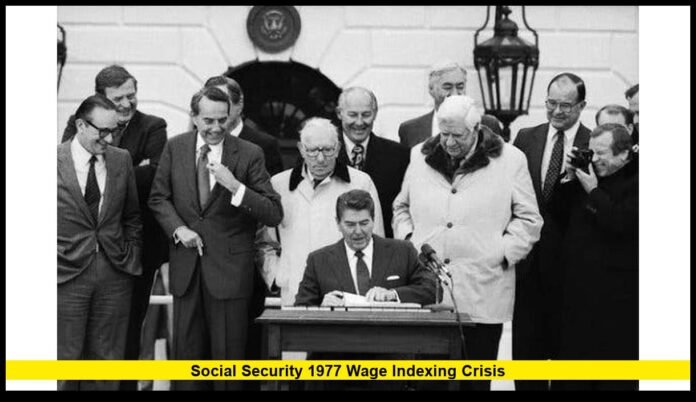

The Social Security 1977 wage indexing crisis was a major turning point in the history of America’s retirement system. During the 1970s, changes to Social Security’s benefit-adjustment rules created an unexpected problem that threatened the program’s long-term financial stability. A combination of inflation adjustments, wage growth, and flaws in the way initial retirement benefits were calculated led to concerns that future benefits could rise faster than the system’s revenue.
Congress ultimately responded with the Social Security Amendments of 1977, introducing a new approach to calculating retirement benefits and changing the way historical earnings were adjusted. The legislation was intended to correct the problem, improve the program’s financial outlook, and preserve Social Security’s role as a source of retirement income for millions of Americans.
The story of the 1977 crisis remains relevant because Social Security continues to face long-term financing questions, and the benefit-calculation framework established during that period still plays an important role in determining retirement payments today.
The Origins of the Social Security Indexing Problem
The roots of the crisis can be traced to the Social Security Amendments of 1972. Before that legislation, Congress generally approved benefit increases through separate legislative actions. The 1972 changes established automatic cost-of-living adjustments, making it possible for benefits to rise without Congress having to pass a new law every time inflation increased.
Automatic COLAs were designed to protect retirees from losing purchasing power. But the new mechanism interacted with the existing method of calculating initial benefits in ways that policymakers had not fully anticipated.
Under the old system, benefit amounts were determined using a benefit table. As average wages increased throughout the economy, the benefit table could be adjusted. Automatic inflation increases also affected benefit levels. This meant that both wage growth and price inflation could influence the benefits available to future retirees.
The combination created an unstable calculation system under certain economic conditions.
The Social Security Administration’s historical account explains that the earlier method could produce benefit increases that reflected both wage and price changes, leading to projected benefit levels that were higher than intended. This became a central reason Congress reconsidered the system in 1977.
How the Old Formula Could Produce Excessively High Benefits
The indexing problem was particularly complicated because wages and consumer prices do not necessarily increase at the same rate.
Wage growth reflects changes in earnings across the economy. Inflation reflects changes in the prices consumers pay for goods and services.
During periods when wage growth and inflation move differently, a formula that combines both influences can produce unexpected results.
The old benefit calculation structure was vulnerable to this interaction. The benefit table could be increased to reflect inflation, while rising earnings across the economy also affected the average earnings used to calculate the benefits of future retirees.
The result was a system in which benefit levels could grow faster than the relationship between workers’ earnings and retirement payments that lawmakers had originally intended.
Why the problem was especially concerning
Social Security benefits are paid over long periods. A change affecting the initial monthly benefit of a new retiree can influence total payments for many years.
If the initial benefit calculation rises too quickly across successive generations of retirees, the long-term cost of the program can increase substantially.
The financial projections available in the 1970s suggested that the existing formula could create benefit levels that were not adequately supported by the tax structure then in place.
This raised concerns about the program’s ability to meet future obligations.
Economic Conditions Made the Crisis Worse
The indexing problem occurred during a period of economic instability.
The United States experienced substantial inflation, unemployment, and periods of weak real wage growth during the 1970s. These conditions affected Social Security from both sides of the financial equation.
On the spending side, inflation-related benefit increases pushed payments higher.
On the revenue side, unemployment and weaker wage growth limited the growth of payroll tax collections.
Social Security is primarily financed through payroll taxes. When more people are employed and wages increase, tax revenue generally grows. When employment weakens or wage growth slows, revenue can become more difficult to sustain relative to program costs.
This combination of higher projected spending and slower revenue growth intensified the financial pressure facing the system.
The long-term outlook was also affected by demographic assumptions. Policymakers were concerned about future population trends, including the number of workers who would contribute payroll taxes compared with the number of people receiving benefits.
The crisis therefore involved more than a technical mistake in a formula. It reflected the interaction of policy design, economic conditions, and demographic expectations.
Why Congress Chose Wage Indexing in 1977
Congress had several possible approaches to correcting the problem.
One option was to make initial benefits grow more closely with prices rather than wages. Another was to redesign the benefit formula to prevent the combination of wage and price adjustments from producing excessive increases.
Ultimately, lawmakers adopted a revised approach that used wage indexing to adjust workers’ historical earnings and a separate formula to calculate initial benefits.
The Social Security Amendments of 1977 were signed into law by President Jimmy Carter on December 20, 1977.
The legislation was intended to address immediate financing concerns while also reducing the long-term financial imbalance.
It changed the method used to determine initial retirement benefits for people becoming eligible under the new rules. Rather than relying on the previous benefit table, the revised system used a formula designed to maintain a more stable relationship between a worker’s lifetime earnings and retirement benefits.
The change became known as decoupling because it separated the influences of wage growth and inflation in the benefit-calculation process.
What Decoupling Changed
The new framework established two distinct stages in the Social Security benefit process.
First, historical earnings are adjusted for wage growth. This allows the system to account for changes in average wages across the economy during a worker’s career.
Second, the initial retirement benefit is calculated using a revised formula. The formula was designed to provide a more consistent relationship between a worker’s adjusted earnings and the benefit amount.
Third, after retirement, inflation adjustments help preserve purchasing power. Benefits can increase through COLAs when inflation rises.
This structure reduced the risk that the same economic changes would unintentionally increase initial benefits through multiple mechanisms.
The reforms did not eliminate wage indexing or inflation protection. Instead, they clarified the purpose of each mechanism.
How Social Security Wage Indexing Works Today
Wage indexing remains an important part of the Social Security retirement benefit calculation system.
A worker’s earnings from earlier years are generally adjusted to account for changes in average wages. This process helps ensure that earnings from decades earlier can be evaluated within the context of the modern economy.
For example, a salary earned in the 1980s cannot be directly compared with a salary earned today without accounting for the broader change in wage levels over time.
Social Security’s wage-indexing process helps address that difference.
The indexed earnings are used in calculating a worker’s Average Indexed Monthly Earnings (AIME). The AIME is then used to determine the worker’s Primary Insurance Amount (PIA), which is the basic benefit amount associated with full retirement age before adjustments for early or delayed claiming.
The formula also uses bend points that separate different portions of a worker’s average indexed earnings.
The system generally applies a higher replacement percentage to the lower portion of earnings than to higher portions. This is one reason Social Security provides proportionally greater replacement of earnings for lower-paid workers.
Wage indexing therefore affects not only the dollar amount of a person’s retirement benefit but also how the benefit formula is structured for each new generation of eligible workers.
Wage Indexing Versus Cost-of-Living Adjustments
The terms wage indexing and COLA are often confused, but they are not interchangeable.
Wage indexing is used primarily when Social Security calculates a worker’s initial benefit.
Cost-of-living adjustments are generally applied to benefits after a person becomes eligible for payments and are intended to help protect purchasing power against inflation.
| Social Security Feature | Wage Indexing | COLA |
|---|---|---|
| Main purpose | Adjust historical earnings | Help offset inflation |
| Primarily affects | Initial benefit calculations | Existing benefits |
| Economic measure | Average wage growth | Consumer price inflation |
| When it applies | Before the benefit is calculated | After benefits are payable |
| Effect | Helps determine starting benefit | Adjusts ongoing payments |
A worker’s initial benefit can be affected by wage indexing, the earnings record, the benefit formula, and the age at which benefits are claimed.
After retirement, annual COLAs can change the monthly payment based on inflation measurements.
The Social Security Administration provides official information about annual inflation adjustments through its Cost-of-Living Adjustment information.
Who Was Affected by the 1977 Changes?
The legislation affected workers entering the benefit system under the revised rules, but Congress also recognized that people nearing retirement could be caught between the old and new systems.
The amendments therefore included transition provisions.
Certain individuals who reached age 62 during the transition years could have their benefits calculated under the earlier rules if the old calculation produced a higher benefit, subject to limitations.
These provisions were intended to prevent the change from creating an abrupt disadvantage for workers who had spent much of their careers under the previous formula.
Transition rules were important because Social Security reforms can affect people differently depending on their birth year, earnings history, retirement timing, and eligibility date.
A formula change that improves long-term financing may still create concerns for workers who are already close to retirement.
Congress had to consider the financial health of the program while also accounting for the expectations of people who had paid payroll taxes for decades.
Did the 1977 Amendments Permanently Fix Social Security?
The reforms significantly improved Social Security’s projected financial outlook at the time, but they did not permanently eliminate future financing problems.
The 1977 legislation was expected to help stabilize the system and improve its financial position over a long projection period.
However, the economic conditions that followed included inflation, high unemployment, and weaker-than-expected wage growth. These developments placed renewed pressure on Social Security’s finances.
By the early 1980s, policymakers again faced serious questions about the program’s ability to meet scheduled obligations.
Congress passed additional major reforms in 1983. Those changes addressed financing issues through a combination of tax-related provisions and benefit changes.
The sequence of reforms illustrates how Social Security’s long-term financial condition depends on multiple factors.
The benefit formula matters, but so do:
- Payroll tax revenue
- Employment levels
- Wage growth
- Inflation
- Population growth
- Life expectancy
- Retirement patterns
- The number of workers paying taxes
- The number of beneficiaries receiving payments
A reform can improve projected finances without guaranteeing that the system will remain financially balanced under every future economic or demographic scenario.
The 1977 Crisis and the Social Security Trust Funds Today
The historical wage-indexing crisis is different from the financing challenge facing Social Security in 2026.
The 1977 problem was strongly connected to the way benefit adjustments interacted with the old calculation formula. Today’s projected financing shortfall reflects a broader combination of demographic, economic, and program-related factors.
The latest 2026 Social Security Trustees Report projects that the Old-Age and Survivors Insurance (OASI) Trust Fund will be able to pay scheduled benefits in full until the fourth quarter of 2032. After reserves are depleted, continuing income would be sufficient to pay approximately 78% of scheduled OASI benefits under the Trustees’ intermediate assumptions.
The report also projects that the combined OASI and Disability Insurance trust funds, if considered together for illustrative purposes, would reach reserve depletion in 2034, with continuing income sufficient to cover approximately 83% of scheduled benefits at that time.
These are projections, not guaranteed future outcomes. The dates and percentages depend on the economic and demographic assumptions used by the Trustees and could change in future reports.
The important distinction is that trust fund reserve depletion would not mean Social Security stops receiving money or immediately disappears. Payroll taxes and other program income would continue to flow into the system. The projected concern is that those continuing revenues would not be enough to pay every benefit currently scheduled under law.
Why Today’s Financing Debate Is Different From the 1977 Crisis
Although both periods involve Social Security’s financial stability, the causes are not identical.
The 1970s problem involved benefit indexing
The interaction of inflation adjustments and the old benefit calculation formula produced unexpectedly high projected initial benefits.
Congress addressed this through a redesigned formula and wage indexing.
Today’s challenge involves a long-term financing gap
The current projections reflect a range of factors, including an aging population, changes in the worker-to-beneficiary ratio, longevity, employment, wages, and other economic assumptions.
The benefit formula established by the 1977 reforms remains part of today’s system, but the current financing debate is not simply a repeat of the earlier indexing mistake.
Congress has options, but no single solution is automatic
Possible approaches to improving Social Security’s financial outlook have included adjustments to payroll taxes, changes to the taxable earnings limit, changes to benefit formulas, adjustments to retirement-related provisions, and other financing measures.
Different proposals would affect workers, retirees, and taxpayers differently.
No future change should be treated as enacted law unless Congress passes legislation and the change becomes legally effective.
How Workers Can Understand the Impact of Wage Indexing on Their Retirement Benefits
The 1977 reforms are not just a historical subject. The wage-indexing system continues to affect how retirement benefits are calculated for today’s workers.
People approaching retirement should understand several important details.
Your earnings record matters
Social Security uses a worker’s covered earnings history to calculate retirement benefits.
Reviewing the earnings record can help identify missing wages or errors that could affect a future benefit calculation.
Your initial benefit is not determined by wage indexing alone
Wage indexing is only one component of the calculation.
The final retirement benefit can also depend on the number of years of earnings, the benefit formula, the worker’s age when claiming, and applicable adjustments.
Claiming early can reduce your monthly payment
Most eligible workers can begin claiming retirement benefits at age 62. However, claiming before full retirement age generally results in a lower monthly benefit.
Waiting beyond full retirement age can increase benefits through delayed retirement credits, subject to the applicable rules.
Inflation adjustments continue after retirement
COLAs are designed to help beneficiaries maintain purchasing power as prices rise.
However, the actual effect of inflation can vary from household to household because retirees may have different spending patterns, particularly for housing, health care, food, transportation, and other necessities.
Where to Find Official Social Security Information
Workers and retirees should rely on official information when reviewing their retirement benefits or following Social Security changes.
The Social Security Administration’s historical information explains how the 1977 reforms corrected the earlier indexing problem.
The agency’s official wage-indexing information is also useful for understanding how national wage growth is incorporated into Social Security calculations.
Readers can review the Social Security Average Wage Indexing Series for historical wage data.
For current program finances, the annual Trustees Report provides projections covering the trust funds, revenue, expenditures, and long-term financial outlook.
The official 2026 Social Security Trustees Report summary provides the latest published projections and explains the expected financial condition of the program under current-law assumptions.
These official resources can help readers distinguish between historical policy changes, current rules, proposed legislation, and future projections.
Frequently Asked Questions
Q1. What was the Social Security 1977 wage indexing crisis?
It was a financing and benefit-calculation problem that developed after the 1972 Social Security changes. The interaction between inflation adjustments and the existing method of calculating initial benefits created unexpectedly high projected benefits under certain economic conditions.
Q2. What caused the Social Security indexing problem?
The problem arose because the old system combined elements of wage growth and inflation adjustments when calculating benefits for future retirees. This interaction could produce increases that were greater than lawmakers had intended, contributing to projected financial shortfalls.
Q3. What did Congress do in 1977?
Congress passed the Social Security Amendments of 1977, which President Jimmy Carter signed on December 20, 1977. The legislation redesigned the initial benefit calculation system, introduced wage indexing into the revised framework, and made financing changes.
Q4. What does wage indexing mean for Social Security?
Wage indexing adjusts historical earnings to account for changes in average wages across the economy. It helps determine the earnings figures used to calculate a worker’s initial Social Security retirement benefit.
Q5. Did the 1977 reforms eliminate inflation adjustments?
No. The reforms changed how initial benefits were calculated but retained inflation-related adjustments for people receiving benefits. COLAs continue to help Social Security recipients respond to increases in consumer prices.
Why the 1977 Wage Indexing Crisis Remains an Important Lesson
The Social Security 1977 wage indexing crisis demonstrates how changes to a benefit formula can have consequences far beyond the original policy goal. Automatic inflation adjustments were intended to protect retirees, but their interaction with the existing formula created a financial problem that required congressional intervention.
The reforms adopted in 1977 established a different framework for calculating initial benefits, using wage indexing to adjust historical earnings and separating that process from inflation adjustments received after retirement.
That structure remains central to Social Security today. While the current program faces its own long-term financing challenges, the 1977 reforms continue to serve as an important example of how lawmakers have changed the retirement system in response to financial pressures.
What do you think Social Security policymakers should prioritize today—protecting scheduled benefits, strengthening program finances, or finding a balance between both? Share your thoughts and stay tuned for the latest Social Security developments.
While Social Security benefit calculations are an important part of retirement planning, beneficiaries and workers should also understand the basics of their Social Security documents. Learn more in our guide explaining whether Social Security cards expire.