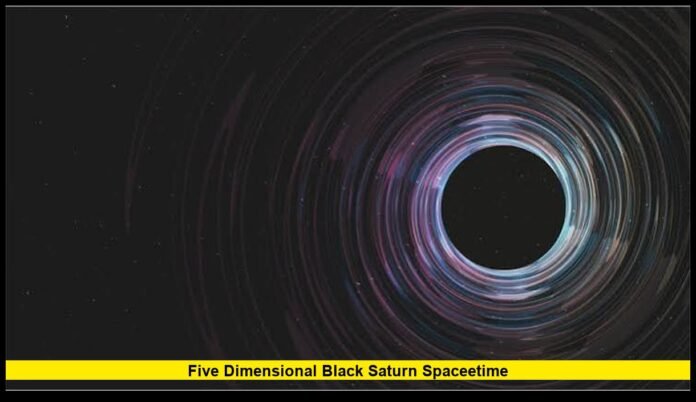

The concept of five dimensional black saturn spacetime is drawing renewed interest among theoretical physicists because it describes an extraordinary arrangement of two black holes existing within a higher-dimensional universe. The theoretical system features a central spherical black hole surrounded by a ring-shaped black hole, creating a gravitational structure unlike anything known to exist in our observable universe. New mathematical work examining this configuration allows both black holes to rotate in two independent planes, opening additional possibilities for understanding gravity, angular momentum, event horizons, and the behavior of spacetime beyond familiar dimensions.
The research is important not because astronomers have discovered a new object in space, but because it demonstrates how complicated black-hole physics can become when scientists investigate mathematical models involving additional spatial dimensions. The findings provide a framework for studying interactions between black holes, the limits of rotational motion, and the conditions under which unusual gravitational configurations may be mathematically possible.
What Is a Black Saturn in Theoretical Physics?
A Black Saturn is a theoretical gravitational system made up of two distinct black holes. One is a spherical black hole located at the center, while the other is a black ring surrounding the central object.
The name is inspired by Saturn, whose rings create a recognizable structure around the planet. However, the similarity is purely visual. A Black Saturn does not contain a planet, ordinary rings of ice, or a collection of rocks. Its surrounding structure is itself a black hole with an event horizon.
The central black hole and the surrounding black ring are separate gravitational objects. Each has its own horizon, mass, angular momentum, and geometric properties. Their relationship creates a complicated spacetime environment in which the gravitational effects of one object influence the other.
The arrangement is possible within certain mathematical descriptions of five-dimensional spacetime. In such a framework, gravity can support geometries that are unavailable or significantly restricted in the four-dimensional spacetime commonly used to describe our universe.
Why Scientists Consider Five-Dimensional Spacetime
Our everyday experience involves three spatial dimensions: length, width, and height. Time is treated as the fourth dimension in Einstein’s theory of relativity, producing the familiar four-dimensional spacetime framework.
Theoretical physics sometimes considers additional spatial dimensions to investigate whether the laws of nature could operate differently under a more complex geometric structure.
A five-dimensional spacetime model contains four spatial dimensions and one time dimension. This additional spatial direction changes the mathematical properties of gravitational systems, including the possible shapes of black-hole event horizons.
In four-dimensional spacetime, black holes are commonly associated with spherical or distorted spherical horizons. In higher dimensions, the mathematical possibilities become broader. Ring-shaped horizons can be supported by gravitational solutions that are not available in the same way in the conventional four-dimensional setting.
These higher-dimensional models are useful for testing the mathematical structure of general relativity and exploring how gravity might behave under conditions that cannot be directly reproduced in ordinary space.
The Central Black Hole and the Surrounding Ring
The Black Saturn configuration contains two components that have different geometric characteristics.
The central object is a spherical black hole. Its event horizon marks the boundary beyond which light and other signals cannot escape to distant observers.
The surrounding object is a black ring. Instead of having a spherical horizon, its horizon has a ring-like topology. In simplified visual terms, it resembles a donut-shaped structure, although its actual geometry is determined by the equations governing the higher-dimensional gravitational system.
The two objects exist within a shared spacetime. Their gravitational fields interact, meaning the system cannot be understood simply as two unrelated black holes positioned near each other.
The ring can influence the central black hole’s rotation and surrounding geometry. Likewise, the central object contributes to the gravitational environment in which the ring exists.
This mutual influence is one reason Black Saturn systems are mathematically challenging. Their properties depend on the parameters of both black holes and the relationship between their horizons.
New Mathematical Work Allows Rotation in Two Planes
One of the most notable developments in recent theoretical research is a mathematical description that allows the Black Saturn system to rotate in two independent planes.
In familiar three-dimensional space, rotation is usually described around a single axis. In a higher-dimensional setting, an object can have angular momentum associated with more than one independent plane of rotation.
This difference creates additional possibilities for black-hole behavior.
Earlier mathematical descriptions of Black Saturn configurations were more restricted in their rotational properties. The newer solution permits the central spherical black hole and surrounding ring to possess rotation in two independent planes, providing a more complete picture of their possible motion.
The ability to examine multiple rotational directions allows physicists to investigate how angular momentum is distributed throughout the system and how the two black holes affect each other’s gravitational geometry.
The research also creates opportunities to examine how different rotational parameters influence the shape and behavior of the event horizons.
Understanding Angular Momentum in Higher Dimensions
Angular momentum is one of the most important properties of a rotating black hole. It influences the structure of the surrounding spacetime, the shape of the event horizon, and the behavior of matter and light nearby.
In a higher-dimensional system, angular momentum becomes more complicated because rotation can occur in separate planes.
The central black hole may have rotational characteristics that differ from those of the surrounding ring. These differences can produce gravitational effects that are difficult to describe using the rotational behavior of an ordinary black hole.
The new Black Saturn solution allows researchers to explore a larger range of possible combinations of angular momentum.
This is important because the relationship between rotation and gravity is central to many questions in black-hole physics. Understanding how angular momentum behaves in higher dimensions could help scientists examine the limitations of existing models and identify new mathematical relationships.
How Frame Dragging Influences the Black Saturn System
Frame dragging is a phenomenon predicted by Einstein’s theory of general relativity. It occurs when a rotating massive object influences the surrounding spacetime, causing the geometry around it to be affected by its rotation.
The effect is associated with rotating black holes and other massive spinning objects. In a Black Saturn configuration, the influence of rotation becomes particularly complicated because both the central black hole and the ring can contribute to the spacetime geometry.
The surrounding black ring can affect the rotational properties of the central black hole’s horizon. This means that the central object may experience rotational effects in a plane even when it does not possess intrinsic angular momentum in that particular direction.
Such behavior illustrates the complexity of higher-dimensional gravitational systems. Rotation is not simply a property belonging to an individual object in isolation. The surrounding gravitational environment can also influence the way spacetime behaves.
Researchers studying Black Saturn solutions can use these mathematical relationships to explore how angular momentum, gravitational interaction, and horizon geometry are connected.
What Does It Mean for a Black Hole to Be Extremal?
The research also examines extremal black holes, which represent a theoretical limit of black-hole properties.
An extremal black hole reaches a maximum rotational state relative to its mass under the relevant mathematical conditions. In the case of rotating black holes, extremality represents a boundary between different possible configurations.
Extremal black holes have several unusual characteristics. In theoretical models, an extremal black hole can have a Hawking temperature of zero.
Hawking temperature is connected to quantum effects associated with a black hole’s event horizon. Although black holes are commonly thought of as objects from which nothing escapes, theoretical calculations predict that quantum processes can produce radiation associated with their horizons.
The temperature depends on the black hole’s physical characteristics. When a black hole reaches the extremal limit, its temperature can approach or reach zero in the mathematical description.
The new Black Saturn framework demonstrates that the central black hole and the surrounding ring can both reach extremality under certain conditions while maintaining separate horizons.
Two Black Holes Reaching Extremality at the Same Time
One particularly interesting aspect of the mathematical solution is the possibility of both black holes reaching the extremal state simultaneously.
The central spherical black hole and the surrounding ring-shaped black hole remain separate objects, but their physical parameters can be arranged so that both reach the extremal limit.
This creates a rare theoretical configuration involving two extremal black holes in a single higher-dimensional gravitational system.
The result is significant because extremal black holes are already considered unusual mathematical objects. Studying two such objects within the same spacetime provides additional opportunities to investigate gravitational interactions and the limits of black-hole rotation.
However, the system does not necessarily become fully balanced simply because both black holes are extremal.
The mathematical analysis indicates that complete equilibrium cannot be achieved in the doubly extremal configuration. The rotational properties of the two objects cannot satisfy all the required matching conditions in both independent planes while preserving the desired regular configuration.
This restriction demonstrates that the mathematical solution has boundaries. Not every combination of rotation, mass, and geometry is possible.
Why Complete Equilibrium Is Not Possible
Equilibrium is an important concept in gravitational physics. A system in equilibrium would remain in a balanced configuration without requiring changes in its relevant physical properties.
For a Black Saturn system, complete equilibrium would involve matching the rotational characteristics of the central black hole and the surrounding ring in both independent planes.
The new mathematical result shows that this condition cannot be fully satisfied in the doubly extremal configuration.
This does not mean the Black Saturn solution is mathematically invalid. Instead, it identifies a limitation within the configuration’s parameter space.
The result helps physicists understand how the geometry of higher-dimensional spacetime constrains the behavior of black holes. It also illustrates that the existence of a mathematical solution does not mean every possible physical condition can be imposed on it simultaneously.
Could a Black Saturn Exist in Our Universe?
At present, there is no observational evidence that Black Saturns exist in the universe.
The configuration depends on a five-dimensional spacetime framework, including an additional spatial dimension beyond the three dimensions of space that scientists observe in everyday life.
Although theoretical physics explores models involving extra dimensions, their existence in the form required by a Black Saturn system has not been established experimentally.
Astronomers have observed black holes through several methods, including their influence on nearby matter, gravitational waves produced during mergers, and images of regions surrounding black-hole event horizons. However, none of these observations has identified a spherical black hole surrounded by a separate black ring forming a Black Saturn.
The research therefore remains theoretical.
Its significance lies in demonstrating what the equations of gravity permit under a higher-dimensional mathematical framework—not in confirming that the configuration has been found somewhere in space.
Why Higher-Dimensional Black Holes Matter to Physics
The study of higher-dimensional black holes can help physicists investigate questions that extend beyond the behavior of ordinary black holes.
These mathematical models provide opportunities to explore:
- The possible shapes of event horizons in additional dimensions
- The limits of black-hole rotation
- How angular momentum can exist in multiple independent planes
- The relationship between gravitational fields and horizon geometry
- The effects of frame dragging in complicated systems
- The mathematical restrictions governing extremal black holes
- The possibility of different black-hole configurations within general relativity
Research into these subjects may help physicists better understand the structure of gravitational theories and identify areas where new mathematical or physical approaches are needed.
Higher-dimensional black-hole models can also provide testing grounds for ideas related to gravity, spacetime geometry, and the relationship between classical physics and quantum theory.
What Could Future Research Reveal?
The new mathematical framework could lead to additional studies examining the stability of Black Saturn configurations.
A mathematical solution may describe a possible arrangement of spacetime, but researchers must also investigate whether the system would remain stable when disturbed. Small changes in the system could potentially alter its configuration, affect its rotational properties, or cause it to evolve into a different state.
Scientists may also explore how light travels near the central black hole and surrounding ring, how gravitational lensing could behave, and whether the system would produce distinctive theoretical signatures.
Black-hole thermodynamics is another possible direction. The presence of two horizons introduces additional questions about temperature, entropy, angular momentum, and the relationship between separate gravitational objects within the same spacetime.
Further work may also examine how the Black Saturn configuration connects to other higher-dimensional black-hole solutions and whether different parameter choices produce recognizable limiting cases.
These investigations could help researchers build a more detailed understanding of the mathematical landscape of higher-dimensional gravity.
The Importance of Five Dimensional Black Saturn Spacetime
The study of five dimensional black saturn spacetime highlights how theoretical physics can reveal possibilities that are hidden within the mathematical structure of gravity. A spherical black hole surrounded by a separate ring-shaped black hole, with both objects rotating in two independent planes, represents a system that cannot be described using the simplest black-hole models.
The research also demonstrates that even highly unusual configurations have mathematical limitations. Both black holes may reach extremality under specific conditions, but the system cannot achieve complete equilibrium when the required rotational properties fail to match in both planes.
While the existence of extra spatial dimensions remains unconfirmed, research into higher-dimensional black holes continues to offer valuable insights into general relativity and the nature of spacetime.
The Black Saturn configuration is a reminder that the universe’s gravitational laws may allow mathematical structures far more complicated than the black holes currently observed by astronomers. Continued theoretical research may reveal additional properties of these systems and help physicists better understand the fundamental nature of gravity.
Key Points Summary
╔════════════════════════════════════════════════════════════════════╗
║ – A Black Saturn is a theoretical system consisting of a spherical black hole surrounded by a ring-shaped black hole. ║
║ – The configuration is described within a five-dimensional spacetime framework involving four spatial dimensions and one time dimension. ║
║ – New mathematical research allows both black holes to rotate in two independent planes. ║
║ – The central black hole and surrounding ring have separate event horizons and interact through their shared gravitational environment. ║
║ – Frame dragging allows the rotation of the ring to influence the rotational properties of the central black hole’s horizon. ║
║ – Both black holes can reach extremality under certain mathematical conditions while remaining separate objects. ║
║ – The doubly extremal configuration cannot achieve complete equilibrium because the rotational conditions cannot be matched in both planes. ║
║ – Black Saturns remain theoretical, and scientists have not discovered observational evidence confirming their existence. ║
║ – The research offers new opportunities for studying black-hole rotation, gravitational interaction, horizon geometry, and higher-dimensional gravity. ║
╚════════════════════════════════════════════════════════════════════╝
Frequently Asked Questions
What is a five-dimensional Black Saturn?
A five-dimensional Black Saturn is a theoretical gravitational configuration containing a central spherical black hole surrounded by a ring-shaped black hole. The system is described using a spacetime framework with four spatial dimensions and one time dimension.
Can a Black Saturn rotate in two directions?
The latest mathematical solution permits rotation in two independent planes. This is one of the important features of higher-dimensional spacetime because it allows more complicated rotational behavior than is possible in familiar three-dimensional space.
Are Black Saturns real astronomical objects?
There is currently no observational evidence that Black Saturns exist. They are mathematical solutions within higher-dimensional theoretical physics rather than confirmed astronomical discoveries.
What is the significance of extremality?
Extremality represents a theoretical limit of a black hole’s properties, including its rotational state. In the Black Saturn model, both the central black hole and the ring can reach extremality under certain conditions.
Why can’t the doubly extremal Black Saturn reach complete equilibrium?
The mathematical conditions required for complete equilibrium cannot be satisfied simultaneously in both independent rotational planes while maintaining the doubly extremal configuration.
What is frame dragging?
Frame dragging is the influence of a rotating massive object on nearby spacetime. In a Black Saturn system, the central black hole and the surrounding ring can both contribute to the rotational behavior of the surrounding spacetime.
Could higher-dimensional black holes reveal new secrets about gravity and the structure of the universe? Share your thoughts in the comments and stay tuned for more fascinating developments in theoretical physics and space science.