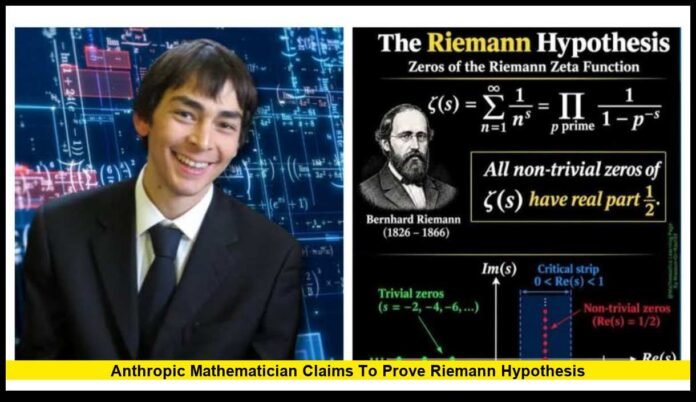

A new mathematical claim involving Anthropic and its artificial intelligence system Claude has drawn attention to one of the most difficult problems in mathematics. The Anthropic mathematician claims to prove Riemann hypothesis development centers on mathematician Levent Alpöge, who says AI-assisted research helped produce an argument that could resolve the famous conjecture about prime numbers.
If the claim is confirmed, it would represent an extraordinary achievement in both mathematics and artificial intelligence. The Riemann Hypothesis has resisted proof for more than a century and remains one of the most closely studied unsolved mathematical problems.
But the announcement should be approached carefully. A claimed solution is not the same as an accepted mathematical proof. Researchers still need to independently evaluate the argument, examine its formal verification and determine whether it establishes the hypothesis without gaps or unsupported assumptions.
The development has nevertheless generated interest because it raises a fundamental question: Could AI systems now be helping mathematicians solve problems that have resisted human researchers for generations?
A 167-Year-Old Mathematical Problem Is at the Center of the Announcement
The Riemann Hypothesis dates back to 1859, when Bernhard Riemann published work that connected the zeros of the zeta function with the distribution of prime numbers.
Prime numbers are numbers that cannot be evenly divided by any positive integer other than 1 and themselves. Although mathematicians have developed powerful techniques for studying primes, their distribution continues to reveal unexpected complexity.
The Riemann Hypothesis predicts that all nontrivial zeros of the Riemann zeta function have a real part equal to one-half. That statement may sound highly specialized, but it is closely connected to how accurately mathematicians can describe the distribution of primes.
The conjecture has become central to number theory because so many mathematical results depend on its truth or would become stronger if it were proved.
The Clay Mathematics Institute’s official Millennium Prize Problems page continues to list the Riemann Hypothesis among the problems awaiting an accepted solution. Its importance is reflected in the institute’s $1 million prize for a qualifying proof.
What Levent Alpöge Actually Claimed
Levent Alpöge published a short note on his personal website on November 20, 2026, stating that he believed he had discovered a proof of the Riemann Hypothesis while working with Claude.
The announcement also makes a broader claim: the method reportedly extends to the Generalized Riemann Hypothesis, involving Dirichlet L-functions.
Alpöge’s account describes a collaborative process in which he helped direct the mathematical work while Claude contributed important technical steps. He indicated that the AI made substantial progress during the final stage of the research.
The exact Claude model used has not been publicly identified in the announcement. Anthropic also had not issued an official statement confirming the result when the claim was first reported.
The original announcement and proof materials are available through Alpöge’s personal mathematical website.
Why the Proof Is Released as Lean Code Instead of a Traditional Paper
One of the most unusual aspects of the announcement is the format of the proposed proof.
Rather than releasing a conventional mathematical paper that explains every step in a readable sequence, Alpöge published a massive formalization written in Lean, a language designed for mathematical proof verification.
The formal material reportedly contains approximately 17 million lines of code distributed across a large archive. Alpöge also described the complete generated written explanation as exceeding 250,000 pages, making a traditional presentation impractical in its current form.
Lean is designed to allow a computer to check whether mathematical statements and their proofs follow the rules of a formal logical system.
This approach offers a potentially important advantage. Mathematical proofs can be extremely long and difficult to review, and formal verification can help identify logical gaps that might otherwise escape attention.
However, computer verification does not eliminate every question. Researchers must still examine whether the formal statements accurately represent the mathematical problem and whether the proof’s assumptions and logical structure are appropriate.
The challenge is therefore not only to verify that the code works but also to understand what the verified code establishes.
Independent Computer Checks Have Produced Encouraging Results
The claim has moved beyond a simple announcement, with outside researchers beginning to examine the formal proof.
MIT mathematician Andrew Sutherland published a verification page documenting several checks of the released Lean files. His reported results included:
- All 175,187 Lean modules compiled without errors.
- The five headline theorems relied only on Lean’s three standard axioms.
- A replay of the modules through Lean’s proof-checking kernel passed.
- Independently written proof-checking systems, including nanoda and con-leche, accepted the exported proof.
- Additional comparison and verification procedures remained underway in the reported verification snapshot.
These findings are important because they provide evidence that the formalized argument can be checked computationally rather than relying solely on the author’s own explanation.
The latest publicly reported verification status can be followed through MIT’s verification page for the Lean proof.
Still, there is a critical distinction between successful computer checks and acceptance by the mathematical community. A proof can pass formal verification while researchers continue to investigate the theorem’s formulation, interpret the mathematical result, examine its scope and develop an understandable explanation of the reasoning.
The checks are encouraging, but the scientific review process is not finished.
What Is the Generalized Riemann Hypothesis?
Alpöge’s claim reportedly goes beyond the original Riemann Hypothesis.
The Generalized Riemann Hypothesis, commonly abbreviated GRH, extends the original conjecture to a broader family of mathematical functions known as Dirichlet L-functions.
These functions are important in number theory and are connected to questions about prime numbers in different arithmetic settings. A proof of the generalized version could have implications beyond the original zeta-function problem.
However, readers should pay attention to the precise scope of the formalized result. In the released Lean project, the generalized hypothesis is described in relation to Dirichlet L-functions, rather than every possible broader interpretation of the generalized conjecture.
That distinction matters because headlines can make a mathematical result sound broader than the formal statement actually establishes.
If the current proof is ultimately accepted, its precise scope will be determined by the theorem statements and the mathematics they establish—not simply by the terminology used in the announcement.
Why Mathematicians Are Still Being Cautious
The Riemann Hypothesis is not an ordinary research problem. It has been examined by leading mathematicians for generations, and a claimed solution would require exceptionally careful review.
Experts need to determine whether the argument is mathematically sound, whether the formalized statements match the intended conjectures and whether the proof can be independently reproduced.
There is also a practical challenge: understanding the argument.
A formal proof containing millions of lines may be difficult for mathematicians to interpret as a conventional mathematical discovery. Computer verification can confirm that a formal proof follows logically, but researchers still need to understand the ideas behind the result and identify whether the approach provides new mathematical insight.
The Associated Press report on the announcement highlights the extraordinary nature of the claim while emphasizing that independent experts still need to assess the proof.
That is why the appropriate description at this stage is a claimed proof with substantial computer-checking progress, not an officially accepted solution.
Could the Riemann Hypothesis Claim Earn a $1 Million Prize?
The Riemann Hypothesis is one of the seven Millennium Prize Problems established by the Clay Mathematics Institute. Each problem carries a $1 million prize for an accepted solution.
But a public announcement alone does not qualify a researcher for the award.
The institute requires a proposed solution to satisfy its formal requirements, including publication in an appropriate mathematical journal and substantial scrutiny and acceptance by the mathematics community over time.
Even if the current Lean proof ultimately proves correct, the prize process could take considerably longer than the initial computer verification.
The mathematical community must first establish that the proof is correct, that the theorem has been stated and established properly, and that the result receives the necessary level of acceptance.
What This Could Mean for Artificial Intelligence Research
If the proof is eventually confirmed, it could become a landmark achievement in AI-assisted mathematics.
The claim is particularly significant because it suggests a possible shift in how difficult mathematical research is conducted. AI systems may increasingly assist researchers with tasks beyond calculations and literature searches, potentially helping develop new approaches, explore complicated mathematical structures and formalize arguments.
The collaboration also highlights the importance of human expertise. Alpöge reportedly helped guide the research, while Claude contributed substantial mathematical work. The announcement therefore does not establish that an AI independently solved the problem without human involvement.
Instead, it raises the possibility that human mathematicians and AI systems could work together to tackle problems that have resisted traditional approaches.
If this proof is validated, it could encourage researchers to explore similar collaborations across number theory, theoretical computer science, physics and other scientific disciplines.
What Happens Next?
The immediate priority is continued independent examination of the proof.
Researchers are expected to focus on completing verification procedures, reproducing the formal build, checking the theorem statements and developing a more understandable account of the mathematical argument.
The most important developments to watch include:
- Completion of the remaining independent verification procedures.
- Additional mathematicians examining the proof and its underlying ideas.
- A readable mathematical explanation or formal research paper.
- Confirmation of the precise scope of the claimed original and generalized results.
- Any formal recognition or response from the Clay Mathematics Institute.
Until these steps are completed, the Riemann Hypothesis should continue to be described as an unsolved problem with a major new proof claim under examination.
Frequently Asked Questions
Q1. Did an Anthropic mathematician prove the Riemann Hypothesis?
Levent Alpöge, a mathematician working at Anthropic, claims that he and Claude discovered a proof. The formal code has passed several reported computer checks, but the mathematical community has not officially accepted the result.
Q2. Who is Levent Alpöge?
Levent Alpöge is a mathematician associated with Anthropic who announced that he worked with Claude on the claimed proof. His announcement describes a collaboration involving human mathematical guidance and AI-generated contributions.
Q3. What AI was used in the claimed proof?
Alpöge identified Anthropic’s AI assistant Claude as his collaborator. The specific model version used in the research has not been publicly identified.
Q4. What is the Riemann Hypothesis?
It is a conjecture concerning the zeros of the Riemann zeta function and their connection to the distribution of prime numbers. It has remained unproved since 1859.
Q5. Has the Lean proof been checked?
Several computer-verification procedures have reportedly passed, including compilation of the large Lean project and acceptance by independently written proof-checking systems. Some additional checks were still underway in the publicly reported verification status, and human mathematical acceptance remains a separate process.
Q6. Does the claim include the Generalized Riemann Hypothesis?
Yes. Alpöge’s announcement claims that the method also establishes a generalized version involving Dirichlet L-functions. The precise mathematical scope of the formalized result remains important to the ongoing evaluation.
Q7. Is the $1 million prize already awarded?
No. The claim has not been officially accepted as a solution, and no Millennium Prize has been awarded for the Riemann Hypothesis.
An AI-assisted proof claim involving one of mathematics’ greatest mysteries has now entered serious verification, and the next phase could determine whether this is merely an extraordinary announcement or a historic mathematical breakthrough. What do you think about AI’s growing role in mathematical discovery? Share your thoughts and follow the latest developments.