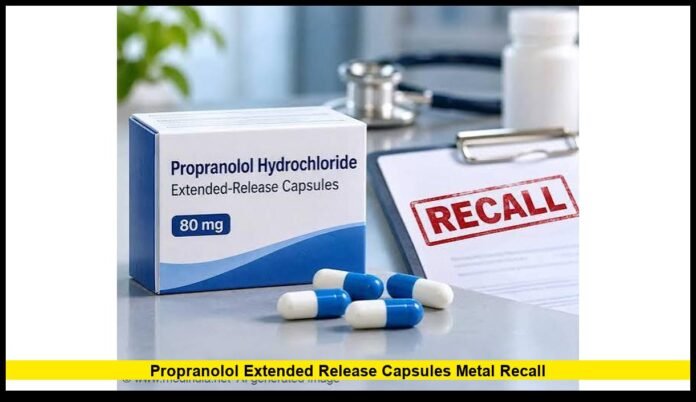

A medication recall can raise immediate concerns for patients who depend on prescription drugs to manage heart conditions, blood pressure, migraines, or other health problems. The Propranolol extended release capsules metal recall is a topic consumers should pay close attention to because recall notices involving prescription medications can affect product safety, availability, and decisions about whether to continue using a particular medication.
Patients who take propranolol extended-release capsules should understand the reason for the recall, which products and batches may be involved, how to determine whether their prescription is affected, and what steps to take before changing their medication routine. Patients should not abruptly stop taking propranolol without consulting a healthcare professional, because sudden discontinuation may cause serious health complications in some individuals.
What Is the Propranolol Extended Release Capsules Metal Recall?
The recall was announced by Breckenridge Pharmaceutical, Inc. on November 16, 2026, and involves one lot of Propranolol Hydrochloride Extended-Release Capsules, USP, 60 mg.
The company initiated a voluntary nationwide consumer-level recall after identifying a potential metal contamination concern associated with the affected lot. The medication was manufactured by Adare Pharma Solutions and distributed to wholesalers and pharmacies across the United States.
The concern is that the affected capsules may contain metal contamination capable of causing physical injury if swallowed. The company stated that the affected lot shared intermediate material suspected of being connected to metal contamination identified in another lot that was not released to the market.
The recall is limited to a specific lot rather than every propranolol extended-release medication on the market. Consumers should therefore carefully check the identifying information on their prescription bottles instead of assuming all propranolol products are affected.
Which Propranolol Product Is Being Recalled?
Patients should compare the information on their prescription packaging with the recall identification details below.
| Product information | Details |
|---|---|
| Medication | Propranolol Hydrochloride Extended-Release Capsules, USP |
| Strength | 60 mg |
| Manufacturer | Adare Pharma Solutions |
| Distributor | Breckenridge Pharmaceutical, Inc. |
| Package size | 100-count bottle |
| National Drug Code (NDC) | 51991-817-01 |
| Lot number | PK25110035 |
| Expiration date | May 2029 |
| Distribution period | October 26–November 4, 2026 |
| Distribution area | Nationwide, United States |
The lot number is the most important detail to check. A prescription bottle containing propranolol 60 mg is not automatically part of the recall. The specific recalled lot is identified by lot number PK25110035.
Patients who have transferred their prescription into another container, such as a pharmacy-labeled bottle, may not have the original lot number visible. In that situation, the pharmacy that dispensed the prescription should be able to review its records and determine whether the medication came from the recalled lot.
Why Was Propranolol Extended-Release Medication Recalled?
The recall was initiated because of the possibility that the affected capsules could contain metal contamination.
According to the company, the recalled lot shared intermediate material suspected of being the source of metal contamination discovered in a separate lot. That other lot was not released to the market.
The company is taking precautionary action because even small foreign metal fragments in a medication could create a physical injury risk when the product is swallowed.
Unlike recalls involving incorrect labeling, dosage errors, or insufficient medication potency, this recall centers on a potential physical contaminant.
The concern is that a person taking an affected capsule could unknowingly swallow material that may injure tissues inside the body. Because the contamination may not be visible to consumers, checking the lot number is more reliable than attempting to inspect the capsules individually.
The official recall announcement is available through the company’s recall notice.
What Health Risks Could Metal Contamination Cause?
The company warned that using capsules from the affected lot could potentially cause lacerations, or cuts, to soft tissues in the body.
The potential injury locations include:
- The oral cavity, or mouth
- The esophagus, which carries food and medication toward the stomach
- The stomach
- The intestine
The seriousness of an injury could depend on the nature and size of any contaminating material, where it travels through the digestive system, and whether it causes tissue damage.
Consumers should not assume that a capsule is safe simply because it looks normal. Potential metal contamination may not be detectable through routine visual inspection.
As of the recall announcement, Breckenridge Pharmaceutical said it was not aware of any adverse events assessed to be related to the recall. That statement means the company had not identified confirmed related adverse events at the time of its announcement. It does not eliminate the potential risk associated with the recalled lot.
Where Were the Recalled Capsules Distributed?
The affected medication was distributed nationwide to wholesalers and pharmacies between October 26 and November 4, 2026.
Because distribution covered the United States, the recall is not restricted to one state, city, pharmacy chain, or geographic region.
Patients in states across the country may need to check their medication supplies, including people who filled prescriptions at:
- Independent community pharmacies
- National pharmacy chains
- Retail pharmacies
- Pharmacies connected to grocery stores
- Other licensed prescription-dispensing locations
The company has instructed wholesalers, pharmacies, and other retail entities to inspect inventory for the affected lot, quarantine recalled products, and prevent them from being distributed or dispensed.
Consumers should contact their own pharmacy rather than rely on geographic information or assume that their local pharmacy was unaffected.
What Is Propranolol Used For?
Propranolol belongs to a class of medications known as beta-blockers. It works by blocking certain effects of adrenaline, which can reduce heart rate and lower blood pressure.
Depending on the formulation and the patient’s condition, propranolol may be prescribed for:
- High blood pressure
- Certain heart rhythm problems
- Angina, or chest pain related to coronary artery disease
- Migraine prevention
- Certain tremors
- Other medical conditions for which a healthcare provider determines beta-blocker treatment is appropriate
Extended-release capsules are designed to release medication over a longer period, allowing patients to follow a different dosing schedule than some immediate-release formulations.
People who depend on propranolol may have been taking it regularly for months or years. That is why a medication recall involving a specific lot requires careful coordination between patients, pharmacists, and healthcare providers.
Patients can learn more about the medication, its uses, precautions, and possible side effects through the National Library of Medicine’s MedlinePlus propranolol information.
What Should Patients Do If They Have the Recalled Medication?
Patients who discover that their medication matches the recalled lot should take the recall seriously and act promptly.
1. Check the prescription bottle
Look for the medication name, strength, NDC, lot number, and expiration date. The recalled product is specifically identified as 60 mg propranolol hydrochloride extended-release capsules with lot number PK25110035.
If the information is missing because the pharmacy transferred the medication into a different container, call the pharmacy and ask it to verify the lot number through its dispensing records.
2. Stop using capsules from the affected lot
Breckenridge Pharmaceutical advises consumers to immediately stop taking product from the recalled lot.
Do not continue taking the affected capsules simply because they appear normal or because no symptoms have occurred.
3. Contact your healthcare provider promptly
Because propranolol is a prescription medication that may be used to manage important cardiovascular conditions, patients should contact their prescribing clinician promptly for medical advice and replacement instructions.
The goal is to ensure that the recalled medication is not used while avoiding an unsafe interruption in treatment.
4. Contact the pharmacy for a replacement
Patients should contact the pharmacy where they obtained the medication to discuss replacement options. The pharmacy may be able to help identify an unaffected product, coordinate with the prescriber, and explain how to return the recalled capsules.
5. Return unused recalled medication
The company advises consumers to return any unused portion of the affected product to the pharmacy where it was obtained.
Patients should not redistribute recalled medication to friends, family members, or other individuals.
Why Patients Should Not Abruptly Stop Propranolol Without Medical Guidance
One of the most important issues surrounding this recall is that propranolol is not a medication that every patient can safely discontinue without planning.
Suddenly stopping beta-blocker treatment, particularly in patients who take propranolol for heart-related conditions, may cause problems such as worsening chest pain, changes in heart rate, or other cardiovascular complications.
This creates an important distinction for consumers:
- Do not continue taking capsules from the recalled lot.
- Do not ignore the recall notice.
- Contact your prescriber or pharmacist promptly to arrange replacement medication and receive instructions about your treatment.
Patients should not attempt to substitute another strength, formulation, or medication on their own. A healthcare professional can determine the appropriate replacement and explain whether any change in dosing or treatment schedule is needed.
If a patient has already taken capsules from the recalled lot, that does not automatically mean an injury has occurred. However, patients should contact a healthcare professional if they have concerns or develop symptoms that could indicate a problem.
What Symptoms Should Consumers Watch For?
The recall is based on the potential risk of physical injury from metal contamination. Patients who have taken medication from the affected lot should pay attention to symptoms that may warrant medical evaluation.
Potential warning signs of injury involving the digestive tract may include:
- New or persistent abdominal pain
- Pain or difficulty swallowing
- Unusual throat or chest discomfort
- Vomiting
- Blood in vomit
- Blood in stool
- Black or unusually dark stools
- Severe or worsening digestive symptoms
These symptoms can have many possible causes and are not proof that metal contamination caused an injury.
Severe abdominal pain, significant bleeding, difficulty breathing, fainting, or other serious symptoms require immediate medical attention. Patients experiencing a medical emergency should call 911 or seek emergency care.
People who have taken the affected capsules but feel well should still follow the company’s recall instructions and contact their healthcare provider for advice.
What Should Pharmacies and Healthcare Providers Do?
The recall also affects pharmacies, wholesalers, and other organizations that handle prescription medications.
The company has instructed these businesses to:
- Check inventories for the affected lot
- Identify bottles carrying lot number PK25110035
- Quarantine recalled products
- Stop distributing or dispensing affected medication
- Notify downstream customers and accounts when necessary
Pharmacies play an important role in helping patients identify potentially affected medication. If a consumer cannot determine whether their bottle is included, the pharmacy should be contacted directly.
Healthcare providers may also need to help patients transition to an unaffected supply, especially when propranolol is being used for a cardiovascular condition requiring continued treatment.
The recall’s nationwide distribution makes pharmacy-level verification particularly important because affected products may have entered different supply chains before reaching consumers.
How to Contact the Company About the Recall
Consumers with questions or concerns about the recall can contact Qualanex, the recall service provider designated by Breckenridge Pharmaceutical.
Recall contact information:
- Phone: 1-855-736-0807
- Email: recall@qualanex.com
- Hours: Monday through Friday, 9 a.m. to 5 p.m. Eastern Time
Patients should have their medication bottle and prescription information available when contacting the recall service provider or pharmacy.
How to Report a Possible Adverse Reaction
Consumers who believe they experienced an adverse reaction or medication-quality problem associated with the recalled product may report it to the U.S. Food and Drug Administration.
The FDA’s MedWatch program allows patients, caregivers, and healthcare professionals to report problems involving medications and medical products. Reporting can help regulators identify potential safety concerns and evaluate patterns involving products in the marketplace.
Consumers can submit a report through the FDA’s MedWatch adverse-event reporting program.
Patients should remember that filing a report does not replace seeking medical care. Anyone experiencing concerning symptoms should contact a healthcare professional promptly, while serious or life-threatening symptoms require emergency attention.
Will the Recall Affect Other Propranolol Products?
The current announcement identifies one specific lot of 60 mg propranolol hydrochloride extended-release capsules.
The recall does not automatically mean that:
- Every propranolol prescription is affected
- All 60 mg extended-release capsules are recalled
- Other strengths of propranolol are included
- Immediate-release propranolol is part of this recall
- Every pharmacy nationwide received the affected lot
Consumers should rely on the exact product and lot identification details rather than broad assumptions about the medication.
The scope of a recall can change if additional information becomes available. Patients, pharmacists, and healthcare providers should monitor official recall announcements and verify whether new lots or products are added.
The FDA maintains a public recalls, market withdrawals, and safety alerts page where consumers can review additional safety notices and recall information.
What Patients Should Watch for Next
The key developments consumers should monitor include whether the recall expands to additional lots, whether regulators issue further information about the contamination concern, and whether the company provides additional instructions for consumers or pharmacies.
At present, the recall announcement identifies one lot and describes a potential contamination risk associated with shared intermediate material. The company has said it is not aware of adverse events assessed to be related to the recall.
Patients should avoid relying on unverified social media posts or generalized claims about the entire propranolol supply. The product’s identifying information remains the most reliable way to determine whether a prescription is included.
For patients who use propranolol regularly, the most practical approach is to check the bottle, contact the pharmacy if the lot information is unclear, and arrange medical guidance for replacement medication if the product is affected.
Frequently Asked Questions
Q1. Is propranolol extended-release medication being recalled nationwide?
Yes. Breckenridge Pharmaceutical announced a voluntary nationwide consumer-level recall of one lot of 60 mg propranolol hydrochloride extended-release capsules because of potential metal contamination.
Q2. Which lot number is recalled?
The affected lot number is PK25110035. The bottles have NDC 51991-817-01 and an expiration date of May 2029.
Q3. Does the recall affect all propranolol medications?
No. The recall announcement identifies one specific lot of 60 mg extended-release capsules. Patients should check their product’s identifying information rather than assume every propranolol medication is affected.
Q4. What should I do if I already took the recalled capsules?
Contact your healthcare provider if you have concerns, particularly if you develop symptoms such as abdominal pain, swallowing difficulties, vomiting, or signs of bleeding. Seek emergency care for serious symptoms. Follow the recall instructions regarding stopping use of the affected lot and arranging replacement medication.
Q5. Can I return the recalled medication to my pharmacy?
Yes. Breckenridge advises consumers to return unused portions of the affected product to the pharmacy where they obtained it.
The Propranolol extended release capsules metal recall highlights why patients should routinely check prescription medication labels and take recall announcements seriously. Anyone with the affected lot should stop using the recalled capsules, contact their healthcare provider and pharmacy promptly, and arrange appropriate replacement medication rather than making changes to treatment without medical guidance.
Have you checked your prescription medication for the recalled lot number? Share your experience in the comments and stay informed about the latest U.S. medication safety updates.
For readers interested in other recent food safety and product recall developments, the USDA has also announced a biscuit recall involving CH Guenther products due to potential safety concerns. Read our coverage of the USDA CH Guenther Biscuit Recall for the latest details.