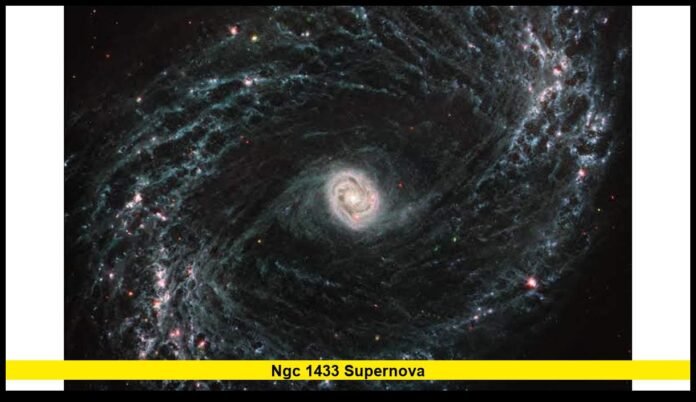

The NGC 1433 supernova is drawing attention from astronomers following the discovery of SN 2026ahvu, a Type Ia stellar explosion in the barred spiral galaxy NGC 1433. The event offers researchers an opportunity to observe a supernova during its developing stages, examine its changing brightness, and investigate the stellar environment that may have produced the explosion. Early observations have already helped classify the event, while continued telescope monitoring is expected to provide additional clues about its evolution.
SN 2026ahvu was detected in early November 2026, when astronomers identified a new source of light in NGC 1433. Follow-up observations confirmed that the object was a supernova rather than an ordinary variable star or another transient astronomical source. Researchers began tracking its brightness and collecting additional data while the explosion continued to evolve.
The discovery is attracting interest because Type Ia supernovae play an important role in astronomy. Scientists use them to investigate stellar evolution, study the physical processes associated with white dwarf stars, and help measure distances across the universe. An early detection can provide a valuable record of the explosion’s development, particularly during stages that may be difficult to examine when astronomers discover a supernova later.
The event also has several scientific questions attached to it, including its progenitor system, the distance to its host galaxy, and the possibility that the exploding star may have been associated with nearby young star clusters. Although researchers have identified interesting clues, several details remain unresolved.
What Is SN 2026ahvu and Why Is It Attracting Attention?
SN 2026ahvu is the official designation for the supernova discovered in NGC 1433. The event belongs to the Type Ia category, which involves the thermonuclear destruction of a white dwarf. Its discovery has attracted attention because astronomers detected it at an early stage and because the host galaxy is close enough, by astronomical standards, to allow detailed observations.
The discovery also creates an opportunity to examine questions that remain unresolved in supernova science. Researchers are interested in understanding what type of stellar system produced the explosion, how the star reached the conditions needed for a thermonuclear event, and whether the explosion can provide a more reliable estimate of the host galaxy’s distance.
The official designation
The name SN 2026ahvu follows the astronomical naming system used for supernova discoveries. The letters and numbers identify the event within the discovery year.
The designation helps researchers distinguish the supernova from other transient objects detected across the sky. Astronomers use the name in observation reports, telescope records, scientific papers, and data archives.
Before classification, the object was identified as a transient source. After researchers examined its spectrum and collected additional observations, they classified it as a Type Ia supernova.
A relatively nearby astronomical event
NGC 1433 is considered relatively nearby compared with many galaxies studied in deep-space astronomy. Its estimated distance is measured in tens of millions of light-years rather than billions.
This relative proximity matters because nearby supernovae appear brighter than otherwise similar events at greater distances. A brighter signal generally allows astronomers to collect more detailed information about the explosion.
SN 2026ahvu is therefore a useful target for studying the behavior of a Type Ia supernova during its early development.
Discovery of the NGC 1433 Supernova in November 2026
Astronomers discovered SN 2026ahvu on November 2, 2026, through the Asteroid Terrestrial-impact Last Alert System, known as ATLAS.
ATLAS regularly scans the sky for objects that move or change brightness. Although its primary purpose includes identifying potentially hazardous asteroids, the survey also detects astronomical events such as supernovae, variable stars, and other transient sources.
When ATLAS detected the new source in NGC 1433, astronomers recorded its brightness at approximately magnitude 17. The source was not visible in the survey’s preceding observation at a comparable detection threshold, indicating that it had appeared or brightened rapidly within a relatively short period.
The early detection helped astronomers begin monitoring the object before it reached its expected maximum brightness.
The initial brightness measurement
At discovery, the supernova was relatively faint. Its apparent magnitude was approximately 17, a level that generally requires astronomical imaging equipment or a telescope capable of detecting faint objects.
In the days following discovery, measurements indicated a substantial increase in brightness. Reports placed the object around magnitude 13.5 within days of its discovery.
Because the magnitude system is logarithmic, a change of several magnitudes represents a significant change in the amount of light reaching Earth. The supernova was therefore undergoing a noticeable brightening rather than a minor fluctuation.
Follow-up observations confirmed the classification
The initial discovery alone did not establish the object’s exact nature. Astronomers needed follow-up observations to determine whether the transient was a supernova and, if so, what type of explosion had occurred.
Spectroscopic observations provided the evidence needed for classification. Researchers examined the light from the object and identified characteristics consistent with a Type Ia supernova.
This classification was important because Type Ia explosions have distinctive physical properties and are used in several areas of astronomical research.
The confirmation allowed researchers to coordinate additional observations and investigate the event with more specialized instruments.
How Bright Is the Supernova Expected to Become?
SN 2026ahvu has been monitored as its brightness increases. Early observations showed that it was rising, and astronomers estimated that it could reach a maximum brightness during the November 18–23 period.
The expected peak brightness was estimated to fall within approximately magnitude 10.5 to 12.1. These numbers are predictions based on the developing observations rather than a guarantee of the final brightness.
Astronomers continue collecting measurements because the actual light curve may differ from the initial forecast.
Understanding astronomical magnitude
The magnitude system can be confusing because its numerical scale runs in the opposite direction from ordinary brightness ratings.
A smaller magnitude value indicates a brighter object. For example:
- An object at magnitude 10 appears brighter than one at magnitude 12.
- An object at magnitude 12 appears brighter than one at magnitude 15.
- An object at magnitude 17 is considerably fainter than one at magnitude 10.
This system allows astronomers to compare the brightness of stars, galaxies, planets, and transient events across a wide range.
The expected magnitude range for SN 2026ahvu places it within the reach of suitable amateur astronomical equipment under favorable observing conditions, although it is not expected to become visible to the naked eye.
Why the peak brightness matters
The maximum brightness provides important information about the supernova’s energy output and evolution. Astronomers can compare the observed peak with the expected characteristics of Type Ia explosions.
A well-measured light curve helps researchers determine how quickly the supernova brightens, when it reaches maximum light, and how rapidly it fades afterward.
Those measurements can also be used to compare SN 2026ahvu with other Type Ia supernovae. Differences in their brightness patterns may provide clues about their progenitor systems and the conditions under which the explosions occur.
For SN 2026ahvu, continued observations near its predicted peak are particularly valuable because they may help address the distance uncertainty surrounding NGC 1433.
NGC 1433: The Galaxy Hosting the Explosion
The supernova is located in NGC 1433, a barred spiral galaxy in the southern constellation Horologium. The galaxy has a recognizable structure featuring a central bar and spiral features extending around its central region.
NGC 1433 has been the subject of astronomical research for many years. Its structure, stellar populations, and surrounding environment make it an interesting target for observations using different types of telescopes.
The new supernova adds another layer to the study of the galaxy. Astronomers can now investigate a temporary explosion within its structure and compare observations from before and after the event.
What is a barred spiral galaxy?
A barred spiral galaxy contains a central elongated structure made up of stars. Spiral arms extend outward from the region surrounding the bar, creating the familiar spiral appearance seen in many galaxies.
The bar can influence the movement of gas and stars within the galaxy. It may also play a role in directing gas toward different regions, including areas where star formation occurs.
NGC 1433’s structure makes it visually distinctive in astronomical images. The newly detected supernova appears as a bright point of light within the galaxy’s visible surroundings.
The galaxy’s location in the southern sky
NGC 1433 is located in Horologium, a southern constellation. Its position is important for observers because the galaxy is easier to view from locations where the southern sky is accessible.
The constellation is not well positioned for many northern observers. People in southern regions generally have better opportunities to observe the galaxy, especially when it rises higher above the horizon.
This geographic difference affects professional observations as well. Several of the telescopes being used to study SN 2026ahvu are located in Chile, where astronomers can observe southern celestial objects more favorably.
How Far Away Is NGC 1433?
The distance to NGC 1433 is one of the important questions associated with the SN 2026ahvu discovery.
The galaxy is frequently described as being approximately 50 million light-years away. However, different astronomical measurements have produced estimates that vary significantly.
Some published measurements place NGC 1433 at approximately 9.1 megaparsecs, equivalent to about 30 million light-years. Other estimates suggest a distance closer to 18.9 megaparsecs, or approximately 62 million light-years.
These differences are not minor when astronomers calculate the intrinsic brightness of an object. A galaxy located farther away will appear dimmer than an otherwise similar galaxy at a closer distance.
Why distance measurements differ
Astronomers use several techniques to estimate the distances of galaxies. Each method has its own limitations, uncertainties, and observational requirements.
Different methods may rely on the properties of stars, the brightness of certain astronomical objects, or measurements associated with a galaxy’s structure and movement.
When measurements disagree, researchers may reexamine the underlying data, assumptions, and calibration methods. A new astronomical event can sometimes provide another opportunity to test existing distance estimates.
Could SN 2026ahvu help determine the distance?
Type Ia supernovae are particularly useful in distance research because astronomers can calibrate their luminosity and compare it with the observed brightness.
The difference between an object’s intrinsic brightness and the brightness observed from Earth provides information about its distance.
SN 2026ahvu could therefore help researchers examine the competing estimates for NGC 1433. However, the final distance determination depends on continued measurements, calibration, and analysis.
The supernova’s evolving light curve may provide useful evidence, but it does not automatically resolve the distance disagreement.
Why Type Ia Supernovae Are Different From Other Stellar Explosions
Supernovae are among the most energetic events in the universe, but they do not all occur through the same physical process.
Some supernovae happen when massive stars exhaust their nuclear fuel and their cores collapse. Other explosions involve white dwarfs undergoing thermonuclear destruction.
SN 2026ahvu belongs to the Type Ia category.
The white dwarf stage
A white dwarf is the dense remnant left behind after a star similar to the Sun has completed its normal evolution and shed much of its outer material.
White dwarfs are extremely compact. They contain a substantial amount of the original star’s mass within a volume comparable to that of Earth.
Although white dwarfs no longer sustain ordinary nuclear fusion in the same way as stars during their main sequence stage, they can remain hot and luminous for a long time as they gradually cool.
Under certain circumstances, a white dwarf may become part of a system that eventually produces a Type Ia supernova.
How a thermonuclear explosion can occur
One possible pathway involves a white dwarf interacting with a companion star. In a binary system, the white dwarf may pull material from another star.
If the conditions are suitable, material may accumulate on the white dwarf. The process can affect the star’s mass, temperature, and internal conditions.
Another proposed pathway involves two white dwarfs in a binary system. The stars may interact and eventually merge, potentially triggering an explosion.
Astronomers are still investigating the relative importance of these different pathways. The exact process responsible for an individual Type Ia supernova may not always be easy to identify.
Why SN 2026ahvu matters to this research
The early discovery of SN 2026ahvu gives astronomers a chance to examine the explosion while it is still evolving.
Researchers can study the light curve, spectrum, and surrounding environment to search for evidence that may distinguish between different progenitor scenarios.
The event is also close enough, compared with many distant supernovae, to allow detailed observations using several facilities.
The scientific value of the explosion therefore extends beyond its appearance. It could help researchers improve their understanding of the physical processes responsible for Type Ia supernovae.
New Images From Gemini South and the Dark Energy Camera
Astronomers have captured SN 2026ahvu using powerful observing facilities in Chile, including the Gemini South telescope and the Dark Energy Camera, known as DECam.
The images show the supernova against the background of NGC 1433, making it possible to examine its position within the galaxy.
The supernova appears as a bright point of light below and to the right of the galaxy’s central region in the released images.
The Gemini South telescope
Gemini South is a major astronomical telescope located in Chile. It is part of the International Gemini Observatory and supports research across a wide range of astronomical subjects.
Its observations of SN 2026ahvu provide a detailed view of the supernova and its surroundings.
High-quality imaging helps astronomers determine the object’s position and compare its appearance with other observations collected at different times.
The Dark Energy Camera
DECam is a powerful astronomical camera mounted on the Víctor M. Blanco 4-meter telescope at Cerro Tololo Inter-American Observatory in Chile.
The camera has been used for wide-field surveys that collect images of large areas of the sky. Its earlier observations of NGC 1433 provide useful records of the galaxy before the supernova appeared.
Researchers can compare older images with new observations to identify the changes caused by the explosion.
Why archival images are valuable
Astronomical events are often easier to understand when researchers can examine what the sky looked like before they occurred.
Older images can help scientists establish whether a source was previously visible, determine its location, and identify nearby objects.
In the case of SN 2026ahvu, archival images of NGC 1433 help astronomers compare the galaxy’s appearance before and after the explosion.
This information may contribute to research into the progenitor system and its surrounding environment.
The Possible Connection Between SN 2026ahvu and Young Star Clusters
One of the more interesting research developments involving SN 2026ahvu concerns its position near two young star clusters in NGC 1433.
Researchers examining archival observations from the Hubble Space Telescope and James Webb Space Telescope identified two ultraviolet-bright clusters close to the reported supernova position. Their analysis found that the explosion lies within a small angular distance of both clusters.
The clusters have estimated ages of approximately 37 million years and 95 million years in one set of measurements. Other analyses using different data combinations produced somewhat different age estimates.
The close positioning has attracted attention because it may provide a clue about the age and evolutionary history of the stellar system that produced the explosion.
Why the cluster proximity is interesting
Star clusters contain groups of stars that formed within a relatively connected environment. Studying their ages can help astronomers understand when the stars formed and how they have evolved.
If SN 2026ahvu is physically associated with one of the nearby clusters, researchers may be able to place limits on the time between the formation of the cluster and the supernova explosion.
That timescale could be particularly important for Type Ia supernova research. Some Type Ia explosions may occur relatively soon after their progenitor stars form, while others may take much longer.
A confirmed association with a young cluster could provide evidence for a relatively short evolutionary pathway.
The possibility of a prompt Type Ia supernova
Astronomers sometimes use the term “prompt” Type Ia supernova to describe an explosion that occurs relatively soon after the progenitor system’s original star formation.
If the supernova originated in one of the nearby clusters, the estimated cluster ages could suggest a delay time of less than approximately 100 million years.
That would make the event potentially important for understanding the earliest possible stages of Type Ia progenitor evolution.
However, the proposed association is not yet confirmed. Researchers must establish whether the supernova and the clusters are physically connected rather than simply appearing close together in the same region of the galaxy.
Why the finding must be treated cautiously
The possibility of a young-cluster association is scientifically interesting, but it remains a preliminary interpretation.
The apparent proximity does not by itself prove that the exploding star formed in either cluster. The supernova’s precise position, the properties of the clusters, and the distance to NGC 1433 all affect the interpretation.
The research has been presented in a preprint and is undergoing the scientific process. Until further evidence confirms the relationship, the cluster connection should be described as a possible association rather than an established fact.
What the Chandra X-Ray Observations Revealed
Another research investigation examined archival X-ray observations from the Chandra X-ray Observatory taken before the supernova occurred.
The researchers searched the earlier data for X-ray emission at the location where SN 2026ahvu later appeared.
The search did not identify detected X-ray photons at that position in the observations examined.
This finding is relevant because some proposed Type Ia progenitor systems may produce detectable X-ray emission before the explosion.
Why scientists searched for X-rays
In certain models, a white dwarf accumulates material from a companion star. The material may undergo hydrogen burning on the white dwarf’s surface under specific conditions.
A sufficiently hot and compact white dwarf in this type of system may produce supersoft X-ray emission.
If such emission were detected before the supernova, it could provide evidence supporting a particular progenitor configuration.
The archival Chandra observations gave researchers an opportunity to test whether a bright X-ray source was present before the explosion.
What the non-detection means
The absence of detected X-ray photons places constraints on certain progenitor models.
The analysis found that the observations could exclude a hot, compact white dwarf undergoing steady hydrogen burning under assumptions involving limited foreground absorption.
However, the result does not eliminate every possible single-white-dwarf progenitor scenario.
A cooler white dwarf, an expanded stellar atmosphere, or a system with more absorbing material could produce weaker or hidden X-ray emission that the earlier observations did not detect.
The X-ray non-detection therefore provides a scientific constraint rather than a definitive answer about the progenitor.
Could two white dwarfs have produced the explosion?
A double-white-dwarf system is one possible explanation for a Type Ia supernova.
In this scenario, two white dwarfs interact through their gravitational relationship. Depending on their masses, orbital evolution, and physical conditions, the system may eventually undergo a merger or another process that leads to a thermonuclear explosion.
The absence of the expected bright supersoft X-ray signal is compatible with some double-white-dwarf models.
However, the observations do not prove that two white dwarfs produced SN 2026ahvu. Other configurations remain possible, and additional observations may help distinguish between them.
How Astronomers Are Tracking the Explosion
The observation of SN 2026ahvu involves more than a single telescope image. Researchers are collecting multiple types of measurements to build a record of the explosion’s development.
Repeated observations are important because the supernova’s brightness, color, and spectrum change as the expanding material evolves.
Photometry and the light curve
Photometry measures the brightness of an astronomical object through selected filters.
For a supernova, astronomers collect brightness measurements over time and use them to construct a light curve. The light curve shows how the object brightens, reaches its maximum, and eventually fades.
The light curve of SN 2026ahvu can help researchers estimate the time of maximum brightness and compare the explosion with other Type Ia supernovae.
These measurements may also help evaluate the distance to NGC 1433.
Spectroscopy
Spectroscopy separates light into its component wavelengths. Astronomers can use the resulting spectrum to examine the chemical elements and physical conditions associated with the supernova.
The spectrum may reveal characteristic features associated with Type Ia explosions and help researchers understand how the expanding material changes over time.
As the supernova develops, different features may become more or less prominent. Continued spectroscopy therefore provides information that a single observation cannot offer.
Coordinated telescope observations
Observations from different facilities can complement each other.
Wide-field imaging can capture the galaxy and surrounding sky, while more detailed observations can focus on the supernova itself. Spectroscopic instruments provide information about the object’s physical properties, and archival observations help researchers understand the environment before the explosion.
The coordinated campaign involving facilities such as Gemini South, Blanco/DECam, and SOAR allows researchers to collect complementary data.
The combined observations may help build a more complete scientific record of SN 2026ahvu.
Can Amateur Astronomers Observe SN 2026ahvu?
SN 2026ahvu may be accessible to amateur astronomers using suitable telescopes, particularly from locations with favorable views of the southern sky.
Its predicted brightness is not sufficient for naked-eye visibility. However, the expected magnitude range may allow detection with small to moderately sized telescopes under good conditions.
The galaxy’s location in Horologium is an important consideration. Observers in the Southern Hemisphere generally have a better view of the constellation, while many northern observers may find the galaxy low on the horizon or difficult to observe.
What equipment may be needed?
A telescope with sufficient light-gathering capability may allow observers to detect the supernova. Imaging equipment can make the target easier to record, especially when astronomers use longer exposures and appropriate image-processing techniques.
Observing conditions also matter. Light pollution, atmospheric conditions, the height of the galaxy above the horizon, and the telescope’s capability can all affect the result.
Why the brightness forecast matters to observers
The supernova’s brightness is expected to change as it develops.
A brighter magnitude makes the object easier to detect, while a lower brightness can require more capable equipment and better observing conditions.
The predicted peak period can help observers plan, but the actual brightness curve may differ from the forecast. Astronomical observations remain the best way to determine how the event is progressing.
For observers who can access the southern sky, SN 2026ahvu offers an opportunity to follow a relatively nearby stellar explosion as it changes over time.
Why SN 2026ahvu Is Important for Cosmic Distance Research
Type Ia supernovae have an important role in astronomy because researchers can use them to estimate distances to galaxies.
Although these explosions vary, astronomers can calibrate their properties and compare their observed brightness with their intrinsic luminosity.
The process allows researchers to estimate how far away the host galaxy is.
The role of standard candles
A standard candle is an astronomical object whose intrinsic brightness can be estimated or calibrated.
When astronomers know how bright an object should be and measure how bright it appears from Earth, they can estimate its distance.
Type Ia supernovae are especially useful because their peak luminosities can be standardized using their light-curve characteristics.
This technique has helped astronomers measure distances beyond the range of methods that rely on nearby stars.
How a nearby supernova helps
A nearby supernova provides an opportunity to collect detailed observations with a strong signal.
Researchers can measure its brightness more precisely, study its spectrum, and compare the event with other supernovae.
The data may help improve the calibration of Type Ia supernovae and contribute to the broader cosmic distance scale.
SN 2026ahvu is particularly interesting because its host galaxy has competing distance estimates. A carefully measured supernova light curve may provide useful evidence for evaluating those estimates.
Latest Developments in the NGC 1433 Supernova
The latest developments surrounding SN 2026ahvu include several important findings and ongoing research efforts.
- Early discovery: ATLAS detected the transient on November 2, 2026.
- Confirmed classification: Follow-up observations identified it as a Type Ia supernova.
- Rapid brightening: Measurements indicated a substantial increase in brightness following discovery.
- Expected peak: Early forecasts placed the maximum brightness around November 18–23, although the actual timing and magnitude may change.
- New telescope images: Gemini South and DECam captured the supernova in NGC 1433.
- Distance research: Different measurements place the galaxy at substantially different distances.
- Possible star-cluster association: Research identified two young clusters near the explosion’s position, but their physical relationship with the supernova remains unconfirmed.
- X-ray investigation: Archival Chandra observations did not detect supersoft X-ray emission at the supernova’s position before the explosion.
- Continued monitoring: Astronomers are collecting photometric and spectroscopic observations to track the event’s development.
These developments illustrate how rapidly the scientific understanding of a newly discovered supernova can evolve. New observations may refine its brightness forecast, provide more information about its progenitor system, and help researchers evaluate the galaxy’s distance.
What Scientists Still Do Not Know
Despite the discovery and follow-up observations, several major questions remain unanswered.
Astronomers have not directly identified the progenitor star system. The possible association with young star clusters remains preliminary, and the X-ray observations do not eliminate every possible evolutionary pathway.
Researchers also need additional measurements to establish the supernova’s detailed light curve and compare its behavior with other Type Ia explosions.
The distance to NGC 1433 remains another important uncertainty. Different measurements suggest significantly different values, and the developing supernova may help researchers investigate the discrepancy.
The exact peak brightness and timing are also subject to change as astronomers collect more observations.
These unanswered questions are part of the scientific value of SN 2026ahvu. A new supernova does not provide every answer immediately, but continued monitoring can gradually reveal more about the event.
Final Thoughts
The NGC 1433 supernova SN 2026ahvu has become an interesting astronomical event because researchers detected it early, confirmed its Type Ia classification, and began observing its development before its expected peak brightness.
Its location in a relatively nearby galaxy gives astronomers an opportunity to collect detailed measurements of the explosion. The observations may help scientists examine how a white dwarf system reaches the conditions required for a thermonuclear explosion and how Type Ia supernovae evolve during their early stages.
The possible connection to young star clusters adds another scientific question. If future research confirms that the exploding star originated in one of the nearby clusters, it could provide valuable information about how quickly some Type Ia progenitor systems develop. However, the relationship has not been conclusively established.
The earlier Chandra observations also provide a useful constraint. The lack of detected supersoft X-rays challenges certain progenitor configurations under specific assumptions, but it does not rule out all possible explanations for the explosion.
Meanwhile, the developing brightness measurements could help astronomers investigate the distance to NGC 1433, which remains uncertain in published research. This makes SN 2026ahvu relevant not only to stellar evolution but also to the study of cosmic distances.
As the supernova continues evolving, astronomers are expected to collect more observations and refine their understanding of the event. Its scientific importance will depend on what researchers learn from the full record of its brightness, spectrum, environment, and possible progenitor system.
The discovery demonstrates how modern astronomical surveys can identify changing objects in the sky and quickly bring professional observatories together to investigate them. SN 2026ahvu is a reminder that even galaxies studied for decades can reveal new events that offer fresh opportunities to understand the universe.
FAQs
Q1. What is the NGC 1433 supernova called?
The supernova is officially designated SN 2026ahvu. Astronomers discovered it in the galaxy NGC 1433 in November 2026 and subsequently confirmed its Type Ia classification.
Q2. When was SN 2026ahvu discovered?
ATLAS discovered the object on November 2, 2026. Researchers then conducted follow-up observations to determine its classification and monitor its changing brightness.
Q3. What type of supernova is SN 2026ahvu?
SN 2026ahvu is a Type Ia supernova, a thermonuclear explosion involving a white dwarf star. Type Ia events are important for research into stellar evolution and cosmic distance measurements.
Q4. How far away is NGC 1433?
NGC 1433 is commonly described as approximately 50 million light-years away. However, published estimates vary, with some placing it around 30 million light-years and others closer to 60 million light-years.
Q5. When could the supernova reach its maximum brightness?
Early observations suggested that SN 2026ahvu could reach maximum brightness around November 18–23, 2026. This is an estimate, and the timing or brightness may change as additional observations become available.
What do you think about this newly discovered stellar explosion? Share your thoughts in the comments and stay tuned for the latest astronomy and space science updates.