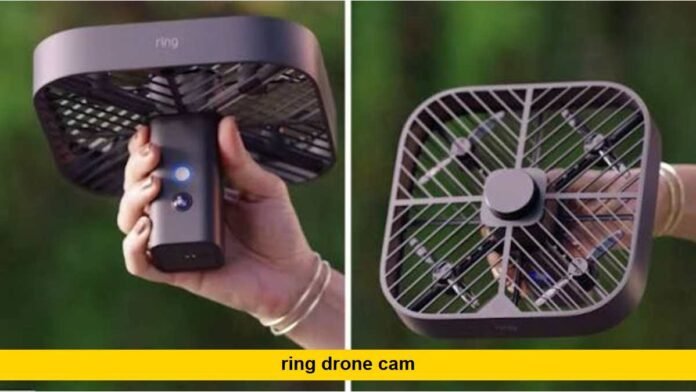

Amazon is taking home surveillance in a new direction with the ring drone cam, an autonomous indoor security device designed to fly around residential spaces and investigate potential security concerns. The new product, announced under Ring’s Ring Robotics initiative, aims to give homeowners a way to monitor multiple areas without installing a separate camera in every room. With a planned U.S. price of $249.99 and shipping expected in January 2027, the device is attracting attention across the smart home security market.
The launch marks an important development for Ring, which has spent years exploring the possibility of mobile indoor surveillance. Rather than relying entirely on fixed cameras, the company is introducing technology that can move through a home, follow customized routes, and respond to certain security alerts.
However, its unusual design also raises questions about privacy, battery performance, subscription costs, and whether consumers will find a flying camera practical for everyday security.
Amazon’s New Approach to Residential Security
The introduction of Ring Robotics represents a broader change in Amazon’s strategy for connected security products. Ring has traditionally focused on video doorbells, indoor cameras, outdoor surveillance equipment, and motion sensors.
Its latest initiative moves beyond stationary monitoring.
The new flying camera is designed to travel between selected locations inside a property. Homeowners can use the Ring application to direct it toward specific rooms or establish routes for monitoring designated areas.
It can also respond to certain alerts from compatible Ring security equipment by flying toward the location associated with the activity.
This approach could help homeowners investigate situations that would otherwise require manually checking multiple cameras or physically walking through their properties.
The product is particularly relevant for larger homes where a single stationary camera cannot provide sufficient visibility.
Price and Expected U.S. Availability
Amazon has announced a retail price of $249.99 for the new residential security device.
The planned U.S. shipping date is January 27, 2027. However, customers should understand that this is a scheduled launch date, not confirmation that unrestricted sales have begun.
An important regulatory condition remains outstanding. Amazon’s announcement states that the device has not received the Federal Communications Commission authorization required before it can legally be sold or leased.
Until that approval is obtained, the company cannot offer the product for commercial sale.
For now, interested consumers can look for availability announcements rather than assume that immediate purchasing is possible.
Amazon has not confirmed a wider international launch schedule.
How the Flying Security Camera Operates
The technology relies on autonomous navigation rather than requiring homeowners to control every movement manually.
During setup, the device maps the indoor environment and establishes locations that can be used for future monitoring.
Users can then select destinations through the Ring app. These may include hallways, living spaces, entrances, or other areas where additional visibility is useful.
Amazon’s AI Pilot system supports this process by combining cameras, specialized vision models, onboard sensors, and cloud processing.
The technology helps the device understand its surroundings, plan movement, and navigate around obstacles.
The result is a security camera that can travel to a selected location rather than remaining permanently attached to a wall or ceiling.
This capability could be particularly useful when homeowners receive an alert while away from their properties.
Camera Quality and Major Technical Features
Video quality is an important consideration for any home surveillance device.
The new flying camera offers 2K video with a 1920 x 1920 resolution. Its 148-degree field of view is designed to capture a broad view of indoor surroundings.
Additional features include:
- 2K video: Provides detailed images during monitoring.
- Wide viewing angle: Offers a 148-degree field of view.
- Autonomous navigation: Supports movement between mapped indoor locations.
- LED spotlights: Help illuminate darker spaces.
- Custom routes: Allow homeowners to choose monitoring locations.
- Connected security integration: Supports investigation of certain alerts from compatible Ring devices.
- Charging dock: Provides a dedicated home for the device when it is not operating.
Reported specifications also indicate a flight duration of up to eight minutes under controlled testing conditions. Actual battery performance can differ depending on operating conditions and usage.
The relatively short operating period means the product is intended for targeted inspections rather than uninterrupted aerial surveillance.
Privacy Becomes a Major Part of the Product Design
A flying camera inside a private residence naturally raises privacy concerns.
Unlike conventional surveillance equipment, a mobile camera can enter different rooms and change its viewing position. That makes recording controls especially important.
Ring says the camera switches off when it returns to its charging dock. Recording begins when a flight is triggered, and visible indicators help communicate its operating status.
Amazon has also announced Throw Away the Key encryption, known as TAKE, for video captured by its new Ring Robotics products.
The company describes this as its strongest default encryption approach for the devices.
Nevertheless, customers should examine the privacy settings, recording policies, account security requirements, and applicable subscription terms before introducing a connected camera into their homes.
Households should also consider the preferences of other residents and visitors who may be affected by indoor monitoring.
Why Ring’s Previous Flying Camera Concept Matters
Amazon’s latest announcement is significant because the company has been exploring this product category for years.
Ring first introduced its Always Home Cam concept in 2020. The original idea involved a camera that could leave a charging station and follow predefined routes around a residence.
The project attracted considerable attention, but bringing the concept to consumers presented engineering challenges.
Developing a small flying device requires balancing battery capacity, camera quality, navigation sensors, computing hardware, and physical weight.
The new product demonstrates that Ring is continuing to pursue autonomous residential surveillance with a different technical approach.
Its AI Pilot platform and connected processing capabilities are central to that effort.
The challenge now is proving that the technology can perform consistently in real homes rather than only in controlled demonstrations.
Ring Protect Subscription and Additional Costs
The purchase price is not the only expense prospective customers should consider.
Ring has indicated that a compatible Ring Protect subscription is required for certain advanced functions, including scheduled patrols and access to supported video-history services.
This means consumers should review the available subscription plans before deciding whether the product fits their budgets.
Someone interested primarily in occasional live monitoring may have different requirements from a homeowner who wants automated patrols and recorded footage.
The company has not made every subscription-related detail equally clear in its initial announcement, so buyers should verify the applicable plan requirements before purchasing.
How It Compares With Traditional Home Cameras
Traditional security cameras remain practical because they offer straightforward installation and continuous monitoring of a particular location.
A flying camera introduces a different advantage: mobility.
Instead of purchasing separate cameras for every room, homeowners may be able to use one device to inspect multiple mapped areas.
However, this does not mean the new technology will replace conventional surveillance equipment.
Fixed cameras can provide continuous coverage, while the flying device has limited operating time and does not include a microphone or speaker for audio recording and two-way communication.
For many households, combining mobile monitoring with strategically installed stationary cameras may offer a more comprehensive security arrangement.
Ring Robotics Also Introduces a Business Security Robot
The residential camera is not the only product in Amazon’s new robotics category.
Ring has also announced the Rover Cam, a wheeled security robot designed for commercial environments such as offices, stores, and warehouses.
Unlike the flying residential device, Rover moves across floors to patrol business premises and investigate disturbances.
It supports video streaming of up to 4K, an adjustable periscope camera, a siren, and a light tower.
Its announced U.S. price is $999.99, with shipping scheduled to begin December 16, 2026.
The two products demonstrate how Amazon intends to apply autonomous movement to different security environments.
One targets residential monitoring, while the other focuses on commercial property protection.
What Consumers Should Consider Before Buying
The technology may appeal to homeowners who want additional visibility across several rooms, but it is not necessarily suitable for every property.
Flight duration is one consideration. Eight minutes of operation may be enough for a quick inspection but could limit longer monitoring sessions.
Noise is another factor because flying propellers can be noticeable inside a quiet home. Pet owners should consider how animals might react to an unfamiliar moving device.
Subscription requirements, internet connectivity, regulatory approval, and the availability of the promised features also deserve attention.
Consumers should avoid treating the announced launch schedule as a guarantee until the FCC authorization requirement has been satisfied.
The Future of Mobile Home Security
The arrival of autonomous security devices could change how consumers think about residential surveillance.
For years, improving home security generally meant installing additional cameras, motion sensors, and alarms. Mobile robotics introduces another possibility: sending a connected device to investigate a particular location when something happens.
Whether this becomes a mainstream feature depends on affordability, reliability, privacy protections, and practical performance.
Amazon’s latest announcement places Ring among the companies exploring this emerging category.
For now, the product remains an upcoming U.S. release with a planned January 2027 shipping date and a $249.99 price.
Its eventual reception will depend on how effectively Ring translates an ambitious technological concept into a dependable household security product.