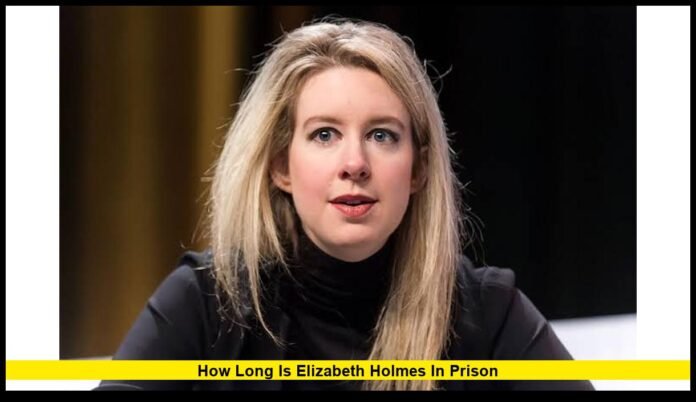

Elizabeth Holmes remains one of the most recognizable figures in America’s corporate fraud history, and public interest in her incarceration continues as new developments emerge. The question of how long is Elizabeth Holmes in prison has become particularly relevant following a federal court decision that shortened her original sentence and a reported plan to transfer her to a halfway house in 2027. The former Theranos CEO is serving a revised 10-year-and-three-month federal prison sentence, with her latest reported projected release date set for February 22, 2030.
Holmes began serving her sentence in May 2023 after being convicted of misleading investors about the capabilities of Theranos, the Silicon Valley medical technology company she founded. Although her conviction survived the appeals process, changes to federal sentencing guidelines gave her an opportunity to seek a shorter prison term.
Her expected transition to a halfway house has also attracted attention because it could give her greater freedom several years before her projected full release. However, this arrangement does not mean that her criminal sentence will be over.
Elizabeth Holmes Prison Sentence: The Latest Situation
Elizabeth Holmes was originally sentenced to 135 months in federal prison, equivalent to 11 years and three months. The sentence was imposed in November 2022 by U.S. District Judge Edward Davila in the Northern District of California.
In March 2026, the court approved a modification that reduced her prison term to 123 months, or 10 years and three months.
The reduction followed a request based on changes to the federal sentencing guidelines. Holmes argued that she qualified for a retroactive reduction because she had no previous criminal-history points and met the applicable eligibility requirements.
The court agreed to reduce her offense level and reconsidered the appropriate sentence under the revised guidelines.
The decision did not overturn her conviction or eliminate the consequences of the Theranos fraud. Instead, it changed the length of imprisonment she must serve.
Her latest reported projected release date is February 22, 2030. She is also scheduled to move to the Austin Transitional Center in Del Valle, Texas, on August 23, 2027.
These developments establish two important milestones in her remaining sentence: a planned halfway-house placement in 2027 and a projected full release in 2030.
When Did Elizabeth Holmes Start Serving Her Prison Sentence?
Elizabeth Holmes entered federal prison on May 30, 2023. She reported to Federal Prison Camp Bryan in Bryan, Texas, to begin serving the sentence imposed for her investor-fraud convictions.
Her sentencing took place several months earlier, on November 18, 2022. However, she did not immediately enter custody because the court had to address post-trial matters and the timing of her surrender.
Holmes had attempted to remain outside prison while challenging her conviction, but her efforts to delay incarceration were unsuccessful.
Her arrival at the Texas facility marked the beginning of her federal imprisonment.
As of November 15, 2026, she has spent approximately three years, five months, and 16 days in federal custody.
Her time served is only one part of the calculation. Federal sentencing rules, qualifying earned-time credits, and other administrative adjustments can affect the projected date on which an incarcerated person leaves federal custody.
Why Was Elizabeth Holmes Sentenced to Prison?
The criminal case against Holmes centered on Theranos, a healthcare technology startup that promised to change how medical testing was performed.
Founded in 2003, the company promoted technology that supposedly could conduct numerous laboratory tests using only a few drops of blood collected through a finger prick.
Holmes presented Theranos as a major innovation that could make testing faster, more convenient, and less expensive. The company attracted prominent investors and established business relationships with major organizations.
At its peak, Theranos was valued at approximately $9 billion.
However, investigations raised serious questions about whether the company’s technology could perform as advertised. Reports revealed that Theranos frequently relied on conventional laboratory equipment rather than exclusively using its proprietary testing systems.
Prosecutors argued that Holmes knowingly misrepresented the company’s technological capabilities, financial condition, and commercial relationships to attract investment.
The federal trial began in 2021 and lasted several months.
On January 3, 2022, a jury found Holmes guilty of three counts of wire fraud and one count of conspiracy to commit wire fraud involving investors.
She was acquitted of other charges, including several allegations involving patients.
The distinction is important because her prison sentence resulted from the investor-related fraud convictions rather than every allegation associated with Theranos.
Why Did the Court Reduce Elizabeth Holmes’ Sentence in 2026?
One of the most significant developments in the case occurred on March 26, 2026, when Judge Edward Davila granted Holmes’s motion for a sentence modification.
Her request relied on Amendment 821 to the United States Sentencing Guidelines, which introduced a retroactive reduction for certain qualifying defendants with no criminal-history points.
Holmes had no prior criminal-history points when she was originally sentenced. Her legal team argued that she met the requirements for the adjustment.
The government opposed the request.
Prosecutors argued that the substantial financial losses associated with Theranos made Holmes an inappropriate candidate for a reduction. They also raised concerns about the seriousness of her conduct and the absence of meaningful acceptance of responsibility.
Nevertheless, the court determined that she satisfied the relevant eligibility requirements.
The judge reduced her offense level from 33 to 31, changing the applicable sentencing range from 135–168 months to 108–135 months.
After considering the relevant sentencing factors, the court imposed a revised sentence of 123 months.
This represented a one-year reduction from her original 135-month prison term.
The judge made clear that the modification did not minimize the seriousness of the fraud or the damage caused to investors and the broader business community.
The decision was a sentencing adjustment, not an acquittal, pardon, or reversal of the original criminal judgment.
Elizabeth Holmes’ Expected Release Date: February 22, 2030
The latest reported projected release date for Holmes is February 22, 2030.
This date is earlier than the completion date of her original prison sentence because of the subsequent sentence modification and applicable federal time-credit calculations.
Her revised sentence is 123 months, but the amount of time an individual physically remains in a federal prison facility can differ from the headline sentence length.
Federal prisoners may qualify for good-conduct time and other credits under applicable laws and regulations. The First Step Act also provides eligible individuals opportunities to earn time credits through approved programs and productive activities.
The application of these provisions depends on individual eligibility and federal corrections calculations.
For Holmes, the reported February 2030 date represents the current projected full release milestone rather than a guarantee that no further administrative or legal changes will occur.
It is also important to distinguish a projected release date from a halfway-house transfer. The two dates describe different stages of the federal correctional process.
Elizabeth Holmes’ Planned 2027 Halfway-House Transfer
Another major development involves Holmes’s scheduled placement at the Austin Transitional Center in Del Valle, Texas.
According to reporting based on an update from the Department of Justice’s Victim Notification System, Holmes is scheduled to transfer to the facility on August 23, 2027.
The planned placement could give her more freedom than she currently has at Federal Prison Camp Bryan.
A halfway house is formally known as a Residential Reentry Center in the federal correctional system. These facilities help eligible individuals prepare for life outside prison while maintaining supervision and structured requirements.
Residents may receive opportunities to:
- Participate in employment and job-search activities.
- Attend approved educational and rehabilitation programs.
- Maintain approved contact with family members.
- Develop practical skills for independent living.
- Receive assistance with preparing for community reintegration.
The exact privileges and restrictions depend on the individual’s placement conditions and federal supervision requirements.
Holmes’s reported transfer is particularly significant because it would occur more than two years before her projected full release.
However, a halfway-house placement is not equivalent to completing a sentence. She would remain under federal custody and subject to the applicable restrictions.
Where Is Elizabeth Holmes Currently Incarcerated?
Holmes is serving her sentence at Federal Prison Camp Bryan in Bryan, Texas.
The institution is a minimum-security federal prison camp operated by the Federal Bureau of Prisons. It houses women serving federal sentences and generally has fewer physical security restrictions than higher-security correctional institutions.
Minimum-security facilities typically focus on structured routines, work assignments, rehabilitation, and preparing incarcerated individuals for eventual reintegration into society.
Holmes’s placement at the facility has attracted considerable attention because of her previous public profile as a prominent Silicon Valley entrepreneur.
Before her conviction, she was widely regarded as an influential figure in the technology and healthcare industries. Her black-turtleneck appearance, ambitious business presentations, and claims about transforming blood testing made her a recognizable personality.
Her incarceration represents a dramatic change from the public image she developed during Theranos’s rise.
Did Elizabeth Holmes Win Her Appeal?
Holmes challenged her conviction and sentence through the federal appeals process, but she did not succeed in overturning the criminal judgment.
On February 24, 2025, the Ninth Circuit Court of Appeals upheld her convictions, sentence, and the joint restitution order involving former Theranos executive Ramesh “Sunny” Balwani.
Holmes subsequently requested a rehearing, but the appeals court denied that request on May 8, 2025.
The unsuccessful appeal meant that her criminal convictions remained in place.
Her later sentence reduction came through a different legal mechanism. It was based on revised federal sentencing guidelines rather than a successful challenge to the evidence or the jury’s verdict.
This distinction explains why Holmes continues serving a federal sentence despite receiving a reduction in 2026.
How Much Money Must Elizabeth Holmes Pay in Restitution?
Her imprisonment is not the only financial consequence of the Theranos scandal.
Holmes and Balwani were ordered to share responsibility for approximately $452,047,268 in restitution to 12 victims.
The restitution order includes investors and organizations that suffered financial losses connected to the fraud.
Joint responsibility means that the defendants can each be held accountable for the court-ordered amount, subject to the rules governing collection and payments. It does not mean that each defendant automatically owes a separate $452 million payment.
The restitution obligation is separate from the prison sentence.
Consequently, completing incarceration does not automatically erase the financial judgment or eliminate any outstanding payment responsibilities.
The size of the restitution order reflects the enormous financial consequences associated with Theranos and remains one of the most significant elements of the case.
What Happens to Elizabeth Holmes After Her Prison Sentence?
Once Holmes completes her custodial sentence, she is expected to remain subject to supervised release.
Her original sentence included three years of supervised release following imprisonment.
Supervised release is different from incarceration. It allows an individual to live in the community while following conditions imposed by the court and monitored by the U.S. Probation Office.
Depending on the applicable conditions, these requirements may include:
- Regular meetings with a probation officer.
- Restrictions on certain types of travel.
- Compliance with employment and reporting requirements.
- Avoiding criminal activity.
- Following financial and other court-imposed obligations.
Holmes is expected to reside in Austin, Texas, after her release, with supervision handled by the U.S. Probation Office there, according to the reported notification information.
Her eventual return to ordinary community life will therefore involve more than simply leaving a correctional facility.
Has Elizabeth Holmes Requested Presidential Clemency?
Holmes has also pursued a separate route for potentially shortening her punishment.
In January 2026, reports revealed that she had asked President Donald Trump to commute her prison sentence.
A commutation can reduce an existing sentence or otherwise change the punishment imposed on an individual. It does not automatically erase the underlying conviction.
A clemency request is not the same as receiving presidential approval.
The reported request was pending when it became public. The March 2026 judicial sentence modification was separate from that process.
Unless an official clemency decision changes her circumstances, the February 22, 2030, projected release date remains the relevant reported date.
Final Outlook: Elizabeth Holmes’ Road Toward Release
Elizabeth Holmes’s incarceration has undergone several important developments since she entered federal prison in May 2023. Her original 11-year-and-three-month sentence was reduced to 10 years and three months in March 2026, and her latest reported projected full release date is February 22, 2030.
The planned August 2027 transfer to an Austin-area halfway house represents another important milestone. Although the move could provide greater flexibility and opportunities to prepare for life outside prison, it will not end her federal sentence.
Her conviction, restitution responsibilities, and upcoming supervised-release requirements remain central to the legal consequences of the Theranos scandal.
The case continues to raise important questions about corporate accountability, investor protection, medical technology claims, and the responsibilities of business leaders.
What are your thoughts on Elizabeth Holmes’ reduced sentence and upcoming halfway-house placement? Share your opinion in the comments and follow the latest developments surrounding the Theranos case.