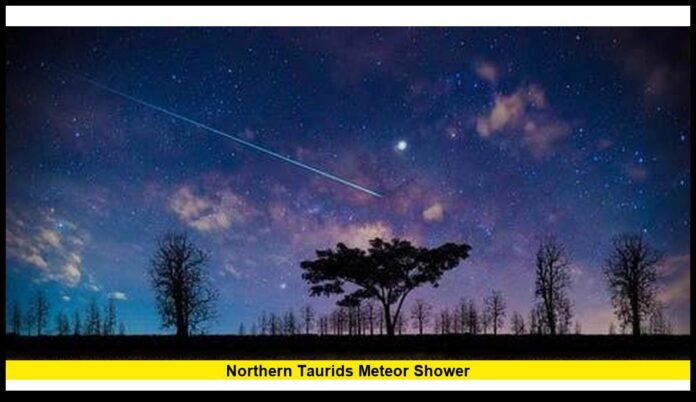

The Northern Taurids meteor shower is one of November’s notable astronomical events, offering skywatchers across the United States another chance to witness shooting stars and potentially spectacular fireballs. The 2026 shower is expected to reach its maximum activity around November 11–12, with favorable moonlight conditions creating an opportunity to observe meteors against a relatively dark night sky.
Unlike major meteor showers that produce dozens of visible meteors every hour, the Northern Taurids are known for their comparatively low activity. Under ideal conditions, observers can expect approximately five meteors per hour. However, the shower has a special reputation among astronomy enthusiasts because it occasionally produces exceptionally bright meteors that stand out even in less-than-perfect viewing conditions.
The 2026 peak is particularly interesting because it follows the November New Moon. With limited lunar illumination, observers have a better opportunity to see weaker meteor trails that might otherwise disappear in bright moonlight.
For people planning to watch from the United States, the most important considerations are finding a dark location, checking local weather conditions, and knowing when the constellation Taurus will be positioned favorably. Here is everything to understand about the Northern Taurids, including their peak, expected activity, visibility, fireball potential, and what happens after November’s main observing period.
Northern Taurids Meteor Shower 2026: At a Glance
The Northern Taurids follow an annual schedule, with their activity extending across several weeks.
Important details for the 2026 event include:
- Expected peak: November 11–12, 2026.
- Active dates: October 20 through December 10, 2026.
- Expected activity: Approximately five meteors per hour under ideal conditions.
- Best observing period: Late night through early morning.
- Radiant: Constellation Taurus.
- Best viewing direction: Generally toward the region surrounding Taurus, while keeping a wide view of the sky.
- Visibility: Across the Northern Hemisphere, including the United States.
- Moon conditions: Favorable around the predicted maximum.
- Special feature: Occasional bright fireballs.
- Equipment: Naked-eye observation is sufficient.
These numbers describe expected astronomical activity. They do not guarantee that every observer will see the same number of meteors.
When Will the Northern Taurids Meteor Shower Peak in 2026?
The Northern Taurids are expected to reach their annual maximum around November 11–12, 2026.
The strongest observing opportunity falls during the night of November 11 and continues into the early morning of November 12.
This period is important because the shower’s activity is expected to be strongest around its predicted maximum. Nevertheless, meteor activity does not begin or end at a specific minute.
Unlike a lunar eclipse, which has clearly defined stages, a meteor shower is an ongoing astronomical event. Individual meteors can appear at different times throughout the night.
The Northern Taurids also remain active for several weeks before and after the peak.
People who cannot observe on November 11 or November 12 can still look for activity during the remaining season, although the chances of seeing numerous meteors may decrease outside the maximum period.
Is the Northern Taurids Meteor Shower Visible Tonight?
Yes. November 12, 2026, is within the predicted peak window.
Skywatchers throughout the United States can search for Northern Taurid meteors if the weather provides clear skies.
The most useful observing period is generally after midnight, when Taurus is positioned higher in the sky.
However, people should not assume that a meteor will appear immediately after they begin watching.
The shower has a relatively low hourly rate, meaning patience is important. Spending 30 minutes or an hour observing the sky can provide a better opportunity than stepping outside briefly and expecting an immediate display.
The event also continues beyond the peak, so missing the main night does not mean missing the entire Northern Taurids season.
Why Are Moon Conditions Important for the 2026 Display?
Moonlight can significantly influence how many meteors people see during an annual meteor shower.
When the Moon is bright, its light spreads across the sky and reduces the contrast between faint meteors and the surrounding darkness.
The 2026 Northern Taurids peak occurs shortly after the New Moon on November 9.
Consequently, the Moon is expected to appear as a relatively thin crescent around the main observing period.
This is favorable for meteor watching because less lunar illumination means weaker shooting stars may be easier to distinguish.
However, good lunar conditions do not guarantee a spectacular display.
Clouds, humidity, atmospheric haze, and artificial lighting remain important factors. Someone observing from a brightly illuminated downtown location may still see fewer meteors than someone watching from a remote area.
For the best results, skywatchers should combine favorable moonlight conditions with a location that offers a genuinely dark view of the night sky.
What Time Should You Watch the Northern Taurids?
The best time to observe the Northern Taurids is generally during the late-night and early-morning hours.
The radiant is located in Taurus, and this region becomes more favorably positioned as the night progresses.
Around 1 a.m. local standard time is a useful reference for observing the radiant during the main November period.
A general viewing schedule is:
| Time | What to expect |
|---|---|
| 9 p.m.–10 p.m. | Early observing opportunities |
| 10 p.m.–Midnight | Taurus rises higher |
| Midnight–1 a.m. | Increasingly favorable conditions |
| 1 a.m.–3 a.m. | Recommended observing window |
| 3 a.m.–Dawn | Additional opportunities before daylight |
These are general guidelines rather than guaranteed peak times.
The actual viewing experience will depend on the observer’s location and local sky conditions.
It is also important to remember that meteors can appear anywhere overhead. You do not need to stare continuously at the constellation Taurus to see the shower.
Where Do the Northern Taurids Appear in the Night Sky?
The Northern Taurids appear to originate from the constellation Taurus.
This apparent starting region is called the radiant.
Taurus is one of the recognizable constellations in the night sky. Its surrounding area contains the Pleiades star cluster, commonly known as the Seven Sisters.
The Pleiades can help observers identify the general location of Taurus.
However, experienced skywatchers generally recommend looking slightly away from the radiant rather than directly at it.
This technique provides a wider viewing area and makes it easier to notice longer meteor trails.
A reclining chair can also help because it allows you to observe more of the sky without constantly changing position.
If you are unfamiliar with constellations, a basic astronomy application can help identify Taurus and the Pleiades before your observing session begins.
Can You See the Northern Taurids Across America?
Yes. The Northern Taurids are visible throughout the United States because they are a Northern Hemisphere meteor shower.
The shower is not limited to a particular state or geographic region. However, the quality of the viewing experience can vary considerably.
Local weather and artificial lighting are generally more important than state boundaries.
Northern Taurids Visibility in the Northeast
People in New York, Massachusetts, Pennsylvania, Vermont, New Hampshire, Maine, and surrounding states can observe the shower during the overnight hours.
The biggest obstacle in major northeastern metropolitan areas is light pollution.
Brightly illuminated areas around New York City, Boston, Philadelphia, and other large cities can make faint meteors difficult to distinguish.
Observers who can safely travel to darker rural locations may have better opportunities.
Northern Taurids Visibility in the Midwest
Residents of Illinois, Michigan, Wisconsin, Minnesota, Indiana, Ohio, and neighboring states can also watch the November meteor shower.
Areas outside major cities generally offer darker skies.
However, November weather can create challenges, particularly when clouds, fog, or precipitation develop overnight.
Checking local forecasts is important before planning a longer observing session.
Northern Taurids Visibility in the South
Texas, Florida, Georgia, Alabama, Louisiana, Mississippi, and other southern states are also suitable observing locations.
Some parts of the South may offer more comfortable overnight temperatures than northern regions.
Nevertheless, humidity, haze, and city lighting can reduce visibility.
A location away from major roads and illuminated buildings can make a meaningful difference.
Northern Taurids Visibility in the Western United States
The Western United States offers numerous locations suitable for observing astronomical events.
Arizona, Utah, Nevada, Colorado, Wyoming, Montana, and New Mexico contain remote areas with relatively dark skies.
These locations can provide excellent opportunities when weather conditions are favorable.
National parks and designated dark-sky areas may also be suitable, although visitors should check opening hours, access restrictions, and nighttime regulations.
Northern Taurids Visibility in Washington and Oregon
Residents of Washington and Oregon can also observe the Northern Taurids.
In the Pacific Northwest, cloud cover and rain may be more significant obstacles than the astronomical position of the shower.
People around Seattle and Portland may need to find a location away from urban lighting and check the forecast before heading outside.
A clear view of the sky is essential. Traveling to a remote location will not help if thick clouds cover the observing area.
How Many Shooting Stars Will the Northern Taurids Produce?
The Northern Taurids are not among the year’s most active meteor showers.
Their expected rate is approximately five meteors per hour under ideal conditions.
This is considerably lower than the rates associated with some major annual showers.
However, the estimated hourly rate should not be treated as a precise count.
Several conditions influence how many meteors an observer can actually see:
- The darkness of the observing location.
- The amount of artificial lighting nearby.
- The height of the radiant above the horizon.
- Cloud cover and atmospheric transparency.
- The observer’s field of view.
- The amount of time spent watching.
Some people may see only a few meteors during an observing session, while others may notice more favorable activity.
The relatively low rate does not mean the shower is uninteresting. Its occasional bright fireballs provide an additional reason to watch.
Why the Northern Taurids Are Associated With Bright Fireballs
The Taurid meteor complex is particularly interesting because of its association with relatively large meteoroids and occasional bright atmospheric events.
When a meteoroid enters Earth’s atmosphere, it encounters increasing resistance and heats the surrounding air, producing the luminous streak commonly called a shooting star.
Some meteors become exceptionally bright. These are known as fireballs.
A Taurid fireball may appear as a brilliant point or streak that moves across a large portion of the sky.
In some cases, a visible trail may remain briefly after the meteor has disappeared.
The Northern Taurids are associated with relatively slow-moving meteors compared with several other annual meteor showers.
Their atmospheric entry speed is approximately 29 kilometers per second, equivalent to about 65,000 miles per hour.
Although this is extremely fast, the shower’s slower relative speed and association with larger meteoroids contribute to its distinctive observing characteristics.
Still, fireballs are not guaranteed. A night with no exceptionally bright meteor can remain a normal and successful Northern Taurids observing session.
Will There Be a Northern Taurids Meteor Storm in 2026?
There is no confirmed forecast of a major Northern Taurids meteor storm for 2026.
The expected activity remains relatively modest, with approximately five meteors per hour possible under ideal conditions.
A meteor storm is significantly more intense than an ordinary annual meteor shower.
During a storm, the number of visible meteors can increase dramatically beyond normal expectations.
The Northern Taurids are sometimes discussed because of their fireball activity, but an isolated bright meteor does not mean a meteor storm is occurring.
For the 2026 event, skywatchers should focus on the confirmed seasonal peak and the possibility of occasional bright meteors rather than expecting an extraordinary storm.
How to Watch the Northern Taurids Without a Telescope
One of the best things about meteor showers is that they do not require expensive astronomical equipment.
The Northern Taurids can be observed with the naked eye.
A telescope is generally unnecessary because its narrow field of view makes it difficult to follow meteors that move across different parts of the sky.
The following recommendations can help improve your experience.
Find a Location Away From City Lights
Artificial lighting reduces the visibility of faint meteors.
Choose a location away from brightly illuminated buildings, shopping centers, streetlights, and major highways.
A dark rural area with an unobstructed horizon is usually a better choice than a downtown viewing location.
Allow Your Eyes to Adjust to Darkness
Your eyes need time to become accustomed to dark conditions.
Allow approximately 20–30 minutes for your vision to adjust.
Avoid checking a bright smartphone screen during this period. If you need an astronomy application, lower the brightness or use a red-light setting.
Dress for Cold November Nights
Temperatures can fall significantly during overnight observing sessions.
Wear warm clothing in layers, particularly if you are watching from a rural or elevated location.
A blanket, gloves, warm hat, and reclining chair can make the experience more comfortable.
Check Weather Conditions Before Observing
Clear skies are essential for seeing meteors.
Clouds, fog, rain, and heavy atmospheric haze can block the view.
Check the local forecast before traveling, especially if you plan to visit a remote location.
Watch the Entire Sky
Do not concentrate exclusively on Taurus.
The radiant helps identify the shower, but individual meteors can travel across different sections of the sky.
Looking slightly away from the radiant gives you a wider viewing area.
Be Patient
The Northern Taurids do not normally produce a continuous stream of shooting stars.
Spend at least 30–60 minutes observing if conditions permit.
A longer session provides more opportunities to see individual meteors and potentially catch a brighter event.
Can You Watch the Northern Taurids From a City?
Yes, although the experience may be limited.
People living in major metropolitan areas can sometimes see the brightest Northern Taurid meteors.
However, artificial lighting makes weaker shooting stars harder to detect.
Residents of New York, Chicago, Los Angeles, Houston, Seattle, and other large cities may benefit from traveling outside heavily illuminated neighborhoods.
Even a relatively short trip toward a darker location can improve visibility.
If traveling is not possible, choose the darkest accessible outdoor area, turn off nearby lights when practical, and allow your eyes to adjust.
Northern Taurids vs. Southern Taurids: Which Is More Interesting?
The Northern and Southern Taurids are related annual meteor showers associated with the constellation Taurus.
They share several characteristics, including relatively low meteor rates and the possibility of bright fireballs.
Their main difference is the timing and location of their radiants.
The Southern Taurids generally reach their maximum earlier in November, while the Northern Taurids peak around November 11–12 in 2026.
| Comparison | Northern Taurids | Southern Taurids |
|---|---|---|
| Peak in 2026 | November 11–12 | November 4–5 |
| Active season | October 20–December 10 | September 20–November 20 |
| Typical ideal rate | Around 5 per hour | Around 5 per hour |
| Radiant location | Northern Taurus | Southern Taurus |
| Notable feature | Occasional fireballs | Occasional fireballs |
Both showers provide opportunities for skywatchers.
Because their activity periods overlap, observers may see meteors associated with either stream during parts of November.
How Do the Northern Taurids Compare With the Leonids?
The Leonids are another important November meteor shower.
Their 2026 peak is expected around November 16–17, several days after the Northern Taurids reach their maximum.
The Leonids generally produce a higher meteor rate, with approximately 15 meteors per hour possible under ideal conditions.
The Northern Taurids, meanwhile, are especially interesting because of their occasional bright fireballs.
The two showers also have different meteor speeds and radiant locations.
For observers who enjoy astronomy, November provides an opportunity to watch both events without needing specialized equipment.
The Northern Taurids offer a chance to see slower-moving meteors and occasional bright fireballs, while the Leonids provide another opportunity to observe a more active annual shower.
What Happens After the November 2026 Peak?
The Northern Taurids continue after November 12.
Their expected active period extends through December 10, 2026.
This means the predicted maximum is not the final opportunity to see the shower.
Activity may decline outside the peak, but individual meteors can remain visible.
The Leonids also provide another November observing opportunity, with their maximum expected around November 16–17.
December brings the Geminid meteor shower, which is expected to peak around December 13–14.
The Geminids generally produce a much higher meteor rate than the Northern Taurids and are among the most popular annual meteor showers.
Skywatchers can therefore look forward to several astronomical events during the final weeks of 2026.
What Should Americans Watch for During the Remaining Northern Taurids Season?
After the main peak, the most important consideration is the shower’s continuing activity.
The Northern Taurids are expected to remain active through December 10, although the number of visible meteors may vary from night to night.
Observers should pay attention to local weather conditions and choose nights when the sky is clear.
The best strategy is to avoid relying exclusively on the predicted maximum date.
A clear night outside the peak may provide a better observing experience than a cloudy night during the maximum.
It is also worth remembering that meteor activity is naturally unpredictable.
Even experienced observers cannot guarantee when a particularly bright fireball will appear.
For casual skywatchers, the combination of patience, dark skies, and comfortable viewing conditions remains the most reliable approach.
Frequently Asked Questions About the Northern Taurids Meteor Shower
When will the Northern Taurids meteor shower peak in 2026?
The Northern Taurids are expected to reach their maximum activity around November 11–12, 2026. The shower remains active from October 20 through December 10, allowing additional observing opportunities after the main peak.
Is the Northern Taurids meteor shower visible on November 12, 2026?
Yes. November 12 falls within the predicted peak period. Observers across the United States can look for meteors during the late-night and early-morning hours if skies are clear.
What is the best time to see the Northern Taurids?
The late-night and early-morning hours are generally recommended. Around 1 a.m. local standard time is a useful reference because the radiant in Taurus is favorably positioned.
How many Northern Taurid meteors can I see per hour?
Approximately five meteors per hour may be visible under ideal conditions. Actual sightings depend on darkness, weather, atmospheric clarity, and the amount of time spent observing.
Can I see the Northern Taurids without a telescope?
Yes. The naked eye is the best way to observe the meteor shower because meteors can appear across a wide section of the sky. Binoculars and telescopes are not required.
Will the Northern Taurids produce fireballs in 2026?
The shower is known for occasional bright fireballs, so such events are possible during the 2026 season. However, individual fireballs cannot be predicted with certainty.
Can people in California see the Northern Taurids?
Yes. California is within the Northern Taurids’ viewing region. People should look for clear skies and choose darker locations away from heavily illuminated metropolitan areas.
Can the Northern Taurids be seen from Washington state?
Yes. Residents of Washington can observe the shower when weather conditions are suitable. Cloud cover and city lighting can affect visibility, particularly around major metropolitan areas.
Will the Moon interfere with the 2026 Northern Taurids?
Moonlight conditions are expected to be favorable around the November 11–12 peak because the New Moon occurred on November 9. This should reduce lunar interference and improve the visibility of fainter meteors.
Are the Northern Taurids and Southern Taurids the same shower?
No. They are separate but related meteor showers associated with the broader Taurid complex. Their radiants and peak dates differ, although their active periods overlap during part of the autumn season.
Will the Northern Taurids produce a meteor storm in 2026?
There is no confirmed prediction of a major meteor storm in 2026. The expected activity is relatively modest, although individual bright fireballs may appear.
When will the Northern Taurids end in 2026?
The Northern Taurids are expected to remain active through December 10, 2026. Activity generally decreases outside the predicted maximum, but meteors may still be visible.
What meteor shower comes after the Northern Taurids?
The Leonids are expected to peak around November 16–17, 2026. The Geminids follow in December, with their predicted maximum around December 13–14.
Is it safe to watch the Northern Taurids meteor shower?
Yes. Observing a meteor shower is a safe activity. Meteors are generally caused by small particles burning up in Earth’s atmosphere. People should follow ordinary outdoor safety precautions, especially when traveling to remote locations at night.
The Northern Taurids meteor shower offers another reason to look up this November, with favorable viewing conditions and the possibility of brilliant fireballs making the 2026 display worth watching. Have you witnessed a Northern Taurid meteor? Share your experience in the comments and keep following the latest astronomy updates.