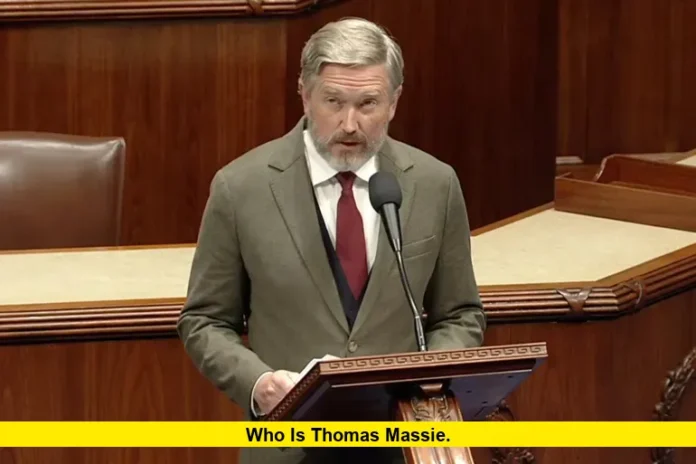

Who is Thomas Massie? Thomas Massie is a Republican politician, engineer, inventor, and longtime U.S. representative from Kentucky who has built a national reputation for challenging both Republican leadership and President Donald Trump. As of the latest update, Massie is drawing renewed attention for his effort to impeach Defense Secretary Pete Hegseth over the Trump administration’s military actions, including the war involving Iran. His political future has also changed significantly after he lost the 2026 Republican primary for Kentucky’s 4th Congressional District.
Massie’s career combines conservative economic principles, libertarian-leaning positions, opposition to certain government spending measures, and a willingness to break with his own party. His latest confrontation over Hegseth has placed him at the center of a major congressional debate about executive power, military authority, and the limits of presidential control.
Who Is Thomas Massie?
Thomas Harold Massie is an American politician who has represented Kentucky’s 4th Congressional District in the U.S. House of Representatives since November 2012. Born on January 13, 1971, in Huntington, West Virginia, he developed a background in engineering and entrepreneurship before entering public office.
Massie attended the Massachusetts Institute of Technology (MIT), where he earned a bachelor’s degree in electrical engineering in 1993 and a master’s degree in mechanical engineering in 1996. His education and experience in technology helped shape his reputation as an independent-minded lawmaker who frequently examines federal spending, government authority, and public policy through a practical and constitutional lens.
Before joining Congress, Massie founded a technology company and worked in local government as Lewis County judge-executive in Kentucky. His business experience distinguished him from many career politicians and contributed to his political identity as an advocate of limited government.
Massie has served on congressional committees dealing with the judiciary, transportation, infrastructure, and related policy matters. His legislative work has covered civil liberties, federal spending, technology, and the scope of executive authority.
Readers can learn more about his background and congressional career through his official House biography.
Is Thomas Massie a Republican or Democrat?
Thomas Massie is a Republican, not a Democrat. He entered Congress as a Republican in 2012 and has continued to identify with the Republican Party throughout his congressional career.
However, Massie does not always follow the positions favored by Republican leadership. He has developed a reputation as a libertarian-leaning conservative who emphasizes constitutional limits, fiscal restraint, individual liberties, and restrictions on federal power.
His disagreements with Republican leaders have included government funding, foreign policy, surveillance, and the authority of the executive branch. He has also supported efforts to make government records public when he believes transparency serves the public interest.
These positions have sometimes put him at odds with Trump and other influential Republicans. His opposition to particular administration policies has demonstrated that party membership does not necessarily mean agreement with every decision made by a president or congressional leadership.
Massie’s political identity is therefore best understood as Republican, with a strong emphasis on individual judgment and limited government rather than consistent alignment with the party establishment.
Thomas Massie and the 2026 Election: What Happened?
The 2026 election cycle brought a major setback for Massie. On May 19, 2026, he lost the Republican primary for Kentucky’s 4th Congressional District to Ed Gallrein, a challenger endorsed by President Donald Trump.
The certified primary results were:
- Ed Gallrein: 57,822 votes, or approximately 54.9%.
- Thomas Massie: 47,539 votes, or approximately 45.1%.
Gallrein defeated the incumbent by roughly 10,300 votes, ending Massie’s bid to secure another Republican nomination for the seat.
The contest attracted national attention because Trump had publicly opposed Massie and backed his challenger. Their conflict reflected broader tensions within the Republican Party over loyalty to the president, congressional independence, government spending, and foreign policy.
Massie had become one of Trump’s most outspoken Republican critics on selected issues. His opposition to administration priorities and his willingness to work with lawmakers from the other party made the Kentucky primary a closely watched test of the president’s influence over Republican voters.
Why Did Thomas Massie Lose the Republican Primary?
Several political factors shaped the contest.
Trump’s endorsement of Ed Gallrein: The president’s support gave Gallrein a significant advantage among Republican voters who strongly backed Trump’s leadership.
Disagreements over policy: Massie repeatedly challenged positions favored by the administration and Republican leaders, including government funding decisions and other major political priorities.
A high-profile campaign: The race attracted substantial national attention and outside spending, turning a Kentucky congressional contest into a broader debate about the future of dissent within the Republican Party.
The question of party loyalty: Some voters viewed Massie’s independence as a strength, while others favored a representative more closely aligned with the president’s agenda.
The result did not change Massie’s party affiliation. He remained a Republican, but he lost the opportunity to run for reelection as the party’s nominee in the district.
The certified results and candidate information are available through Ballotpedia’s 2026 Kentucky 4th District Republican primary coverage.
What Is Thomas Massie’s Current Congressional Status?
Massie’s defeat in the Republican primary means he will not return to Congress for another term representing Kentucky’s 4th Congressional District, barring an extraordinary change in circumstances.
His existing congressional term runs through January 3, 2027. Losing a primary does not immediately remove an elected representative from office. Instead, the incumbent ordinarily continues serving until the current term expires.
This distinction is especially important because Massie has continued participating in congressional debates after his primary defeat. His current work includes the renewed effort to impeach Defense Secretary Pete Hegseth.
Although Massie’s congressional career is approaching its scheduled conclusion, his latest actions could influence discussions about military accountability, congressional oversight, and executive authority beyond his time in office.
Thomas Massie Impeachment Effort: Why Is He Targeting Pete Hegseth?
One of Massie’s most significant recent actions is his effort to impeach Defense Secretary Pete Hegseth.
On November 9, 2026, Massie introduced a renewed impeachment resolution against Hegseth, escalating a dispute over the Trump administration’s military operations and the constitutional limits on the use of American military force.
Massie’s effort centers on allegations that Hegseth abused his authority and carried out unlawful military orders. The resolution raises concerns about the administration’s handling of the conflict involving Iran and military operations in other regions, including Yemen and Venezuela.
Massie argues that the executive branch cannot exercise unlimited authority over military action without appropriate congressional oversight. His position reflects a broader constitutional debate over the balance of power between the president and Congress, particularly when the United States becomes involved in sustained hostilities.
The impeachment effort is politically significant because Massie is a Republican challenging a defense secretary appointed by a Republican president. It also highlights the divide between lawmakers who support the administration’s military strategy and those who believe Congress must exert stronger control over decisions involving war.
What Are the Main Allegations Against Pete Hegseth?
The resolution outlines several allegations concerning Hegseth’s conduct as defense secretary. These include claims related to the administration of military operations, compliance with the War Powers Resolution, the treatment of civilians during military action, and alleged restrictions on political speech.
Massie has argued that the administration’s military actions in Iran proceeded without the required congressional authorization and that continued hostilities raise additional legal and constitutional questions.
The resolution also addresses military operations involving Yemen, Venezuela, the Caribbean Sea, and the eastern Pacific. The precise legal questions differ across the allegations, and the claims would need to be assessed through the appropriate constitutional and congressional processes.
These are allegations contained in an impeachment resolution, not established findings of guilt. Introducing articles of impeachment does not itself prove that an official violated the law or the Constitution.
The House must determine whether to advance the measure. If the House impeaches Hegseth, the Senate would then consider the case under the constitutional impeachment process.
What Is the Latest Update on Pete Hegseth Impeachment?
As of the latest update, Massie’s renewed impeachment resolution has placed the issue before the House, with a vote potentially coming by November 11, 2026.
The House leadership’s procedural decisions will be important. Speaker Mike Johnson could allow the House to consider the resolution, while Republican lawmakers could attempt to delay its consideration by referring it to committee or voting to table it.
Democratic leaders have expressed support for moving forward with impeachment, although the outcome depends on the House’s procedural decisions and the votes of its members.
President Trump has defended Hegseth and criticized the impeachment effort. Hegseth has also defended his leadership and the administration’s military campaign.
Even if the House approves impeachment, that would not automatically remove Hegseth from office. The Senate would have to consider the charges, and conviction requires a two-thirds vote of senators present.
The immediate political question is whether Massie can force a meaningful congressional vote before his current term ends. The broader question is whether lawmakers will use the impeachment process to challenge the administration’s interpretation of its military powers.
For the latest developments surrounding the resolution, see Associated Press coverage of Massie’s Hegseth impeachment effort.
Why Does Thomas Massie’s Hegseth Impeachment Push Matter?
Massie’s effort has significance beyond his personal disagreement with Hegseth. It raises several questions about the constitutional responsibilities of Congress and the president.
Congressional authority over military action: The Constitution divides war-related powers between Congress and the executive branch. Disputes over military operations can become tests of how that balance works in practice.
Accountability for Cabinet officials: Impeachment is one of the constitutional mechanisms available to Congress when lawmakers believe a federal official has committed impeachable offenses.
Republican divisions over foreign policy: Massie’s position highlights disagreements within the Republican Party about military intervention, presidential authority, and congressional oversight.
The consequences of a possible House vote: Even if conviction in the Senate remains uncertain, a House vote could establish how lawmakers view the allegations and create a public record of their positions.
The effort also comes at a transitional moment for Massie. With his term scheduled to end in January 2027, the impeachment resolution could become one of the defining issues associated with his final weeks in Congress.
Thomas Massie’s Political Views and Voting Record
Massie is widely associated with limited-government conservatism and libertarian principles. His political positions often focus on the relationship between individual freedom and federal authority.
His record includes scrutiny of government spending, opposition to certain surveillance policies, support for civil liberties, and skepticism toward military interventions that he believes lack sufficient legal authorization.
Massie has also been willing to challenge Republican leadership on procedural questions and government funding. These positions have earned him support from voters who value congressional independence, while attracting criticism from Republicans who believe his approach weakens party unity.
His stance on the Hegseth impeachment resolution fits within this broader pattern. Massie is arguing that constitutional restrictions on government power should apply regardless of which party controls the White House.
Nevertheless, individual votes and policy positions should be evaluated separately. A lawmaker’s record can reflect different considerations depending on the legislation, the constitutional questions involved, and the circumstances surrounding each decision.
What Is Thomas Massie’s Net Worth?
Thomas Massie’s net worth is not publicly established as one exact, verified figure. Estimates based on congressional financial disclosures place his disclosed financial position in a broad range, but those records should not be confused with an audited calculation of his personal wealth.
His most recent annual disclosure, covering the 2025 reporting year and filed in May 2026, lists assets and liabilities using government-required value ranges. A third-party analysis of the filing places the estimated net-worth range at approximately $696,000 to $5 million, with a midpoint near $2.9 million.
That midpoint is a calculation based on disclosure ranges, not a confirmed statement of Massie’s actual net worth. Congressional disclosures use broad categories, and the rules do not capture every asset or liability in the same way a complete personal balance sheet would.
How Did Thomas Massie Make His Money?
Massie’s financial background includes several sources.
Technology entrepreneurship: Before entering Congress, he founded SensAble Technologies, a company that developed technology allowing users to interact with digital objects through touch-based feedback.
Agriculture and farming: Massie has operated a cattle farm in Kentucky. Agricultural assets and related business interests have formed part of his financial background.
Investments and other holdings: His financial disclosures report categories of assets, liabilities, and income. These figures provide a partial picture of his finances but do not establish an exact net worth.
Congressional salary: Members of the U.S. House generally receive an annual base salary of $174,000, excluding any other permitted income or benefits.
For context, financial disclosure records are designed to promote transparency and identify potential conflicts of interest. They are not intended to provide a precise, audited net-worth figure for every member of Congress.
Thomas Massie’s Personal Life and Family
Massie was born in West Virginia and later established his life and career in Kentucky. His engineering education, business background, and agricultural work have been important parts of his public identity.
He married Rhonda Massie, his high school sweetheart, and they had four children. Rhonda died in 2024.
Massie’s personal background is distinct from his political profile, but his experience as an inventor, entrepreneur, and farmer has contributed to his reputation as a lawmaker who emphasizes practical problem-solving and skepticism toward centralized government authority.
He has often presented himself as someone whose political decisions are guided by constitutional principles rather than a desire to follow party leadership on every issue.
What Happens Next for Thomas Massie?
Massie’s immediate political focus is the effort to advance the Hegseth impeachment resolution and force Congress to address the allegations it contains.
The next major development is whether the House considers the resolution by the anticipated deadline or uses procedural measures to delay or block it. If the measure advances, the result would determine whether the issue proceeds to the Senate.
Massie’s own congressional term is scheduled to end on January 3, 2027. His defeat in the Republican primary means his current role in Congress is nearing its conclusion, although he could remain involved in public debate and political activity after leaving office.
His longer-term political plans should not be treated as settled unless he makes a confirmed announcement. For now, the clearest measure of his remaining congressional influence is the extent to which he can bring attention to the constitutional and legal questions raised by his impeachment effort.
For readers following American politics, Massie’s case illustrates how a member of the president’s own party can challenge the administration, even when doing so carries substantial political consequences.
Thomas Massie’s final months in Congress could prove consequential as lawmakers debate the limits of executive power and the future of the Republican Party.
What do you think about Massie’s effort to impeach Pete Hegseth? Share your views in the comments and stay tuned for the latest developments.