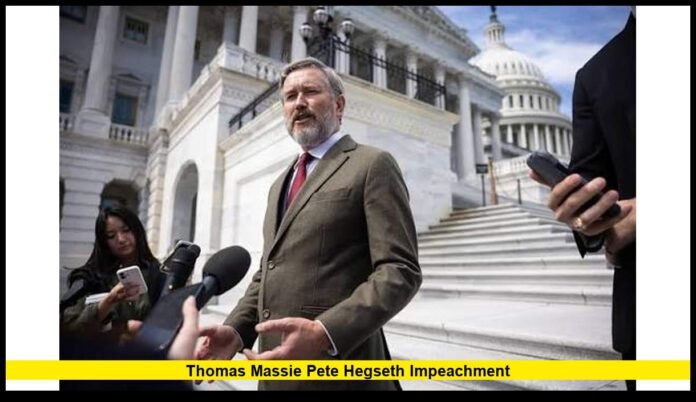

The Thomas Massie Pete Hegseth impeachment battle is intensifying in Washington as Republican Representative Thomas Massie renews his effort to remove Defense Secretary Pete Hegseth through a congressional impeachment process. On November 9, 2026, Massie reintroduced a resolution containing eight articles of impeachment, raising allegations concerning the war with Iran, civilian casualties, military strikes against suspected drug-trafficking vessels, and the use of government authority against political critics.
The move places Hegseth under renewed pressure as lawmakers return to Capitol Hill following the 2026 midterm elections. The House could consider the resolution as early as November 11, although Republican leaders could pursue procedural steps to block or delay a direct vote. The outcome remains uncertain, and no final House impeachment decision has been confirmed.
The dispute has implications beyond Hegseth’s future at the Pentagon. It raises questions about presidential authority to conduct military operations, Congress’s constitutional role in decisions involving war, and the standards that should govern the conduct of senior national security officials.
Thomas Massie Restarts His Impeachment Campaign
Massie, a Republican representing Kentucky, initially introduced articles of impeachment against Hegseth in September 2026. The resolution did not receive a final House vote before Republican leadership ended the chamber’s scheduled legislative business ahead of the midterm elections.
With lawmakers returning for the final weeks of the current Congress, Massie has renewed the initiative. His November 9 filing puts the eight allegations back before the House and creates a new procedural deadline for congressional action.
The resolution argues that Hegseth’s conduct as defense secretary has violated legal obligations and constitutional limits. Massie maintains that the allegations concern the exercise of government power, rather than a simple disagreement over the secretary’s management style or military effectiveness.
Massie has also called on President Donald Trump to replace Hegseth. The congressman argues that the administration should address the controversy before the next Congress begins its work in January 2027.
The timing is politically significant. Democrats are expected to control both chambers in the incoming Congress, creating the possibility of additional investigations and more aggressive oversight of the Pentagon.
However, the resolution’s reintroduction does not mean that impeachment has occurred. House members must still decide whether to advance the charges, and the Senate would have a separate role if the House approves them.
Why Pete Hegseth Faces Growing Pressure
Hegseth’s position has become increasingly controversial amid criticism of the administration’s military campaign against Iran and questions about the Pentagon’s leadership.
Supporters of the defense secretary argue that he has pursued the administration’s national security objectives and strengthened its approach to military readiness. Critics, meanwhile, have challenged the legal basis for certain military operations and raised concerns about civilian protection, congressional oversight, and the treatment of officials who disagree with administration policy.
The Iran conflict is particularly important because it forms the basis of three of Massie’s eight impeachment articles. The resolution alleges that Hegseth helped conduct hostilities without the necessary authorization from Congress and continued military operations in circumstances that Massie argues violated federal law.
The controversy also comes as Republicans assess their performance in the midterm elections. Disagreements about the war, its costs, and its effects on American national security have complicated the political debate surrounding the administration’s foreign policy.
Hegseth has rejected the impeachment effort as politically motivated. He has defended the Iran campaign as necessary to counter the threat posed by the Iranian government and has maintained that his leadership at the Pentagon deserves support.
The competing positions mean that the impeachment dispute will involve both legal questions and political judgments about the secretary’s responsibilities.
The Iran War Is at the Center of Three Impeachment Charges
The most prominent part of Massie’s resolution concerns the administration’s authority to use American military forces against Iran.
The first three articles challenge the legal basis, continuation, and duration of the military campaign. Massie argues that the administration acted without a declaration of war or specific congressional authorization and that the defense secretary failed to respect Congress’s role in determining the nation’s involvement in hostilities.
The dispute centers partly on the War Powers Resolution of 1973, a federal law designed to regulate the introduction of U.S. armed forces into hostilities without congressional authorization.
Under the law, the president generally must report certain deployments to Congress within 48 hours. The statute also establishes a 60-day period for unauthorized hostilities, subject to its terms and exceptions, with a possible additional period for withdrawal under specified conditions.
Massie’s resolution alleges that the administration failed to comply with these requirements. It also challenges the continuation of military operations despite congressional action seeking to end U.S. participation in the conflict.
The administration’s legal position and the precise application of the statute remain important to the dispute. The constitutional relationship between the president’s commander-in-chief powers and Congress’s authority over war has been debated for decades.
A disagreement about military authority does not, by itself, establish an impeachable offense. The House must decide whether the conduct described in the resolution amounts to the kind of serious misconduct that warrants impeachment.
Civilian Casualties Raise Questions About Military Accountability
Another article in the resolution concerns the protection of civilians during armed conflict.
Massie points to a deadly strike on an elementary school in Minab, Iran, during the early stages of the war. The resolution alleges that the Pentagon failed to maintain or follow adequate safeguards designed to limit civilian casualties and protect nonmilitary locations.
The allegation places military targeting procedures and civilian harm under congressional scrutiny. International humanitarian law establishes protections for civilians and civilian objects during armed conflict, while military operations must comply with applicable rules governing distinction, proportionality, and precautions.
Determining responsibility for a particular strike requires evidence about targeting decisions, intelligence assessments, the circumstances of the operation, and the chain of command. The existence of civilian casualties alone does not settle every legal question concerning responsibility.
Massie’s impeachment article alleges that Hegseth bears responsibility for failures in this area. That claim remains an allegation within the resolution rather than a final judicial or congressional finding.
The issue is nevertheless central to the debate because the defense secretary leads the department responsible for overseeing U.S. military operations and ensuring compliance with applicable legal obligations.
Military Strikes Against Suspected Drug Boats Face Scrutiny
The fifth article concerns U.S. military strikes against vessels suspected of involvement in drug trafficking in the Caribbean Sea and the eastern Pacific Ocean.
Massie alleges that some operations amounted to unlawful extrajudicial killings, including allegations involving people who survived an initial strike or were left shipwrecked. The resolution questions whether the use of lethal military force in these circumstances complied with domestic law and applicable international obligations.
The underlying legal issue involves the distinction between military operations and law-enforcement activities. Suspected drug trafficking is generally addressed through interdiction, investigation, arrest, and prosecution. The circumstances under which military force may lawfully be used against people suspected of criminal activity can be complex.
Massie’s argument is that the Pentagon exceeded lawful limits in conducting these operations. The administration’s national security rationale and the specific circumstances of individual strikes are relevant to assessing those claims.
The allegations have broader implications for U.S. policy in the Western Hemisphere. They concern not only the effectiveness of counter-narcotics operations but also the legal standards that govern the use of lethal force beyond conventional battlefields.
The impeachment resolution does not itself determine criminal responsibility for the incidents. Any conclusions would depend on the evidence and the applicable legal framework.
Senator Mark Kelly’s Free Speech Dispute
Massie’s sixth article concerns the Pentagon’s actions toward Democratic Senator Mark Kelly of Arizona, a retired Navy captain.
Kelly previously joined other lawmakers in a public message reminding military personnel that they must not obey unlawful orders. The message triggered a dispute with the administration over military discipline, political speech, and the responsibilities of service members.
Massie alleges that Hegseth used the authority of his office to retaliate against Kelly for his public statements. The resolution raises concerns about whether the Pentagon’s actions improperly targeted a sitting senator for exercising constitutionally protected speech.
The dispute touches on several sensitive issues. Military personnel must follow lawful orders, but they also have obligations under military law concerning unlawful commands. At the same time, the government must respect applicable constitutional protections, including those governing political expression.
The circumstances of any disciplinary or administrative action matter when assessing whether it represents legitimate enforcement of military rules or unlawful retaliation.
Massie’s resolution argues that Hegseth crossed that line. Hegseth and his defenders reject the broader impeachment campaign, and the allegations have not been established through a final impeachment judgment.
Venezuela and Yemen Add to the Legal Dispute
The final two articles concern U.S. military operations involving Venezuela and Yemen.
The seventh article alleges that Hegseth participated in directing an operation to capture Venezuelan leader Nicolás Maduro and Cilia Flores without sufficient constitutional or legal authority. Massie’s argument focuses on the limits of executive power when American forces conduct operations involving foreign political leaders.
Such operations can raise difficult questions about the use of military force, the legal basis for intervention, and the relationship between national security objectives and international obligations.
The eighth article addresses military operations against Houthi targets in Yemen. Massie alleges that these operations lacked adequate congressional authorization and violated applicable limits on executive war-making authority.
The allegations concerning Venezuela and Yemen broaden the resolution beyond the Iran conflict. They suggest that Massie’s objections concern the administration’s approach to military action across several regions rather than a single campaign.
Each operation involves distinct circumstances, however. The legal basis for one military action cannot automatically determine whether another operation was lawful. Any assessment must consider the relevant authorizations, facts, and legal obligations.
How House Leaders Could Respond to the Resolution
The House’s next procedural decision will determine whether lawmakers consider the impeachment articles directly or prevent them from advancing.
Because Massie has used a privileged resolution procedure, House leadership faces pressure to address the measure within a limited period. A vote could occur by November 11, but the date remains a possibility rather than a confirmed outcome.
Speaker Mike Johnson has opposed holding an impeachment vote while the United States remains involved in military hostilities. Republican leaders could also seek to table the resolution or pursue another procedural route that prevents a direct vote on the allegations.
Democratic leaders have signaled support for impeachment. House Democratic Leader Hakeem Jeffries has described himself as firmly in favor of the effort, adding to pressure on Republicans to take a public position.
The narrow balance of power in the outgoing House makes individual votes important. Massie has suggested that some Republicans may be more willing to support the resolution after the midterm elections, although individual lawmakers’ final positions will determine whether that possibility translates into votes.
Even if the House approves the articles, Hegseth would not automatically lose his position. Impeachment is the formal accusation stage of the constitutional process.
The Senate would then consider whether to convict him. Removal requires a two-thirds majority of senators present, a substantially higher threshold than the simple majority generally required to approve articles in the House.
Hegseth’s Defense and Trump’s Political Support
Hegseth has characterized the impeachment initiative as a political attack and defended his handling of the Pentagon. He argues that the administration’s military policies serve U.S. national security interests and rejects Massie’s characterization of his conduct.
President Trump has also defended Hegseth and criticized Massie. The president’s position could influence Republican lawmakers who are weighing whether to support the resolution or oppose it on procedural and substantive grounds.
The disagreement illustrates a broader divide within the Republican Party over foreign intervention and the limits of presidential authority. Some conservatives emphasize a strong executive role in national security, while others argue that Congress must exercise greater control over military operations.
Massie’s position reflects the latter concern. He maintains that lawmakers should evaluate whether the secretary’s actions complied with the law rather than simply judging whether they agree with the administration’s policy goals.
Hegseth’s supporters, by contrast, may argue that the resolution uses impeachment to challenge policy decisions that should be addressed through oversight, debate, or other congressional mechanisms.
The House’s handling of the resolution will reveal how much support exists for each position.
What Comes Next in the Thomas Massie Pete Hegseth Impeachment Battle
As of the latest available reporting on November 10, 2026, Massie has reintroduced the eight articles, but the House has not confirmed a final decision on impeachment. Lawmakers may consider the resolution within the next two legislative days, while Republican leadership retains procedural options that could affect the timing and outcome.
The immediate developments to watch are the scheduling of a House vote, the number of Republicans willing to support impeachment, and any effort to table or refer the measure.
The Senate would become relevant only if the House approves the articles. A conviction would require a two-thirds majority of senators present, and no completed Senate proceeding has been confirmed.
The dispute is likely to remain an important test of congressional oversight, military accountability, and the constitutional balance between the executive and legislative branches.
For now, the distinction between allegations and established findings remains essential. Massie’s resolution presents serious accusations, but the constitutional process has not yet produced a final determination on them.
Join the discussion in the comments and follow the latest developments as lawmakers decide the future of the Pete Hegseth impeachment effort.