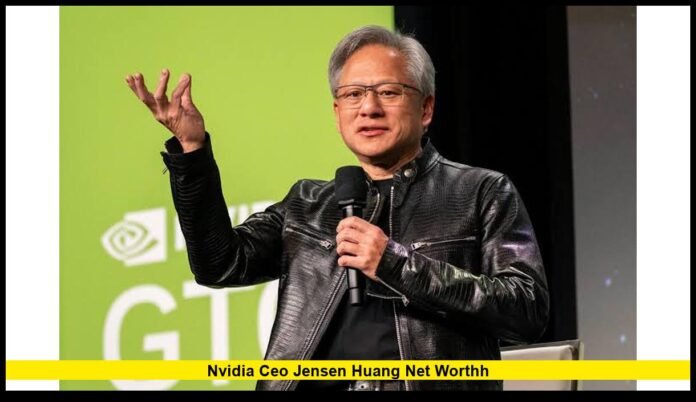

The nvidia ceo jensen huang net worth estimate reached approximately $162.2 billion in Forbes’ November 8, 2026, billionaire ranking, placing the Nvidia co-founder among the world’s wealthiest individuals. His fortune reflects the extraordinary growth of Nvidia, particularly its position in artificial intelligence computing, advanced semiconductors, and data-center technology. However, recent fluctuations in technology stocks have demonstrated how quickly his estimated wealth can change.
Jensen Huang’s financial success is closely connected to a company he helped establish more than three decades ago. Nvidia has evolved from a graphics-processing business into a major force in the global computing industry. That transformation has made Huang’s ownership stake exceptionally valuable.
His financial standing also illustrates a defining feature of modern technology wealth: founders can accumulate enormous fortunes through company ownership without receiving anything close to that amount in annual salary.
Jensen Huang’s Latest Billionaire Ranking
The latest available Forbes figure used for this report places Huang’s estimated fortune at $162.2 billion as of November 8, 2026. He occupied eighth position in the publication’s worldwide billionaire ranking.
His position changed considerably during the first week of November. A major decline in semiconductor stocks affected Nvidia’s market value and reduced Huang’s estimated fortune.
On November 5, Bloomberg reported that his wealth had fallen by approximately $15.1 billion to $150.9 billion. The decline pushed him down to 13th place in its billionaire ranking.
Different wealth trackers reported different valuations during the same period. Forbes and Bloomberg use separate calculation methods and market-price reference points, so their estimates do not always match.
The important point is that Huang’s fortune remains closely connected to Nvidia’s publicly traded shares. His billionaire ranking can move whenever investors reassess the company’s value.
The Business Behind Huang’s Extraordinary Wealth
Nvidia’s development is central to understanding Huang’s financial position.
He co-founded the company in 1993 with Chris Malachowsky and Curtis Priem. The original business focused on graphics technology for computers, particularly the demanding visual requirements of video games.
At the time, computer graphics represented a growing commercial opportunity. Nvidia sought to develop processors capable of delivering increasingly sophisticated visual performance.
The company gradually established itself in the graphics-processing market. Its GPUs became widely recognized among gaming enthusiasts, computer manufacturers, and professional users.
However, Nvidia’s ambitions extended beyond gaming.
The company invested in computing technologies that could perform complex calculations efficiently. This work eventually positioned its GPUs for applications in scientific computing, machine learning, and artificial intelligence.
As AI development accelerated, Nvidia became an important supplier of the hardware and software infrastructure supporting that industry.
Huang’s financial success followed this business transformation.
Why Nvidia Stock Determines So Much of His Fortune
Company ownership is the most important element of Huang’s estimated wealth.
He retains a substantial equity interest in Nvidia, meaning movements in the company’s stock price directly influence the estimated market value of his holdings.
Forbes profiles have placed his ownership stake in the approximate 3% to 4% range, although the precise figure depends on the reporting date and treatment of shares held through related entities.
Even a relatively small percentage of a multitrillion-dollar corporation can represent an enormous personal fortune.
Consider a hypothetical example. A 3% stake in a company valued at $4 trillion would represent $120 billion in equity value. This calculation does not establish Huang’s exact holdings or Nvidia’s current valuation, but it demonstrates why ownership percentages matter so much.
The stock-market connection also explains why his wealth can fall substantially without any announcement that he has sold shares.
If Nvidia’s share price declines, the estimated value of his ownership decreases. A strong market rally can produce the opposite result.
Consequently, the latest nvidia ceo jensen huang net worth figure should always be considered alongside the date on which it was calculated.
Artificial Intelligence Changed Nvidia’s Financial Future
Artificial intelligence has become a major component of Nvidia’s business and investor appeal.
Modern AI systems require powerful computing infrastructure. Developing large models involves processing extensive datasets and performing enormous numbers of mathematical operations.
Nvidia’s GPUs are designed to handle parallel computing workloads, making them valuable for these applications.
The company also offers networking products, software, and integrated computing systems. These technologies help customers build infrastructure for AI training and inference.
Another important part of Nvidia’s business is CUDA, its software platform for GPU computing. The platform allows developers to use Nvidia hardware for applications extending beyond conventional graphics.
This combination of processors, software, and networking has helped establish Nvidia as a significant participant in the AI infrastructure market.
Major technology companies and cloud providers have invested heavily in computing capacity to support artificial intelligence services.
That investment has increased attention on Nvidia’s products and future earnings potential.
Huang’s ownership position gives him a direct financial connection to the company’s success. Nevertheless, AI investment trends do not guarantee uninterrupted stock-price growth.
Huang’s Salary Is Only One Part of His Financial Picture
As Nvidia’s chief executive, Huang receives compensation for managing the company and directing its long-term strategy. His executive pay can include a base salary, performance-related incentives, stock awards, and additional benefits.
However, his compensation package is not the main reason he ranks among the world’s richest people.
The distinction between annual earnings and accumulated wealth is particularly important in his case. His Nvidia shares have a market value that can exceed his yearly compensation by an enormous margin.
Executive compensation disclosures also require careful interpretation. Stock awards may carry vesting requirements, and their reported grant value does not necessarily equal the cash an executive receives.
Huang’s personal fortune therefore reflects decades of company ownership rather than simply the income he earns from his executive position.
From Electrical Engineering to Technology Leadership
Huang’s professional background began with engineering education and experience in the semiconductor business.
Born in Taiwan in 1963, he moved to the United States during his childhood. He studied electrical engineering at Oregon State University before earning a master’s degree from Stanford University.
Before launching Nvidia, he worked at semiconductor companies, including Advanced Micro Devices and LSI Logic.
Those positions provided experience in an industry that would eventually become the foundation of his entrepreneurial success.
His technical background also shaped Nvidia’s early direction. Rather than treating graphics processors as a narrow gaming component, the company pursued technologies that could support increasingly demanding computing applications.
Huang’s continued leadership has helped Nvidia navigate several major industry transitions.
What Could Influence His Wealth Going Forward?
Nvidia’s financial performance will remain the most important influence on Huang’s estimated fortune.
Several developments deserve attention:
- AI infrastructure spending: Continued investment in computing facilities could support demand for Nvidia products.
- Semiconductor competition: Rival chipmakers and internally developed processors from large technology companies could affect Nvidia’s market position.
- Corporate earnings: Revenue growth, profitability, and future business guidance can influence investor expectations.
- International regulations: Trade restrictions and export policies may affect the company’s access to particular markets.
- Stock-market conditions: Interest rates, investor confidence, and technology-sector valuations can influence Nvidia shares.
These factors create opportunities as well as risks. Strong demand does not automatically translate into higher share prices, particularly when investors have already priced in substantial growth.
The relationship between business performance and market expectations will remain important when assessing Huang’s wealth.
Does His Net Worth Represent Cash?
Huang’s estimated wealth should not be confused with money held in bank accounts. Billionaire rankings calculate the estimated value of an individual’s assets, including publicly traded shares and other investments, after accounting for applicable liabilities where information is available.
A substantial portion of his fortune is connected to Nvidia equity. Converting that ownership into cash would require selling shares, potentially creating tax obligations and affecting the value received.
Public estimates also cannot provide a complete picture of every private investment, property holding, or financial obligation.
For this reason, the $162.2 billion estimate represents an approximate measure of his financial position, not immediately available spending money.
Why Jensen Huang’s Wealth Is Significant
Huang’s financial position reflects the growing importance of semiconductor technology in the global economy. Computing power has become essential to businesses developing artificial intelligence, operating cloud platforms, and processing increasingly complex workloads.
Nvidia’s success demonstrates how a company specializing in one area of technology can develop into a major supplier across multiple industries.
His journey also highlights the financial rewards of maintaining ownership in a successful public company. While executive compensation attracts attention, long-term equity ownership has been the defining source of his wealth.
The November market fluctuations provide another important reminder: even the world’s wealthiest technology entrepreneurs remain exposed to changes in financial markets.
The Bottom Line
Jensen Huang’s estimated $162.2 billion fortune places him among the most prominent billionaires in the world. His wealth comes primarily from his Nvidia ownership, supported by the company’s development into a major provider of artificial intelligence and accelerated computing technology.
His financial standing will continue to reflect Nvidia’s business performance, competitive position, and stock-market valuation. For anyone following the technology industry, Huang’s fortune offers an interesting measure of how dramatically the AI boom has reshaped the semiconductor business.
What are your thoughts on Jensen Huang’s rise to billionaire status and Nvidia’s influence on artificial intelligence? Share your opinion in the comments.