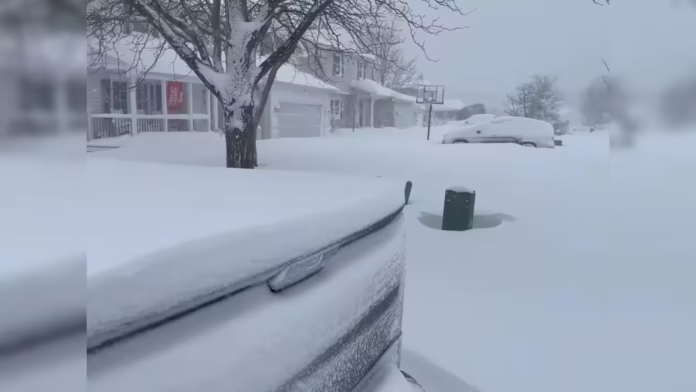

The 2026 white Christmas weather predictions are giving Americans an early look at where snow could transform Christmas Day into a winter wonderland. From the snow-covered landscapes of Alaska and the Rocky Mountains to the busy streets of New York and Chicago, holiday weather expectations are becoming a major topic as families plan celebrations and winter trips.
The latest long-range outlooks offer a mixed picture for the United States. The Old Farmer’s Almanac’s November forecast favors a white Christmas in the Northeast, Intermountain region, and Alaska, while other parts of the country have more uncertain prospects. Meanwhile, the National Oceanic and Atmospheric Administration (NOAA) expects warmer-than-average temperatures across much of the northern United States during the 2026–2027 winter season.
These outlooks do not guarantee snow on December 25. The final result will depend on temperatures, winter storm tracks, precipitation, and whether snow that falls earlier in December remains on the ground.
For people hoping to wake up to snow-covered rooftops and frosty Christmas landscapes, the most useful question is not simply whether winter will be cold, but which cities have the strongest historical chances of experiencing a white Christmas in 2026.
Latest White Christmas Forecast for 2026
The early forecast picture is beginning to take shape, although city-specific Christmas Day predictions remain uncertain.
The Old Farmer’s Almanac published its 2026 white Christmas outlook in early November. Its regional forecast identifies the Northeast, Intermountain region, and Alaska as the leading areas for a white Christmas. Several other regions have a chance of seeing snow, while the outlook is less favorable in some areas, including the Atlantic Corridor and Upper Midwest.
These are long-range predictions rather than confirmed forecasts of the weather on December 25.
NOAA’s winter outlook, released on October 15, provides a different kind of information. It favors warmer-than-average temperatures across much of the northern United States, including the Pacific Northwest, northern Rockies, Midwest, and much of the East. Wetter-than-average conditions are favored across portions of the southern United States and along the East Coast.
The two outlooks should not be treated as direct contradictions. The Almanac offers a regional holiday prediction, while NOAA’s seasonal outlook describes the likelihood of broader temperature and precipitation patterns over several months.
Neither can establish exactly where snow will fall or remain on Christmas morning.
Readers can follow the latest seasonal guidance through the NOAA Climate Prediction Center.
2026 White Christmas Predictions by U.S. Region
The chances of experiencing a white Christmas vary considerably across the country. Latitude, elevation, distance from the Great Lakes, and local temperature patterns all influence the likelihood of snow cover.
Northeast and New England
The Old Farmer’s Almanac favors a white Christmas in its Northeast region, making this one of the most closely watched areas for the 2026 holiday.
Northern Maine, inland New England, and higher elevations generally have better historical prospects than locations closer to the Atlantic coast.
However, the forecast differs across neighboring areas. The Almanac’s outlook does not favor a white Christmas in the Atlantic Corridor, illustrating why a prediction for the broader Northeast should not automatically be applied to every city.
New York City, Philadelphia, and nearby coastal communities can experience rain, mixed precipitation, or mild conditions during December. A winter storm could still bring snow, but temperatures and the timing of the storm will determine whether snow accumulates and remains on the ground.
Great Lakes and the Midwest
The Great Lakes region presents a more complicated picture.
Parts of Illinois, Indiana, Ohio, and Michigan have a chance of a white Christmas in the Almanac’s regional outlook. However, the outlook is not uniformly favorable across these states.
Lake-effect snow can increase snowfall in communities near the Great Lakes, while nearby areas receive considerably less. A brief period of warmer weather can also melt snow before Christmas arrives.
Historical climate conditions generally favor northern Minnesota and parts of Wisconsin and Michigan more than locations farther south. Nevertheless, the broader seasonal temperature outlook and the timing of winter storms will influence the final result.
The Rocky Mountains and Intermountain West
The Intermountain region is among the areas favored for a white Christmas in the Old Farmer’s Almanac’s 2026 outlook.
Higher-elevation destinations in Colorado, Wyoming, Idaho, and Montana often have favorable winter conditions. Mountain temperatures and elevation can help snow accumulate and remain on the ground through the holiday.
However, conditions differ between mountain communities and nearby valleys. A ski destination may have established snow cover while a lower-elevation city experiences rain or dry weather.
Travelers looking for a snowy Christmas should therefore consider the specific destination rather than assuming that every part of a mountain state will experience the same conditions.
Pacific Northwest
The Pacific Northwest has a mixed outlook for Christmas snow.
Mountainous areas in Washington and Oregon generally have better historical snow prospects than lowland communities. Seattle and Portland, by contrast, frequently experience winter rain rather than a sustained blanket of snow.
NOAA’s winter outlook favors warmer-than-average temperatures across the Pacific Northwest. This does not rule out a cold spell or snowstorm, but it reinforces the need for caution when interpreting early Christmas predictions.
For Seattle-area residents, the most useful information will be the local temperature forecast and the development of any cold-air outbreak as Christmas approaches.
The South and Southeast
A white Christmas is generally less common across the southern United States than in northern states and mountainous regions.
The seasonal outlook favors wetter-than-average conditions across parts of the South and East. However, wetter weather does not necessarily mean snow.
For Christmas snowfall to occur in many southern locations, sufficiently cold air must coincide with a storm that supplies enough moisture.
Higher elevations in the southern Appalachians have better historical prospects than nearby lowlands. Major cities across much of Texas, Louisiana, Mississippi, Alabama, Georgia, and Florida generally have lower historical chances of a traditional white Christmas.
Unusual winter storms can still bring snow to parts of the South, but such an outcome should not be treated as the expected Christmas weather.
Alaska
Alaska remains one of the most promising regions for a snowy Christmas.
The Old Farmer’s Almanac includes Alaska among the areas favored for a white Christmas in 2026. Many communities experience cold winter temperatures and established snow cover during December.
Anchorage and Fairbanks are useful examples of destinations where winter conditions can support a snowy holiday, although the weather differs between coastal and inland locations.
The seasonal outlook favors warmer-than-average temperatures across much of Alaska and drier-than-average conditions in some areas. Even so, those broad patterns do not eliminate the possibility of snow on Christmas Day.
Will These Major U.S. Cities Have a White Christmas in 2026?
Many readers want a straightforward answer about their own city. At this stage, historical climate patterns provide a useful starting point, but they cannot establish whether a city will have snow on December 25, 2026.
| City | Historical snow prospects | What matters for Christmas 2026 |
|---|---|---|
| Anchorage, Alaska | Generally favorable | Local temperatures and snow-cover persistence |
| Minneapolis, Minnesota | Favorable compared with many southern cities | Cold spells, snowfall, and thaws |
| Duluth, Minnesota | Strong historical potential | Lake-effect snow and temperature changes |
| Boston, Massachusetts | Variable | Coastal temperatures and winter storm timing |
| New York City, New York | Less consistent than northern inland areas | Whether a storm produces lasting snow cover |
| Chicago, Illinois | Variable | Cold-air outbreaks and snow accumulation |
| Denver, Colorado | Variable despite its elevation | Storm timing and snowmelt |
| Seattle, Washington | Historically less favorable than nearby mountain areas | Lowland temperatures and cold-air intrusions |
| Portland, Oregon | Generally less favorable than mountain destinations | Whether precipitation falls as snow |
| Fairbanks, Alaska | Generally favorable | Local snowfall and existing snow cover |
Important: These are qualitative descriptions of historical climate patterns, not numerical probabilities or confirmed 2026 forecasts. Individual neighborhoods can also experience different conditions.
NOAA’s climate records are useful for understanding the long-term likelihood of snow cover at specific locations. Historical data should not be confused with a prediction for this particular Christmas.
How the Old Farmer’s Almanac Forecast Compares With NOAA
The Old Farmer’s Almanac and NOAA serve different purposes when discussing winter weather.
The Almanac has published a regional white Christmas forecast for 2026, identifying areas where it expects snow-covered conditions to be more or less likely. Its outlook is designed to give readers an early sense of the potential holiday weather.
NOAA’s seasonal outlook focuses on probabilities for above-average, near-average, or below-average temperatures and precipitation over broader periods. It does not predict snowfall for Christmas Day several weeks in advance.
The distinction is important because a seasonal temperature outlook cannot tell readers whether a particular storm will arrive on December 24 or whether snow will melt before the holiday.
For example, a region can experience above-average temperatures throughout the month and still receive a snowstorm during a short cold spell. Another region may have plenty of precipitation but remain too warm for snow to accumulate.
Readers can explore the Almanac’s regional predictions in its 2026 White Christmas Forecast.
The most reliable approach is to consider historical climate conditions and long-range outlooks as background information, then rely on local forecasts as Christmas approaches.
Could El Niño Change the White Christmas Forecast?
El Niño is an important influence on the 2026–2027 winter outlook.
This climate pattern develops when sea surface temperatures in parts of the tropical Pacific become warmer than average. It can influence the jet stream, storm tracks, and the distribution of precipitation across North America.
NOAA’s October outlook identifies a strengthening El Niño as a major factor shaping the upcoming winter.
The expected seasonal pattern favors warmer-than-average temperatures across much of the northern United States and wetter-than-average conditions across parts of the southern United States and East Coast.
However, El Niño does not determine whether a specific city will have a white Christmas.
Several local factors remain important:
- Temperature: Snow is more likely to accumulate when the atmosphere is sufficiently cold.
- Storm tracks: The path of a winter storm determines which areas receive precipitation.
- Moisture: A storm must supply enough moisture to produce meaningful snowfall.
- Cold-air outbreaks: A temporary surge of cold air can create favorable conditions for snow.
- Existing snow cover: Snow from an earlier storm may remain on the ground through Christmas.
These factors interact differently across the country. As a result, broad seasonal patterns cannot replace a local Christmas weather forecast.
What Is Considered a White Christmas?
In the United States, a white Christmas is commonly defined as having at least one inch of snow on the ground on December 25.
Snow does not have to fall on Christmas Day itself.
For example, a town that receives snowfall on December 21 and retains at least one inch of snow cover through Christmas morning would meet the standard definition.
On the other hand, a city could experience a few snowflakes on December 25 but still fail to qualify if insufficient snow remains on the ground.
This distinction helps explain why snow cover is just as important as the possibility of a Christmas Day storm.
Historical climate data can show how frequently different locations experience qualifying snow cover. Those records are useful for comparing cities, but they do not guarantee that a particular location will experience the same conditions in 2026.
When Will the 2026 Christmas Snow Forecast Become More Reliable?
The accuracy of a Christmas weather forecast generally improves as December approaches.
Early November 2026
Seasonal outlooks and historical climate data provide a broad picture of winter conditions. They can help identify regions with favorable snow prospects, but they cannot reliably predict specific Christmas Day snowfall amounts.
Early December 2026
Meteorologists can begin evaluating developing cold-air patterns, storm systems, and regional temperature changes with greater detail.
Forecasts may identify areas to watch, although changes in storm tracks can still affect the final outcome.
Mid-December 2026
Forecasts become increasingly useful for identifying potential winter storms and assessing whether temperatures may support accumulating snow.
Travelers can begin making more informed decisions about destinations and transportation plans.
December 21–24, 2026
The final days before Christmas should provide a much clearer picture of local conditions, including potential snowfall, precipitation type, and the likelihood that existing snow will remain on the ground.
Forecasts can still change, so checking updates regularly remains important.
Readers can find local forecasts and winter weather alerts through the National Weather Service.
How to Prepare for a Possible White Christmas
Whether you are traveling to a mountain resort or staying home for the holidays, monitoring the weather can help you prepare for changing conditions.
Consider these practical steps:
- Check local forecasts regularly during December.
- Watch for winter storm watches and warnings.
- Prepare vehicles for snow, ice, and freezing temperatures.
- Allow extra travel time during winter weather.
- Check airline updates before leaving for the airport.
- Keep warm clothing and emergency supplies available.
- Monitor temperatures to determine whether existing snow cover could melt.
- Consider higher-elevation destinations if experiencing snow is a priority.
A snowy Christmas can create memorable holiday scenery, but winter weather may also bring icy roads, flight delays, and dangerous cold. Travel decisions should be based on current local conditions rather than a long-range prediction alone.
Frequently Asked Questions About White Christmas 2026
Will it snow on Christmas Day in 2026?
It is too early to determine which U.S. cities will receive snow on December 25. Early outlooks identify regions with promising snow prospects, but reliable local predictions will become available closer to Christmas.
Which states have the best chances of a white Christmas in 2026?
Alaska and several northern states have historically favorable conditions for snow cover. Higher-elevation areas in the Rocky Mountains and parts of New England also have strong historical prospects. The actual 2026 outcome will depend on local weather conditions.
Does NOAA predict a white Christmas in 2026?
NOAA’s seasonal outlook provides broad temperature and precipitation probabilities rather than a city-by-city Christmas snowfall forecast. Its current outlook favors warmer-than-average conditions across much of the northern United States.
What does the Old Farmer’s Almanac predict for Christmas 2026?
The Almanac’s early outlook favors a white Christmas in the Northeast, Intermountain region, and Alaska. Other regions have varying prospects, and its predictions should be treated as preliminary rather than guaranteed.
Will New York City have snow on Christmas Day?
New York City’s Christmas snow prospects remain uncertain. Historical conditions are less consistently favorable than in many northern inland communities, and the final outcome will depend on temperatures, storm timing, and existing snow cover.
When will the Christmas 2026 forecast become clearer?
Forecasts should become more useful during December, particularly in the final week before Christmas. Local forecasts during the days immediately preceding December 25 will provide the best guidance for specific locations.
Final Outlook: Will 2026 Bring a White Christmas to the United States?
The early outlook for Christmas 2026 offers reasons for optimism in several northern and mountainous regions, but it does not guarantee widespread snowfall.
The Old Farmer’s Almanac favors a white Christmas in the Northeast, Intermountain region, and Alaska. NOAA’s seasonal outlook, meanwhile, points toward warmer-than-average conditions across much of the northern United States and wetter-than-average conditions in parts of the South and East.
These broad patterns highlight why local conditions matter. A snowy holiday will depend on the arrival of cold air, the timing of winter storms, and whether snow remains on the ground through December 25.
For now, historical climate information offers the best starting point for identifying promising destinations. As December approaches, updated local forecasts will provide a clearer picture of where Americans may wake up to a white Christmas.
Are you dreaming of a white Christmas in 2026? Tell us your city and whether you expect snow on December 25, and keep checking for the latest holiday weather updates!