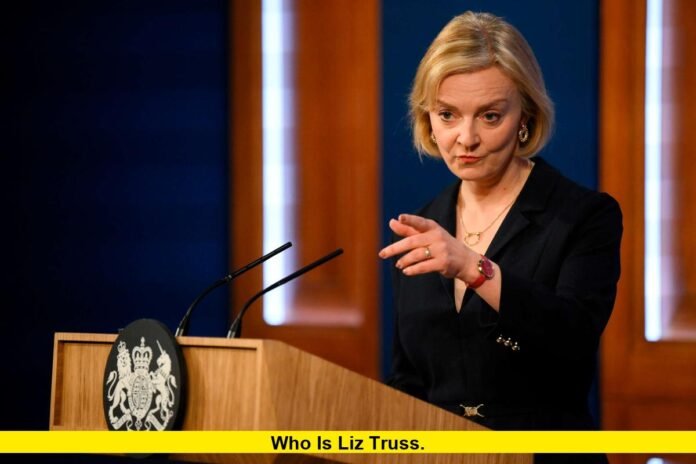

Who is Liz Truss is a question that continues to attract attention in the United States and internationally because of her brief but consequential time as Britain’s prime minister, her economic policies, and her continued involvement in political debates.
Liz Truss is a British politician who served as the United Kingdom’s prime minister from September 6 to October 25, 2022. She became the country’s third female prime minister, following Margaret Thatcher and Theresa May. Her 49-day premiership was the shortest in modern British political history.
Truss remains a notable figure in discussions about British conservatism, economic policy, international relations, and the political consequences of her government’s controversial financial decisions. Her political career also includes senior cabinet positions under several Conservative prime ministers.
Who Is Liz Truss Today? Latest Political Activities
As of November 6, 2026, Truss remains active in conservative political commentary, public appearances, and debates about Britain’s economic direction. Her latest activities have returned her to international attention, particularly in the United States.
In late October 2026, Truss released a new book titled Bank Job: A Short Book on How the Bank of England Broke the Bond Market and Brought Down the Government. The book revisits the financial turmoil that followed her government’s 2022 mini-budget and presents her argument that institutions, including the Bank of England, played a major role in her downfall.
Truss has continued to dispute the criticism directed at her economic program. Her interpretation of the crisis remains controversial, especially among economists and political commentators who emphasize the market reaction to her government’s unfunded tax-cut proposals.
She also attracted attention after appearing at a dinner at President Donald Trump’s Mar-a-Lago resort in Florida on November 3, 2026, during the U.S. midterm elections. The appearance highlighted her continued engagement with American conservative political circles.
These developments show that, although Truss no longer holds elected office, she continues to seek influence through books, media appearances, and international political events.
Who Is Liz Truss? Early Life and Family Background
Liz Truss was born Mary Elizabeth Truss on July 26, 1975, in Oxford, England. She grew up in a family that valued education and public debate.
Her father, John Kenneth Truss, worked as a mathematics professor. Her mother, Priscilla Grasby, worked as a nurse and teacher and was involved in political activism.
During her childhood, Truss lived in several parts of the United Kingdom, including Paisley in Scotland and Leeds in England. Her family background exposed her to different political perspectives and helped shape her early understanding of public policy.
Her parents held left-leaning political views, while Truss later developed a strong commitment to free-market economics and Conservative Party politics. This contrast became a frequently discussed part of her political biography.
Truss attended Merton College at the University of Oxford, where she studied philosophy, politics and economics. She graduated in 1996.
At Oxford, she participated in political activities and initially supported the Liberal Democrats. She later moved toward the Conservative Party, reflecting a major shift in her political outlook.
Her early experiences established the foundation for a career that would eventually take her into Britain’s highest political office.
How Liz Truss Started Her Career
Before entering Parliament, Truss worked in the private sector. She held positions in the energy and telecommunications industries, including commercial and economic management roles.
Her professional experience gave her exposure to business operations, competition, investment, and economic decision-making. These subjects later became central to her political arguments.
Truss also became involved in Conservative politics and worked to establish herself as a candidate for public office. Her first attempts to enter Parliament were unsuccessful.
She contested the Hemsworth constituency in 2001 and again in 2005 but did not win either election. Rather than abandoning politics, she continued developing her political profile and building support within the Conservative Party.
In 2006, she was elected as a councillor in Greenwich, London. She served on the local council before focusing on national politics.
Her persistence eventually paid off when she won the South West Norfolk parliamentary constituency in the 2010 general election.
That victory marked the beginning of her long career in the House of Commons and opened the door to increasingly senior government positions.
Liz Truss’s Rise Through the Conservative Party
Truss entered Parliament in 2010, when David Cameron led the Conservative Party. She soon became associated with efforts to promote free-market policies, competition, and economic reform.
In 2012, she joined the government as a parliamentary under-secretary of state for education. The position gave her experience in government administration and policy development.
Her responsibilities expanded in 2014 when she became secretary of state for environment, food and rural affairs. She held that position until 2016.
Following the United Kingdom’s decision to leave the European Union in the 2016 referendum, Truss remained a prominent Conservative politician during a period of major political change.
Prime Minister Theresa May appointed her lord chancellor and secretary of state for justice in July 2016. Truss later became chief secretary to the Treasury in 2017 under Prime Minister Boris Johnson’s predecessor, Theresa May.
In 2019, Johnson appointed Truss secretary of state for international trade. She also served as minister for women and equalities.
Her growing responsibilities demonstrated the confidence successive Conservative leaders placed in her. Truss developed a reputation as a politician willing to promote market-oriented reforms and defend Britain’s post-Brexit economic opportunities.
Liz Truss as Foreign Secretary
Truss became foreign secretary in September 2021 under Boris Johnson.
The role placed her at the center of Britain’s international relations during a period marked by growing tensions between Russia and Ukraine.
She supported Ukraine as Russia intensified its military aggression, and Britain continued providing assistance to the Ukrainian government. Truss also took a prominent position on sanctions and Western cooperation against Moscow.
Her work as foreign secretary strengthened her international profile. She traveled widely, represented Britain in diplomatic discussions, and emphasized the importance of national sovereignty and alliances with Western countries.
Truss also remained closely associated with Britain’s post-Brexit trade strategy. She argued that leaving the European Union created opportunities for the United Kingdom to establish independent trade agreements.
Her time at the Foreign Office proved important in her leadership campaign. It gave her experience in international affairs and increased her visibility among Conservative Party members.
When Johnson announced his resignation in July 2022, Truss entered the contest to replace him.
How Liz Truss Became Prime Minister
The Conservative leadership election in 2022 followed a period of political turmoil under Johnson. His government faced mounting criticism over its conduct and several controversies that undermined confidence in his leadership.
Truss competed against other senior Conservative politicians, including former chancellor Rishi Sunak.
Her campaign emphasized tax reductions, economic growth, deregulation, and a smaller role for government in the economy. She argued that reducing the tax burden would encourage investment and help Britain address its economic challenges.
On September 5, 2022, the Conservative Party announced that Truss had defeated Sunak in the leadership contest.
She became prime minister the following day, September 6, after meeting Queen Elizabeth II at Balmoral Castle in Scotland. The monarch died two days later, making the early days of Truss’s premiership a period of national mourning.
Truss became Britain’s third female prime minister and the fourth Conservative prime minister since the 2016 Brexit referendum.
Her government entered office facing high inflation, rising energy costs, and pressure on household budgets. She promised decisive action to improve economic growth and address the cost-of-living crisis.
However, the economic policies she introduced soon became the defining controversy of her premiership.
Why Liz Truss Resigned After Just 49 Days
Truss’s government announced a major fiscal package in September 2022 under Chancellor of the Exchequer Kwasi Kwarteng.
The plan, widely known as the mini-budget, included significant tax reductions and changes to planned tax increases. The government argued that lower taxes would encourage businesses to invest and stimulate economic growth.
However, investors questioned how the government would finance its plans and whether the measures would worsen inflationary pressures.
Financial markets reacted sharply. The pound fell against the U.S. dollar, while British government bond prices dropped and yields rose. The turmoil placed pressure on pension funds that relied on leveraged investment strategies.
Mortgage costs also came under pressure as financial uncertainty spread through the market.
The Bank of England intervened to stabilize the government bond market. The turmoil intensified political criticism of Truss and Kwarteng, forcing the government to reverse major parts of its economic program.
Kwarteng left office in October 2022, and Jeremy Hunt replaced him as chancellor. Hunt subsequently announced the reversal of several tax measures associated with the mini-budget.
The political damage proved difficult to contain. Conservative lawmakers questioned Truss’s leadership, while opposition politicians argued that her policies had undermined economic stability.
On October 20, 2022, Truss announced her resignation as Conservative Party leader and prime minister. She remained in office until October 25, when Rishi Sunak succeeded her.
Her 49 days as prime minister made her the shortest-serving British prime minister in modern history.
The episode became a major case study in the relationship between government fiscal policy, financial markets, investor confidence, and political accountability.
What Liz Truss Says About Her Downfall
Truss has repeatedly challenged the prevailing interpretation of her premiership.
In her 2024 book, Ten Years to Save the West, she presented her political views and argued that Western governments needed to defend economic freedom, national sovereignty, and traditional conservative principles.
Her 2026 book, Bank Job, returns directly to the financial crisis that ended her time in office.
In the book, Truss argues that the Bank of England, the Treasury, and other institutions contributed to the crisis. She disputes the view that her government’s tax-cutting agenda alone explains the collapse in market confidence.
Her argument has generated renewed debate about the causes of the 2022 bond-market turmoil.
Critics maintain that the government failed to provide a credible fiscal framework for its tax cuts and underestimated the reaction from investors. They point to the sharp movement in sterling and government bond yields as evidence that the announcement damaged confidence.
Truss, by contrast, maintains that established institutions resisted her plans for economic reform.
These competing interpretations remain central to her public identity. Her latest book has brought the dispute back into the news, but it has not erased the political consequences of the policies introduced during her premiership.
Liz Truss’s Political Position and Conservative Beliefs
Truss is associated with the free-market and libertarian wing of British conservatism.
Her political priorities generally include lower taxes, private enterprise, deregulation, national sovereignty, and limiting the influence of unelected institutions.
She has also argued for stronger national control over economic and political decisions. Her positions reflect a broader debate within conservative politics about the appropriate size of government and the balance between elected leaders and independent institutions.
For American readers, her outlook shares some themes with sections of the U.S. conservative movement, particularly its emphasis on tax reductions, business freedom, and skepticism toward government bureaucracy.
However, Britain’s political system differs from the American system. The United Kingdom has a parliamentary government, and the prime minister depends on support within the House of Commons and the governing party.
Truss’s experience illustrates how quickly a British prime minister can lose political authority when economic policies undermine confidence among lawmakers, investors, and the public.
Her continued criticism of established institutions also keeps her involved in debates about the future direction of Britain’s right-wing politics.
Why Liz Truss Is No Longer a Member of Parliament
Truss lost her South West Norfolk seat in the July 4, 2024, general election.
Labour candidate Terry Jermy defeated her in a constituency she had represented since 2010. The result ended her parliamentary career after 14 years in the House of Commons.
The defeat came during a difficult election for the Conservative Party, which lost power after 14 years in government.
Truss’s defeat attracted particular attention because she was a former prime minister who had served for only a short period. Her association with the 2022 economic turmoil remained a major part of the political discussion surrounding her record.
Since leaving Parliament, she has focused on public commentary, political appearances, writing, and media projects rather than holding elected office.
She has continued to promote her views at conservative events in Britain and abroad, including gatherings connected to the American right.
Her departure from Parliament does not prevent her from participating in political debate, but she no longer exercises the responsibilities or influence that come with being an elected member of the House of Commons.
What Is Liz Truss Doing in 2026?
Truss’s activities in 2026 show that she is attempting to maintain a public role outside elected politics.
One of her main platforms is The Liz Truss Show, through which she discusses political and economic issues with guests. In September 2026, the program relaunched on UKLive, a YouTube channel, with plans for twice-weekly livestreams.
The program gives Truss a platform to discuss her views on government, economic reform, free speech, and conservative politics.
She has also remained involved in international conservative events. In July 2026, she was associated with efforts to organize CPAC Great Britain, an event linked to the Conservative Political Action Conference movement in the United States.
Her recent visit to Mar-a-Lago in Florida further demonstrated her interest in maintaining connections with American conservative figures.
In early November 2026, she also attracted attention for publicly supporting fracking in Lincolnshire, England, arguing that the area has significant shale gas potential. The position reflects her longstanding emphasis on energy security and expanding domestic energy production.
These activities suggest that Truss is seeking to influence political debate through media, publishing, and advocacy rather than through an immediate return to elected office.
Liz Truss’s Legacy in British Politics
Truss’s political legacy remains closely connected to the speed and circumstances of her departure from Downing Street.
Supporters argue that Britain needs stronger economic growth, lower taxes, and a more direct challenge to bureaucratic constraints. They see her agenda as an attempt to address long-term economic weaknesses.
Critics counter that her government failed to prepare adequately for the consequences of its fiscal proposals. They argue that the mini-budget damaged investor confidence and contributed to financial instability at a time when households were already facing high living costs.
Her premiership also demonstrated the importance of credibility in economic policymaking. Governments must consider not only the intended effects of tax and spending decisions but also how financial markets, businesses, and households are likely to respond.
For the United States, Truss’s experience offers a useful example of how economic announcements can influence currency markets, borrowing costs, and political stability beyond a country’s borders.
Her latest book and public appearances show that she continues to contest the interpretation of her time in office. Yet her brief premiership remains the defining event of her career.
Who Is Liz Truss? The Key Facts at a Glance
| Detail | Information |
|---|---|
| Full name | Mary Elizabeth Truss |
| Date of birth | July 26, 1975 |
| Birthplace | Oxford, England |
| Political party | Conservative Party |
| Education | Philosophy, politics and economics, University of Oxford |
| Prime minister | September 6–October 25, 2022 |
| Time in office | 49 days |
| Previous major role | Foreign secretary, 2021–2022 |
| Parliamentary service | 2010–2024 |
| 2024 election result | Lost South West Norfolk to Terry Jermy |
| 2026 book | Bank Job |
| Current public activities | Political commentary, media appearances, publishing, and conservative events |
Final Thoughts
Liz Truss remains one of the most recognizable figures in recent British political history. Her rise from a business professional and backbench politician to prime minister demonstrated her ambition and ability to advance within the Conservative Party. Her short time in Downing Street, however, ensured that economic policy and financial market confidence would define much of her public reputation.
As of November 6, 2026, she continues to defend her record, challenge the institutions she blames for her downfall, and promote her political ideas through books and media appearances. Her latest activities keep her connected to debates on both sides of the Atlantic, even though she no longer holds elected office.
What do you think of Liz Truss’s political legacy and her latest efforts to return to the spotlight? Share your thoughts and stay updated on her next moves.