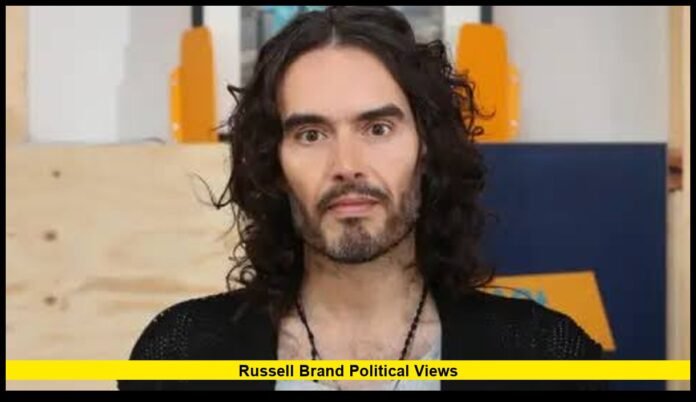

Russell Brand political views have attracted growing attention as the British comedian and former Hollywood actor has moved from progressive activism toward right-wing populism, conservative political commentary, and a stronger emphasis on religion and individual liberty. Once known for challenging capitalism and questioning conventional electoral politics, Brand has increasingly focused on government accountability, media distrust, censorship, and opposition to established political institutions.
His transformation illustrates how political identities can change when public figures reconsider traditional party loyalties and build audiences through independent media. Brand’s support for Donald Trump, criticism of mainstream journalism, and discussions about Christianity have made him a recognizable voice in debates that extend beyond British politics into the American conservative movement.
His public profile also faces a significant legal development. On November 5, 2026, a British jury found Brand guilty of one count of rape and three counts of sexual assault following a criminal trial. He denied the charges and was acquitted of two additional rape charges and attempted indecent assault. The convictions have added another major dimension to public discussion surrounding his career and influence.
Understanding his political evolution requires looking at his early activism, his changing views on government authority, his relationships with conservative political figures, and the controversies surrounding his online commentary.
Key Points Summary
╔════════════════════════════════════════════════════════════════════╗
║ – Russell Brand developed a public reputation through progressive activism and criticism of economic inequality. ║
║ – His political commentary increasingly shifted toward conservative populism, individual liberty, and opposition to established institutions. ║
║ – Brand supported Donald Trump during the 2024 presidential election and attended major Republican political events. ║
║ – Government accountability, free speech, media criticism, and religious faith remain prominent themes in his public messaging. ║
║ – His independent online platforms have helped him reach audiences interested in alternative political commentary. ║
║ – On November 5, 2026, a British jury convicted Brand of rape and three counts of sexual assault; he denied the charges. ║
╚════════════════════════════════════════════════════════════════════╝
Who Is Russell Brand?
Russell Brand is a British comedian, actor, author, and online commentator who first became widely known through stand-up comedy, television presenting, and radio broadcasting. His energetic performance style, outspoken personality, and willingness to discuss controversial subjects helped him establish a distinctive public image.
During the 2000s and early 2010s, Brand appeared in Hollywood productions, released books, and developed a reputation as a provocative entertainer. Over time, however, his interests increasingly moved beyond entertainment into political debate, social criticism, and discussions about personal transformation.
His 2014 book, Revolution, represented an important stage in this transition. Rather than concentrating exclusively on his entertainment career, Brand questioned conventional political structures and called for fundamental changes to economic and social systems.
He also began using digital platforms to communicate directly with audiences. This allowed him to discuss politics without depending entirely on traditional television networks or established news organizations.
As his online presence grew, political commentary became a central feature of his public identity.
How Russell Brand’s Political Beliefs Developed
Brand’s early political activism was associated with progressive ideas, particularly criticism of economic inequality, corporate influence, and the concentration of power.
He frequently questioned whether established political parties adequately represented ordinary citizens. In his view, electoral competition did not necessarily address the deeper economic structures that influenced people’s lives.
His arguments reflected several recurring concerns.
Economic inequality: Brand criticized systems that allow wealth and political influence to accumulate among a relatively small number of powerful individuals and organizations.
Corporate power: He questioned the relationship between business interests and government decision-making, arguing that commercial influence could undermine democratic accountability.
Political participation: He challenged the assumption that voting alone was sufficient to produce meaningful social change. His earlier commentary encouraged people to consider broader forms of civic engagement.
Social justice: Poverty, unequal opportunities, and the treatment of disadvantaged communities were important themes in his progressive-era activism.
Institutional accountability: Even before his later conservative turn, Brand frequently questioned established authorities and encouraged audiences to challenge conventional assumptions.
These positions helped him attract viewers who were frustrated with traditional politics. His criticism of the establishment was not initially associated exclusively with the political right.
Instead, he presented himself as an outsider challenging a political and economic system that he believed had failed ordinary people.
Why Russell Brand Moved Toward Conservative Populism
Brand’s political evolution became more visible as his online commentary expanded to cover public health, cultural disagreements, government restrictions, and the relationship between media organizations and political power.
The COVID-19 pandemic marked an important period in this development. Brand increasingly questioned government restrictions and public-health decisions, placing greater emphasis on individual choice, institutional transparency, and freedom of expression.
Some of his commentary involved disputed claims about powerful institutions and controversial interpretations of public events. Critics argued that certain presentations lacked adequate evidence, while supporters viewed his willingness to challenge official narratives as a valuable alternative to conventional media coverage.
His subject matter also began overlapping more frequently with discussions popular among conservative and libertarian commentators.
This did not mean that every aspect of his earlier worldview disappeared. His distrust of concentrated power and criticism of influential elites remained important elements of his public identity.
The change was more apparent in the political alliances, cultural issues, and media personalities with which he became associated.
Today, describing Brand simply as a former left-wing activist would overlook the complexity of his current public position. His commentary draws on populist distrust of institutions while increasingly engaging with themes associated with the American political right.
Russell Brand’s Support for Donald Trump
Donald Trump became a major focus of Brand’s political commentary during the 2024 U.S. presidential election.
Brand publicly expressed support for Trump, presenting the Republican candidate as a political figure associated with challenging established institutions and defending individual freedom.
This endorsement attracted attention because Brand had previously built his political reputation through criticism of capitalism and traditional political elites. His support for Trump illustrated how his anti-establishment outlook had developed in a different ideological direction.
Brand attended the Republican National Convention in Milwaukee, Wisconsin, in July 2024. The event brought him into the broader political environment surrounding Trump’s presidential campaign.
He also attended Trump’s inauguration in January 2025, further strengthening the association between Brand’s public image and the American conservative movement.
Several issues help explain the connection between his commentary and Trump’s political appeal.
- Distrust of established media: Both Brand’s commentary and Trump’s political messaging frequently challenge the credibility of mainstream news organizations.
- Opposition to political elites: Brand’s criticism of powerful institutions overlaps with Trump’s populist presentation of himself as an opponent of the political establishment.
- Free speech: Brand frequently discusses censorship, online expression, and restrictions on political debate.
- Government accountability: He emphasizes the need to question official decisions and scrutinize those exercising public authority.
However, Brand’s support for Trump should not be interpreted as proof that he agrees with every Republican policy. His political commentary often focuses on broad themes rather than presenting a comprehensive party platform.
He is also a British public figure, not an American citizen entitled to vote in U.S. federal elections simply because he supports a presidential candidate.
Did Russell Brand Support Robert F. Kennedy Jr.?
Brand also expressed support for Robert F. Kennedy Jr. during the 2024 presidential campaign, when Kennedy was running as an independent candidate.
Kennedy attracted attention by challenging established political institutions and raising questions about government transparency and public-health policy. These subjects overlapped with Brand’s growing interest in institutional accountability and individual freedom.
His support for Kennedy demonstrated that his political interests were not always confined to the traditional Democratic-Republican divide.
As the campaign progressed, Brand also expressed support for Trump. This movement between political figures helps explain why his ideological identity is sometimes described through several overlapping labels.
His political approach is better understood through his stated priorities and public endorsements than through an assumption that he follows every conventional position associated with one party.
Free Speech and Russell Brand’s Criticism of Mainstream Media
Free speech has become one of the most recognizable themes in Brand’s online commentary.
He frequently questions whether governments, technology companies, and media organizations exercise too much influence over the information people encounter. His discussions often emphasize the importance of allowing unpopular opinions and challenging widely accepted narratives.
Brand’s criticism of mainstream journalism also reflects a broader shift in how people consume political information.
Traditional news organizations operate through editorial structures, professional reporting practices, and established standards for verification. Independent commentators can publish directly to their audiences, offering different interpretations and perspectives.
This freedom can broaden public discussion, but it also creates challenges.
Information shared through online platforms may not receive the same level of editorial scrutiny as professionally reported news. Opinion, speculation, and verified facts can appear together in a single video or discussion, making it harder for audiences to distinguish between them.
Brand’s supporters argue that his commentary encourages skepticism toward powerful institutions. Critics contend that skepticism becomes problematic when disputed allegations are presented without sufficient evidence.
A useful way to evaluate his arguments is to examine specific claims individually, consider the available evidence, and distinguish documented events from personal interpretations.
Questioning established authorities is a legitimate part of democratic debate, but alternative commentators should be held to the same standards of accuracy as traditional media organizations.
Russell Brand’s Views on Religion and Christianity
Religion has become increasingly prominent in Brand’s public life.
In 2024, he was baptized in the River Thames and began discussing his Christian faith more openly. His public commentary has since included greater attention to spirituality, moral responsibility, redemption, and the search for meaning.
This development added a religious dimension to a public identity previously associated mainly with comedy, provocative interviews, and political activism.
Brand has connected faith with questions about modern culture, personal freedom, and the responsibilities individuals have toward one another.
His religious discussions sometimes intersect with conservative cultural commentary, particularly when he addresses traditional values and the role of spirituality in public life.
Nevertheless, Christian belief does not automatically determine a person’s position on every political issue. Religious communities contain a wide range of political perspectives, including progressive, conservative, and independent traditions.
Brand’s faith is therefore best understood as one element of his evolving public identity rather than a complete explanation for his political views.
Is Russell Brand a Conservative, Libertarian, or Populist?
No single political label fully captures Brand’s public commentary.
Conservatism can emphasize traditional values, social stability, national identity, and particular approaches to economic policy. Libertarianism prioritizes individual liberty and limits on government authority. Populism frames political conflict as a struggle between ordinary citizens and powerful elites.
Brand’s views overlap with all three in different ways.
His criticism of government restrictions and emphasis on personal freedom resemble libertarian arguments. His support for Trump and participation in Republican political events connect him with the American conservative movement.
Meanwhile, his continuing criticism of political elites, major corporations, and established media reflects a populist outlook.
His earlier progressive activism also remains relevant to understanding his development. His opposition to economic inequality and corporate influence demonstrates that his political journey did not follow a simple path from one established party to another.
For that reason, right-wing populist commentator is a useful description of his more recent political alignment, although it does not encompass every subject he discusses.
How Social Media Changed Russell Brand’s Political Influence
Online platforms have transformed Brand’s ability to reach audiences.
Rather than relying primarily on television appearances and entertainment projects, he has developed a digital presence built around political discussions, interviews, commentary, and personal reflections.
This approach gives him greater control over his content and enables him to address subjects that might not receive extended attention in conventional broadcasting.
His audience includes people interested in alternative political viewpoints, distrust of established institutions, and debates about freedom and cultural change.
Digital media also allows political personalities to develop strong relationships with followers who feel disconnected from traditional political organizations.
However, popularity should not be confused with accuracy. A large audience does not establish that every claim made by a commentator is correct, just as criticism from established institutions does not automatically prove that a claim is false.
Readers and viewers benefit from comparing information across independent sources and examining whether evidence supports the conclusions being presented.
Brand’s career illustrates both the opportunities and the risks of political communication in an environment where independent personalities can influence public debate without holding elected office.
Latest Developments and Controversies Surrounding Russell Brand
Brand’s public reputation has been affected by controversies involving his online commentary and allegations of sexual misconduct.
On November 5, 2026, a jury at Southwark Crown Court in London found him guilty of one count of rape and three counts of sexual assault following a four-week criminal trial. The offenses involved four women and dated from 2004 to 2009.
He was acquitted of two other rape charges and one charge of attempted indecent assault. Brand denied the charges against him.
The verdicts represent a major development in his public life and are separate from his political positions. They also make it important to distinguish established legal outcomes from allegations and political commentary when discussing his reputation.
The case has drawn renewed attention to questions about celebrity influence, accountability, and the treatment of people who report sexual offenses.
For audiences following his political commentary, the development also underscores the importance of evaluating public figures critically rather than allowing political agreement or disagreement to replace careful consideration of verified facts.
Why Russell Brand’s Political Views Matter Today
Brand’s political journey reflects wider changes in public attitudes toward established institutions and political communication.
Some people who once supported progressive movements have become more skeptical of mainstream liberal institutions. Others have moved toward conservative or libertarian commentators because they believe traditional political organizations fail to address their concerns.
Brand’s changing outlook brings several debates together: economic inequality, government power, freedom of expression, cultural identity, religion, and the influence of digital media.
His supporters may see him as a public figure willing to challenge conventional narratives. His critics argue that his commentary sometimes promotes disputed claims and that his political arguments require closer scrutiny.
These competing assessments help explain why he continues to attract attention across ideological boundaries.
The broader lesson is that political identity is rarely understood through a single endorsement or statement. Examining a person’s changing positions, public alliances, and arguments provides a more complete picture than relying on a single label.
Frequently Asked Questions About Russell Brand’s Political Views
1. What are Russell Brand’s political views?
Brand’s political outlook has evolved from progressive activism and criticism of capitalism toward right-wing populism. His recent commentary emphasizes individual liberty, free speech, government accountability, and skepticism toward established institutions.
2. Does Russell Brand support Donald Trump?
Yes. Brand publicly supported Trump during the 2024 presidential election, attended the Republican National Convention, and attended Trump’s inauguration in January 2025.
3. Was Russell Brand previously a left-wing activist?
Yes. He became known for criticizing economic inequality, corporate power, and conventional political systems. His 2014 book, Revolution, reflected many of those earlier concerns.
4. Is Russell Brand a conservative?
His recent public associations and political commentary place him closer to conservative populism than his earlier activism did. However, his broader criticism of powerful institutions means that no single ideological label captures all his positions.
5. Does Russell Brand support free speech?
Brand frequently argues that governments, media organizations, and digital platforms can restrict public debate. His supporters view this as a defense of open discussion, while critics question some of the claims he promotes.
6. What role does Christianity play in his public life?
Brand was baptized in 2024 and has discussed Christian faith, redemption, spirituality, and moral responsibility. Religious themes have become more prominent in his public commentary.
7. Did Russell Brand support Robert F. Kennedy Jr.?
Yes. Brand expressed support for Kennedy during the 2024 independent presidential campaign before also publicly supporting Trump.
8. What happened to Russell Brand in November 2026?
On November 5, 2026, a British jury convicted Brand of one count of rape and three counts of sexual assault. He denied the charges and was acquitted of two additional rape charges and attempted indecent assault.
9. Why did Russell Brand change his political outlook?
There is no single established explanation. His increasing focus on government restrictions, free speech, institutional distrust, conservative commentators, and religious faith has contributed to the change in his public political identity.
Conclusion
Russell Brand’s political evolution illustrates the changing boundaries of contemporary political debate. His journey from progressive activism to conservative populist commentary has brought him into discussions about free speech, government accountability, religious faith, and the influence of online personalities.
His support for Donald Trump and his criticism of established institutions have reshaped how many people understand his politics. At the same time, controversy surrounding his commentary and the November 2026 criminal convictions has made his public reputation increasingly complex.
Understanding his political position requires looking beyond a single label and considering the evolution of his public statements, the issues he prioritizes, and the evidence supporting his claims.
What do you think about Russell Brand’s political evolution? Share your opinion in the comments and keep following the latest developments in politics, media, and celebrity culture