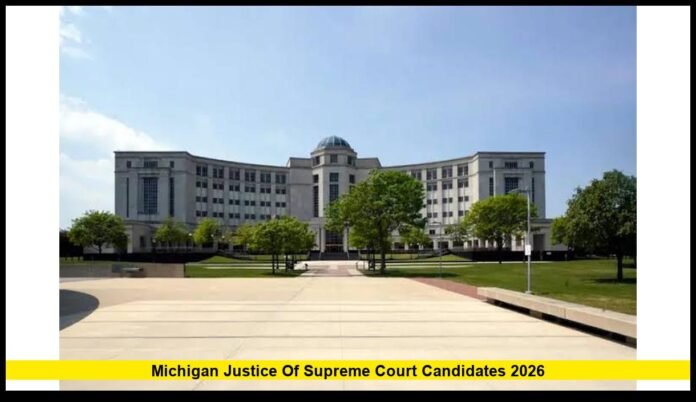

The Michigan Justice of Supreme Court candidates 2026 are competing for two seats on the state’s highest court in the November 3 general election. The six candidates are Chief Justice Megan Cavanagh, Justice Noah Hood, Casandra Morse-Bills, Michael D. Warren Jr., Thomas W. Howe, and Jody White. Their backgrounds, judicial experience, and approaches to the law are important considerations for voters deciding who should serve on Michigan’s Supreme Court.
The election is taking place on Election Day, November 3, 2026. Two seats are available, and each carries an eight-year term. Although candidates appear on the ballot without party labels, political parties have nominated them through their state conventions. The Democratic Party nominated the two sitting justices, the Republican Party selected two circuit court judges, and the U.S. Taxpayers Party nominated two additional candidates.
This judicial contest matters because the Michigan Supreme Court makes final decisions on questions of state law, reviews constitutional disputes, and influences how legal protections are interpreted throughout Michigan. Voters choosing the next justices will help shape the court’s membership and its approach to significant legal issues.
Michigan Supreme Court Election 2026: Key Details
Michigan voters are choosing two justices from a field of six candidates. Unlike elections in which voters select one candidate for a single position, this contest allows the two candidates who receive the most votes to win the available seats, subject to applicable election and certification procedures.
The principal details of the election are:
- Election Day: November 3, 2026.
- Office: Justice of the Michigan Supreme Court.
- Number of available seats: Two.
- Term length: Eight years for each seat.
- Number of listed candidates: Six.
- Ballot format: Nonpartisan.
- Party nominations: Democratic, Republican, and U.S. Taxpayers Party conventions.
The candidates listed for the election are Megan Cavanagh, Noah Hood, Thomas Howe, Casandra Morse-Bills, Michael Warren, and Jody White. The official candidate listing identifies Cavanagh and Hood as incumbents.
As of the latest available election-day information, the six candidates remain the field for the two positions. Election results should not be treated as final until the appropriate election authorities have reported and certified them. No winner should be declared solely on the basis of campaign statements or unverified preliminary figures.
Who Are the Michigan Justice of Supreme Court Candidates 2026?
The six candidates have different professional backgrounds. Two are already serving on the Michigan Supreme Court, two are experienced circuit court judges, and two were nominated by the U.S. Taxpayers Party.
Megan Cavanagh
Megan Cavanagh is the incumbent chief justice of the Michigan Supreme Court and the Democratic Party’s nominee for another term. She was first elected to the court in 2018 and became chief justice in March 2025 after being selected unanimously by her fellow justices.
Cavanagh earned an undergraduate degree in environmental engineering from the University of Michigan and a law degree from Wayne State University Law School. Before joining the Supreme Court, she worked as an appellate attorney, gaining experience with cases involving the interpretation and application of existing law.
Her professional background combines legal practice with experience in a technical field. As chief justice, she also holds a leadership position within Michigan’s judicial system.
Cavanagh’s candidacy gives voters an opportunity to evaluate the work of an incumbent justice and her leadership of the state’s highest court. Her record, judicial opinions, and stated priorities are relevant considerations for voters assessing her bid for another eight-year term.
Noah Hood
Noah Hood is the second incumbent seeking a full term on the Michigan Supreme Court. Governor Gretchen Whitmer appointed him to the court in April 2025 following the departure of former Chief Justice Elizabeth Clement.
Hood previously served as a judge on the Wayne County Circuit Court and the Michigan Court of Appeals. He also presided over Detroit’s Veterans Treatment Court. Before his judicial appointments, he worked in the U.S. Attorney’s Office in Toledo, Ohio.
He graduated from Yale University and earned his law degree from Harvard Law School.
Hood’s experience across trial-level and appellate courts is a central part of his professional background. His work at different stages of the judicial process provides experience with trial proceedings, legal appeals, and the application of law to individual cases.
The 2026 election represents his first campaign for a full elected term on the Michigan Supreme Court. Voters can consider his judicial experience, decisions, and approach to impartiality when evaluating his candidacy.
Casandra Morse-Bills
Casandra Morse-Bills is the Republican Party’s nominee and a sitting circuit court judge. She presides over Michigan’s 23rd Judicial Circuit, which serves Alcona, Arenac, Iosco, and Oscoda counties.
Before becoming a judge, Morse-Bills served as the Oscoda County prosecuting attorney. She was first elected to the bench in 2018 and won another term in 2024. Her background includes criminal prosecution and judicial responsibilities at the local level.
Morse-Bills completed her undergraduate education at the University of South Florida and earned her law degree from Thomas M. Cooley Law School in Lansing.
Her experience in prosecution and circuit court proceedings distinguishes her professional background from those of the two incumbent Supreme Court justices. If elected, she would move from a regional trial court to Michigan’s highest court, where cases involve major questions of statutory interpretation, constitutional law, and appellate review.
Voters considering Morse-Bills may examine her judicial record, professional experience, and explanations of how she would approach the responsibilities of a Supreme Court justice.
Michael D. Warren Jr.
Michael D. Warren Jr. is the other Republican nominee. He has served as a judge in Oakland County and was appointed to the Sixth Circuit Court in December 2022 by then-Governor John Engler.
Warren earned his undergraduate degree from Wayne State University and his law degree from the University of Michigan Law School. He has also taught business law at Wayne State University and previously taught constitutional law at Western Michigan University’s Cooley Law School.
His background includes judicial service, legal education, and teaching. These experiences are relevant to the Supreme Court’s work, which frequently requires judges to interpret complex statutes, assess constitutional arguments, and explain the legal reasoning behind their decisions.
Warren has emphasized his trial experience and his view that judges should apply the law rather than make policy from the bench. Those statements form part of his public case for election, while voters can separately examine his record and judicial philosophy.
His campaign, alongside Morse-Bills’s, offers voters an alternative to the two incumbent justices in the 2026 contest.
Thomas W. Howe
Thomas W. Howe is one of two candidates nominated by the U.S. Taxpayers Party. His name appears among the six candidates in the official listing for the November general election.
Howe’s candidacy is distinct from those of the incumbent justices and the Republican circuit court judges because he is running under the U.S. Taxpayers Party nomination.
An important qualification issue applies to Howe and the other U.S. Taxpayers Party nominee. Election coverage has reported that neither Howe nor Jody White is licensed to practice law in Michigan. Michigan’s constitutional and legal requirements for Supreme Court service include professional qualifications that affect eligibility to assume office.
Consequently, voters should distinguish between appearing on the ballot and satisfying the legal requirements to serve if elected. Howe’s listing as a candidate does not, by itself, establish that he meets every qualification for taking office. His eligibility should be understood in light of the applicable law and any authoritative determination by the appropriate officials or courts.
Jody White
Jody White is the second U.S. Taxpayers Party nominee for the Michigan Supreme Court. White is also among the six candidates officially listed for the two available seats.
White’s professional background differs from that of the candidates who have served as judges or practiced law. Published candidate information identifies real estate work as a major part of White’s professional experience, along with advocacy related to concerns about Michigan’s probate system.
White has described an interest in judicial accountability and problems encountered by individuals dealing with probate proceedings. Those concerns relate to an area of the court system that handles matters such as estates, guardianships, and certain disputes involving vulnerable individuals.
However, experience advocating for changes to the judicial system is not the same as being qualified to serve as a justice. As with Howe, reports about White’s lack of a Michigan law license raise a significant eligibility issue. Voters should not assume that ballot access automatically means a candidate can legally take office.
The inclusion of Howe and White in the election demonstrates why voters need to consider both a candidate’s stated priorities and the legal requirements associated with the position.
Why the Michigan Supreme Court Election Matters
The Michigan Supreme Court serves as the state’s highest judicial authority. Its decisions can affect residents, businesses, public institutions, government agencies, and lower courts across Michigan.
The court interprets Michigan’s Constitution and state laws. It also reviews selected appeals and resolves important legal disputes that may not have a further appeal within the state judicial system.
Its responsibilities can involve issues such as:
- Constitutional challenges to state laws and government actions.
- Criminal appeals and the interpretation of criminal statutes.
- Civil litigation involving individuals, organizations, and businesses.
- Election-related disputes and questions about ballot measures.
- Legal rules that govern lower state courts.
- Questions concerning the rights and responsibilities of Michigan residents.
The Supreme Court does not decide every legal disagreement in Michigan. Cases must reach it through the applicable legal process, and the court’s authority is governed by the state constitution and relevant statutes.
Nevertheless, its rulings can establish legal precedents that lower courts must follow. This gives the 2026 election significance beyond the individual candidates and their campaigns.
Political Balance of the Michigan Supreme Court
The composition of the Michigan Supreme Court has become an important part of the election debate. Before the November 2026 election, six of the court’s seven justices had been appointed or nominated by Democratic governors or through Democratic Party nominations.
The Democratic Party selected incumbents Cavanagh and Hood for the two seats on the ballot. Republicans nominated Morse-Bills and Warren, while the U.S. Taxpayers Party nominated Howe and White.
Because the seats are nonpartisan on the ballot, voters do not select candidates through party labels printed alongside their names. Nevertheless, party nominations, endorsements, campaign spending, and public statements have made political differences part of the broader election discussion.
The two available seats could affect the court’s membership and future ideological balance. However, the election should not be understood as a direct vote on every decision the court may make. Individual justices are expected to evaluate cases according to the law, the relevant facts, and applicable constitutional principles.
A justice’s party affiliation or nominating party alone does not establish how that person will rule in every case. Voters may gain a fuller understanding by reviewing judicial records, public statements, and the candidates’ explanations of their legal philosophies.
Latest Updates on the Michigan Supreme Court Candidates 2026
The latest available reporting confirms that the November 3 general election features six candidates competing for two Supreme Court seats. The incumbent justices are seeking continued service, while the Republican nominees are attempting to replace them. The U.S. Taxpayers Party candidates are also listed on the ballot.
Candidate forums and voter guides have provided additional information about the candidates’ experience and priorities. Some candidates have discussed their judicial philosophies, access to justice, courtroom experience, and approaches to constitutional interpretation.
Not every candidate participated in every voter guide. As a result, the amount of publicly available information may differ between candidates. An unanswered questionnaire should not automatically be interpreted as evidence of a particular legal position.
Election results remain a separate question from candidate status. Since November 3 is Election Day, early election-day coverage identifying the candidates does not establish who will win. Preliminary vote totals, when available, may change as additional ballots are counted and official procedures are completed.
For the most accurate election outcome, voters should rely on official Michigan election reporting and subsequent certification rather than predictions or unverified social media posts.
How Voters Can Evaluate the Candidates
A useful way to assess the Michigan Supreme Court candidates is to focus on their qualifications, records, and stated approaches to the law.
Judicial and legal experience: Examine whether candidates have worked as judges, attorneys, prosecutors, appellate specialists, or legal educators. Different forms of experience can provide different perspectives, but professional qualifications for the office remain essential.
Judicial philosophy: Consider how candidates explain constitutional interpretation, the role of precedent, and the responsibility of judges to apply the law impartially.
Public record: For sitting justices and judges, relevant decisions and professional histories may help voters understand their approaches to legal disputes.
Transparency and accountability: Review whether candidates explain their priorities clearly and address the responsibilities and limitations of judicial office.
Eligibility requirements: Confirm that candidates meet the constitutional and statutory qualifications required to serve. This is especially relevant when public reporting raises questions about professional licensing.
These considerations can help voters make a more informed decision without relying exclusively on party endorsements or campaign advertisements.
Final Thoughts on Michigan Justice of Supreme Court Candidates 2026
The Michigan Justice of Supreme Court candidates 2026 election gives voters the opportunity to influence the composition of the state’s highest court for years to come. Megan Cavanagh and Noah Hood are the Democratic nominees seeking continued service, while Casandra Morse-Bills and Michael Warren represent the Republican Party. Thomas Howe and Jody White complete the six-candidate field under the U.S. Taxpayers Party nomination.
The two seats carry eight-year terms, and the court’s decisions can shape constitutional interpretation, criminal law, civil disputes, and the operation of Michigan’s judicial system. Understanding each candidate’s experience, public positions, and eligibility is therefore an important part of evaluating the race.
As election-day reporting develops, readers should distinguish confirmed candidate information from preliminary vote totals and wait for authoritative results before treating the outcome as final. The candidates’ backgrounds and the court’s responsibilities provide the context needed to understand why this judicial election matters to Michigan residents.
Share your thoughts in the comments and stay updated for verified developments in the Michigan Supreme Court election and its official results.