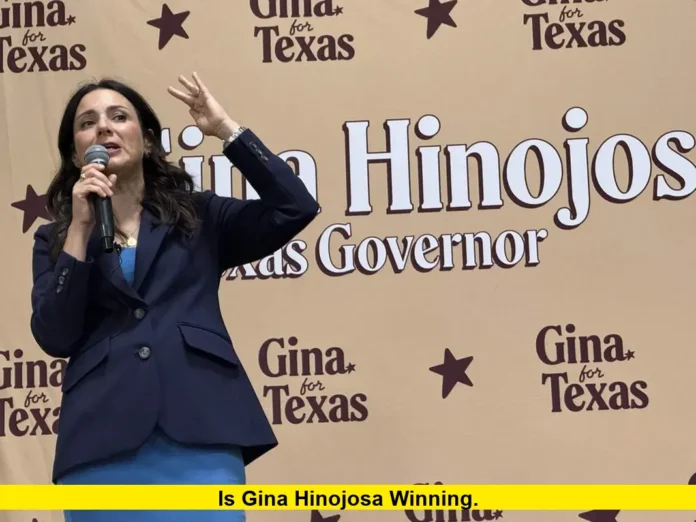

The question is Gina Hinojosa winning is drawing attention as Texas voters decide whether to elect the Democratic state representative as their next governor or give Republican incumbent Greg Abbott another term. The Texas governor’s race is being closely watched because recent polling has shown a competitive contest, with the candidates separated by only a few percentage points in several surveys.
As of the latest available information on Election Day, November 3, 2026, there is no confirmed winner in the Texas governor’s race. Pre-election polling generally gives Abbott a narrow lead, although at least one major final poll has placed Hinojosa slightly ahead. Prediction markets, including Kalshi, also indicate that Abbott entered Election Day as the favorite. However, neither polling numbers nor market probabilities establish the final result.
Hinojosa’s campaign has focused on public education, household affordability, government accountability, and the cost of living in Texas. Her challenge is to turn growing attention to those issues into enough votes to defeat a Republican incumbent who has won statewide elections repeatedly.
The central point is that Gina Hinojosa remains a competitive candidate, but she has not been confirmed as the winner. The final outcome depends on ballots cast, votes counted, and the official election results.
Is Gina Hinojosa Winning the Texas Governor’s Election?
As of the latest available pre-election information, the answer is not yet known. Election Day is November 3, and the final outcome cannot be determined from pre-election surveys alone.
Recent polling has placed Hinojosa and Abbott within a relatively narrow range. Several surveys conducted during the final days of October showed Abbott leading, while a New York Times/Siena College survey released around Election Day showed Hinojosa narrowly ahead.
The variation between polls matters because it indicates that the race is competitive. Small differences in survey methods, voter turnout assumptions, undecided voters, and the timing of interviews can produce different estimates.
The available information points to three important conclusions:
- No confirmed winner: A candidate cannot be declared the winner simply because a poll or prediction market favors that person.
- A close polling contest: Hinojosa has remained within striking distance of Abbott in multiple final-week surveys.
- An advantage for Abbott in broader forecasts: Several election models and prediction markets have continued to favor the incumbent despite signs of a closer contest.
These findings are not contradictory. Polls estimate voter preferences, election forecasts combine polling with other factors, and prediction markets reflect the prices traders are willing to pay for particular outcomes.
For voters searching for the latest Gina Hinojosa election results, the distinction between a projected outcome and a certified result is especially important. Until reliable election-night reporting provides sufficient evidence to call the race, neither candidate should be described as the confirmed winner.
Latest Gina Hinojosa Election Update for November 3, 2026
The Texas governor’s election has reached its decisive stage, with Hinojosa challenging Abbott in the general election. Libertarian candidate Pat Dixon is also on the ballot.
The final days of the campaign have attracted attention because polling has suggested a closer contest than some earlier forecasts anticipated. Hinojosa has sought to make public schools, household expenses, and questions about the use of state resources central issues for voters.
Abbott, meanwhile, is seeking another term and retains the advantages associated with incumbency, an established statewide political operation, and a Republican voting base that has helped him win previous elections.
The election-day situation should be assessed using three separate measures.
Polling results: These show how surveyed voters say they intend to vote. They do not represent actual ballots counted on Election Day.
Election forecasts: These combine polling with factors such as political history, turnout, and campaign conditions to estimate the likelihood of different outcomes.
Official election returns: These reflect ballots reported by election authorities and provide the basis for determining the winner. Early returns can change as additional counties and voting locations report their totals.
The distinction is particularly important in a statewide race in Texas, where large urban counties, suburban communities, and rural areas can report different voting patterns. The order in which counties report results may also affect which candidate leads at a particular moment.
At this stage, the most accurate description is that Hinojosa is competing in a closely watched race against Abbott, with the winner still to be determined by the vote count.
What the Latest Polls Say About Gina Hinojosa and Greg Abbott
Polling is one of the main reasons the question of whether Gina Hinojosa is winning has attracted so much interest.
Several surveys released in the final days before the election showed Abbott with a modest advantage. However, a New York Times/Siena College poll conducted from October 27 through November 1 placed Hinojosa at 48% and Abbott at 47% among likely voters, suggesting a narrow Hinojosa lead within the survey’s margin of error.
Other late-October surveys produced different results. A YouGov poll placed Abbott at approximately 50% and Hinojosa at 49%, while a Texas Southern University survey showed Abbott ahead by a wider margin. CNN/SSRS and other pollsters also reported results that generally favored Abbott.
The disagreement between these surveys is a reminder that no individual poll can establish the election outcome.
| Polling measure | What it indicates |
|---|---|
| New York Times/Siena College | Hinojosa narrowly ahead, 48% to 47% |
| YouGov | Abbott narrowly ahead, 50% to 49% |
| Texas Southern University | Abbott ahead in the survey |
| CNN/SSRS | Abbott held a modest advantage |
| Broader polling averages | Generally showed Abbott leading by a small margin |
These figures represent pre-election polling, not official election results. Different surveys use different sample sizes, voter screens, field dates, and statistical adjustments, so their numbers should not be treated as perfectly interchangeable.
Why the Polling Gap Matters
A lead of one or two percentage points is relatively small in a statewide election. Depending on the poll, the difference may fall within the survey’s margin of error, meaning the results do not provide strong evidence that one candidate is definitively ahead among all voters.
Undecided voters can also affect the final margin. If enough undecided voters choose Hinojosa, she could outperform polls that show Abbott leading. If they break toward Abbott, the incumbent could strengthen his advantage.
Turnout is another important factor. A candidate can perform well in a poll but fall short if supporters do not cast ballots in sufficient numbers. Conversely, strong participation among a candidate’s core voters can help produce a better result than expected.
For Hinojosa, the polling figures demonstrate that a victory is possible. They do not establish that a victory has occurred.
Gina Hinojosa Kalshi Odds: What the Prediction Market Shows
Search interest in gina hinojosa kalshi reflects the growing use of prediction markets to follow major political contests.
Kalshi is a prediction-market platform where eligible participants trade contracts tied to specified future outcomes. Its Texas governor market allows participants to trade on which candidate will win, while related markets cover the percentage of the vote Hinojosa may receive.
In the latest available pre-election market snapshot, Kalshi favored Abbott over Hinojosa. One broader election-market listing placed Abbott’s chance of winning at approximately 67% and Hinojosa’s at approximately 34%, with small differences possible because of market spreads and timing.
Those figures are market-implied probabilities, not official forecasts from election administrators. They can change as traders respond to polls, campaign developments, legal disputes, turnout information, and other news.
How to Interpret Gina Hinojosa’s Kalshi Odds
A market probability of 34% does not mean that Hinojosa has received 34% of the votes. It means the market price has been interpreted as implying roughly that probability of the specified outcome, subject to trading spreads and the contract’s rules.
Likewise, Abbott’s higher market probability does not guarantee that he will win.
Prediction markets and opinion polls answer different questions. Polls measure the preferences reported by respondents. Election markets reflect the prices at which participants trade contracts connected to a defined outcome.
Market prices can also move rapidly. A new poll showing Hinojosa ahead could improve her implied odds, while a survey or development favoring Abbott could push them in the opposite direction.
The precise market percentage can vary depending on when it is checked and which contract is being viewed. A market asking whether Hinojosa will win is different from one asking whether she will receive at least 48% of the vote.
For that reason, readers should identify the exact Kalshi market before interpreting a displayed percentage. A vote-share contract is not the same as a winner-take-all election contract.
The latest available market signals favored Abbott, but they did not eliminate Hinojosa’s possibility of winning. The actual election outcome must be determined from the vote count rather than market prices.
What Does Gina Hinojosa Stand For?
The question what does Gina Hinojosa stand for is central to understanding why her campaign has attracted attention in the 2026 Texas governor’s election.
Hinojosa is a Democratic state representative from Austin who has built her political profile around public education, economic opportunity, government accountability, and policies intended to help working families. Her campaign presents these issues as connected: stronger public schools, more manageable household expenses, and greater accountability in state government can help Texans achieve financial stability.
Her priorities differ from Abbott’s Republican approach to governing, creating a clear contrast for voters deciding which candidate should lead Texas.
Public Education and Texas Schools
Public education is one of the most prominent issues in Hinojosa’s campaign.
She argues that Texas should strengthen its public school system and ensure that taxpayer funding supports students, teachers, and local schools. Her campaign has criticized policies that it believes divert public resources away from public education.
Her education priorities include:
- Increasing support for Texas public schools.
- Improving the resources available to teachers and students.
- Opposing school voucher policies that allow public funds to be used for eligible private-school expenses.
- Pausing or reconsidering the state’s A–F school accountability ratings system.
These positions are intended to appeal to families concerned about school funding, classroom resources, and the quality of public education.
Education is also a significant point of disagreement between Hinojosa and Abbott. Abbott has supported expanding school choice, including programs that provide public assistance for eligible private education expenses. Hinojosa has emphasized strengthening the public school system instead.
The disagreement gives voters a direct policy choice between the candidates.
Household Affordability and the Cost of Living
Hinojosa has also made affordability a major part of her campaign.
Housing expenses, property taxes, electricity bills, and everyday costs are important concerns for many Texas households. Her campaign argues that state government should do more to help residents manage these financial pressures.
Among the proposals associated with her platform are a one-time household payment of $1,500 funded through the state’s rainy-day resources, a temporary suspension of the state gasoline tax, and measures aimed at freezing residential electricity rates.
These are campaign proposals rather than benefits that Texans can automatically claim. Their implementation would depend on the applicable legal authority, legislative approval where required, and the details of any final policy.
That distinction matters because campaign promises do not become law simply because a candidate wins an election.
For voters comparing the candidates, the relevant question is how each proposal would be funded, who would qualify, how long the benefits would last, and what effects the measures might have on state finances.
Government Accountability and Corruption Concerns
Another major theme in Hinojosa’s campaign is government accountability.
She has criticized Abbott’s administration and argued that state resources should be directed toward public needs rather than benefiting politically connected interests. Her campaign uses the expression “Abbott Corruption Tax” to frame its argument that Texans bear the costs of questionable government decisions.
This is campaign rhetoric expressing Hinojosa’s political position, not an independently established tax or a separate tax that Texans pay under that name.
The broader issue is whether voters believe the governor and state agencies are using public money transparently and responsibly.
Hinojosa’s emphasis on accountability also gives her campaign a way to connect policy disagreements with concerns about public trust. Her argument is that stronger oversight and more responsible government spending could help improve services and protect taxpayers.
Voters should distinguish between documented findings, pending legal disputes, political allegations, and campaign characterizations when evaluating claims about government misconduct.
Economic Opportunity for Texas Families
Hinojosa’s campaign also emphasizes the idea that hard work should provide a realistic path to financial security.
Her approach focuses on public education, household costs, and the use of state resources. The campaign argues that Texas families should be able to build stable lives without being overwhelmed by rising expenses or seeing public services weakened.
This economic message is designed to reach more than one group of voters. Parents concerned about schools, homeowners dealing with property expenses, and working families facing higher bills may all find elements of the platform relevant to their circumstances.
However, the practical effects of the proposals would depend on their final design and implementation. Voters should consider the costs, funding mechanisms, eligibility rules, and potential trade-offs rather than evaluating the platform solely through its campaign messaging.
Who Is Gina Hinojosa? Her Political Career and Background
Gina Hinojosa is a Texas Democratic politician who represents a district in the Austin area in the Texas House of Representatives. Before seeking the governorship, she developed a political career centered on state legislation and issues affecting public institutions and families.
Her background is relevant to the governor’s contest because the office requires leadership over a large state government, including education, public safety, infrastructure, economic policy, and relations with the Texas Legislature.
As a state representative, Hinojosa has participated in the legislative process and developed positions on issues that have become central to her gubernatorial campaign.
Her campaign for governor is an attempt to move from the legislative branch into the state’s highest executive office.
That transition would involve a different set of responsibilities. A governor must work with lawmakers, oversee the executive branch within the powers established by Texas law, manage state priorities, and respond to emergencies and statewide challenges.
Hinojosa’s supporters argue that her legislative experience and focus on public services make her a credible alternative to Abbott. Critics may question whether her proposals are practical, whether they could secure sufficient legislative support, and whether she could manage the state government effectively.
Those questions are part of the broader debate voters face when choosing between an incumbent governor and a challenger.
Can Gina Hinojosa Beat Greg Abbott?
The question can Gina Hinojosa beat Greg Abbott has become especially relevant as the election approaches.
The available pre-election information indicates that she has a viable path to victory, although Abbott entered Election Day with an advantage in several forecasts and prediction markets.
There are several reasons the race deserves attention.
First, the polling gap is relatively small. Multiple surveys have placed the candidates within a few percentage points of one another. A narrow polling advantage is not a guarantee of victory, and the final result may differ from the estimates.
Second, the campaign has emphasized issues that directly affect household budgets. Public education, electricity costs, property-related expenses, and government accountability provide Hinojosa with a message focused on everyday concerns.
Third, the contest offers a clear choice between two different political approaches. Abbott’s record as governor and support for Republican policies are central to his campaign, while Hinojosa is asking voters to support a Democratic alternative.
Nevertheless, Abbott has important advantages. He is an established statewide officeholder, has won previous gubernatorial elections, and benefits from the existing Republican political base in Texas. His campaign experience and statewide recognition also matter in a contest involving millions of voters.
The state’s political history is another consideration. Texas has generally favored Republican candidates in recent statewide elections, creating a structural challenge for Democrats seeking the governorship.
Hinojosa would therefore need to assemble a broad coalition of voters, including strong Democratic participation and enough support from independents and other persuadable voters to overcome Abbott’s advantages.
What Could Help Hinojosa Win?
Several factors could improve Hinojosa’s chances of defeating Abbott.
- Strong turnout among Democratic voters: High participation in Democratic-leaning communities could help narrow the statewide gap.
- Support from independent voters: Persuading voters who are dissatisfied with the incumbent or undecided about the candidates could prove important.
- A strong response to affordability concerns: Voters who prioritize school funding, household expenses, and government accountability may be receptive to her message.
- A favorable final vote distribution: Her chances would depend on how support is distributed across major metropolitan areas, suburbs, and other parts of Texas.
- Undecided voters breaking in her favor: A late shift could change the outcome if enough voters move toward Hinojosa.
These are factors that could influence the result, not evidence that any particular outcome has occurred.
What Could Keep Abbott Ahead?
Abbott’s position is supported by his incumbency, his established Republican coalition, and the state’s recent statewide voting patterns.
If Republican voters turn out in large numbers and the incumbent retains enough support among suburban and independent voters, Abbott could maintain his advantage.
The polling picture also matters. Although Hinojosa has appeared ahead in at least one prominent final survey, several other polls have continued to show Abbott leading. The overall pattern does not establish a clear Hinojosa advantage.
Consequently, the evidence supports describing the election as competitive rather than predicting that the challenger will win.
Bottom line: Gina Hinojosa can beat Greg Abbott, but the latest available pre-election evidence does not establish that she will. The result depends on actual voter turnout and the final count.
Why the Texas Governor’s Race Matters Beyond Election Day
The contest is significant because the governor has substantial influence over the direction of state government.
Although the governor cannot unilaterally enact every campaign proposal, the office carries important responsibilities involving the state budget, executive agencies, appointments, legislative priorities, and emergency management.
The winner will face decisions affecting education, taxes, economic development, public safety, energy policy, and the delivery of state services.
For Hinojosa, winning would represent a major change in Texas leadership and give Democrats an opportunity to pursue a different set of priorities. For Abbott, another victory would provide an additional term to continue his existing policy agenda.
The outcome could also influence the broader political landscape. A close contest would demonstrate the importance of turnout and voter persuasion in Texas, while a decisive result would provide a clearer indication of the balance of support between the parties.
However, one election should not automatically be interpreted as proof that the entire state has shifted permanently toward either party. Individual races are influenced by candidates, campaigns, national political conditions, and the specific issues voters consider most important.
The practical consequences of the election will become clearer after the results are established and the winning candidate’s governing priorities take shape.
How to Read Gina Hinojosa Election Results as Votes Are Counted
As election returns become available, readers should pay attention to the status of the results rather than relying exclusively on headlines or social media posts.
Several terms are particularly important.
Unofficial results are preliminary totals reported during the counting process. These numbers can change as additional ballots are counted and election officials complete their work.
Projected winner means a news organization or election-analysis organization has determined that the available evidence supports calling the race for a candidate. A projection is not the same as official certification.
Certified results are the final results formally established through the applicable election-administration process.
A candidate who leads in early returns may not necessarily win. The effect of later-counted ballots depends on where they originate, the voting methods involved, and the preferences of those voters.
Readers should also distinguish between the statewide popular vote and individual county results. A candidate can lead in a particular county without leading statewide, and a strong performance in one part of Texas does not independently determine the winner.
For those following Hinojosa and Abbott, the most useful approach is to evaluate the statewide totals alongside the amount of the vote reported, the remaining ballots to be counted, and the status of the race call.
As of the latest available pre-election information used in this article, there is no confirmed winner to report.
Latest Update: What Readers Should Know About Gina Hinojosa
The main developments shaping interest in Hinojosa’s campaign are the close polling contest, the contrast between her policy platform and Abbott’s record, and the prediction-market odds favoring the incumbent.
The latest available polling showed a race in which Hinojosa was competitive but did not hold a consistent lead across surveys. The New York Times/Siena College poll placed her slightly ahead, while several other surveys favored Abbott.
Kalshi’s broader governor-election market also favored Abbott before Election Day. That market signal reflects traders’ expectations, not votes already counted or a guaranteed outcome.
These indicators provide useful context for understanding the contest, but they should not be confused with live election returns. A current, verified vote total or official race call would be needed to establish whether either candidate has won.
The most responsible conclusion is therefore straightforward: Hinojosa entered Election Day with a credible opportunity to challenge Abbott, but her victory remains unconfirmed in the latest available pre-election information.
Final Thoughts: Is Gina Hinojosa Winning?
The answer to is Gina Hinojosa winning depends on whether the question refers to pre-election polling, prediction-market expectations, or the actual election result.
Before the vote count, Hinojosa had reasons to remain competitive. Several polls showed a close race, and one prominent final survey placed her narrowly ahead of Abbott. Her campaign’s emphasis on public education, affordability, and government accountability also established a clear contrast with the incumbent’s policy agenda.
At the same time, Abbott entered Election Day favored by several polling averages and prediction markets. His incumbency and Texas’s recent Republican voting history presented substantial challenges for the Democratic challenger.
Neither set of indicators proves the outcome. Polls can be wrong, market probabilities can change, and election-night leads can shift as additional votes are counted.
Until verified results establish a winner, it would be inaccurate to declare either candidate victorious. Readers following the race should distinguish between the latest forecasts and the final official outcome.
What do you think will decide the Texas governor’s race between Gina Hinojosa and Greg Abbott? Share your thoughts in the comments and stay updated as verified election results become available.