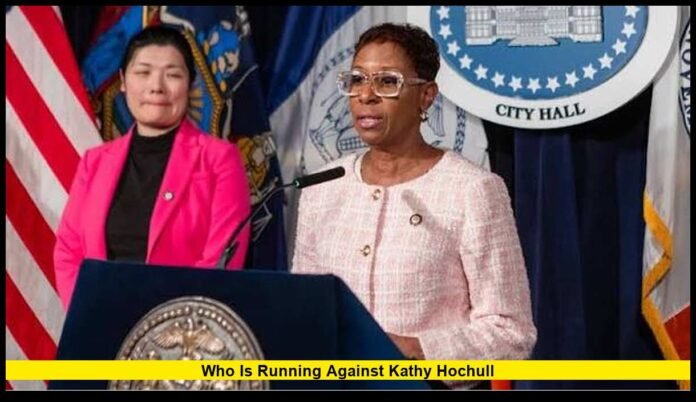

New York’s 2026 gubernatorial election has brought renewed attention to the question, who is running against Kathy Hochul as the Democratic incumbent seeks another term as governor. Her principal opponent is Republican Bruce Blakeman, the Nassau County executive, who is campaigning on affordability, taxes, public safety, immigration, and government spending. The election also features candidates outside the two major parties, giving voters additional choices as they decide the future political direction of New York.
The contest is important because New York continues to face major economic and public policy challenges. Rising housing costs, pressure on household budgets, transportation expenses, business competitiveness, and concerns about public safety have become central subjects in the campaign. Hochul is defending her administration’s record, while Blakeman is presenting himself as an alternative to the policies currently guiding the state.
The November 3, 2026, election will determine whether Hochul continues in office or New York begins a new chapter under different leadership. The governor’s position carries significant influence over state budgets, legislation, infrastructure, public services, and economic priorities.
Bruce Blakeman: The Republican Challenging Kathy Hochul
Bruce Blakeman is the principal Republican candidate in New York’s 2026 gubernatorial election. He serves as Nassau County executive, a position that places him at the center of local government on Long Island. His campaign is built around the argument that New York needs a different approach to managing public finances, improving public safety, and making the state more affordable for residents.
Blakeman has sought to appeal to voters who are concerned about taxes, government spending, immigration enforcement, and the financial pressures facing families and businesses. His campaign presents his local-government experience as a foundation for leading the state.
As a Republican, Blakeman also offers voters an alternative to the Democratic policies associated with Hochul’s administration. His challenge is to turn dissatisfaction with state government into sufficient statewide support, including in areas where Democratic candidates traditionally perform well.
Blakeman’s major campaign priorities include:
- Lowering the cost of living: Addressing taxes and other expenses that affect households and businesses.
- Public safety: Supporting law enforcement and advocating changes to policies he believes undermine effective crime prevention.
- Government spending: Calling for greater fiscal discipline and scrutiny of state expenditures.
- Immigration enforcement: Seeking a different approach to cooperation between state authorities and federal immigration agencies.
- Business competitiveness: Promoting policies intended to make New York more attractive to employers and investors.
Blakeman’s campaign centers on the belief that changes in leadership and policy could improve the state’s economic outlook. Voters will decide whether his proposals offer a more effective alternative to the incumbent administration.
Kathy Hochul’s Record as New York Governor
Kathy Hochul became governor in August 2021 after Andrew Cuomo resigned. She subsequently won the 2022 gubernatorial election, becoming the first woman elected governor of New York in her own right.
Before becoming governor, Hochul served as lieutenant governor and represented New York’s 26th Congressional District in the U.S. House of Representatives. Her background in federal, state, and local politics has shaped her approach to governing.
In the current campaign, Hochul is seeking to build on her administration’s record while addressing concerns about housing, household expenses, transportation, public services, and economic development.
Her supporters argue that continued Democratic leadership would provide stability and allow the administration to pursue policies already underway. Her critics contend that the state continues to face persistent problems that require a different strategy.
The main areas of Hochul’s policy agenda include:
- Housing affordability: Encouraging housing construction and addressing the shortage of available homes.
- Economic development: Supporting business investment, employment, and long-term economic growth.
- Transportation and infrastructure: Maintaining and improving important public transportation systems and infrastructure.
- Public safety: Pursuing policies intended to address crime and improve community security.
- Public services: Funding and managing essential state programs, including education and other services relied on by residents.
Hochul’s reelection campaign requires her to demonstrate that her administration has made meaningful progress on these issues. It also requires her to persuade voters that her plans can deliver further improvements.
Who Are the Other Candidates in the 2026 Governor’s Race?
Although Hochul and Blakeman are the central figures in the contest, the election includes additional candidates associated with smaller political parties and independent candidacies.
Jean Anglade is listed as an independent write-in candidate, while Jonathan Makeley is associated with the Prohibition Party as a write-in candidate. Their participation gives voters additional options beyond the Democratic and Republican tickets.
Write-in candidacies differ from candidates printed directly on the ballot. Voters who wish to support an eligible write-in candidate generally need to follow the applicable ballot instructions and enter the candidate’s name correctly.
The presence of these candidates does not necessarily mean that the contest is equally competitive among all participants. Hochul and Blakeman are the principal candidates representing the two major parties.
New York also uses a fusion-voting system, which allows candidates to receive votes on multiple party lines. Consequently, Hochul appears on both the Democratic and Working Families Party lines, while Blakeman appears on the Republican, Conservative, and Vote Affordable lines.
This arrangement can make the ballot look more complicated than a simple two-candidate contest. However, the same candidate’s votes across different party lines contribute to that candidate’s overall electoral total.
Who Is Running for Lieutenant Governor?
The lieutenant governor’s election is closely connected to the governor’s race because candidates run together as a ticket.
Adrienne Adams is Hochul’s running mate. She previously served as speaker of the New York City Council, where she gained experience in legislative leadership and municipal government.
Blakeman’s running mate is Todd Hood, who is running alongside him on the Republican-aligned ticket.
The lieutenant governor is the state’s second-highest executive officer. The position includes responsibilities established by state law and a role in the state Senate. The lieutenant governor may also succeed the governor under circumstances defined by New York law.
The choice of running mate can help candidates broaden their appeal, highlight different areas of experience, and present voters with a prospective administration rather than a governor alone.
The Biggest Issues Shaping the New York Governor Election
New York’s economic and political circumstances have made several policy questions particularly important in the 2026 campaign. The candidates differ in their priorities and in how they propose to address the state’s challenges.
Affordability and Household Expenses
The cost of living is a major concern for residents across New York. Housing, food, utilities, transportation, insurance, and other everyday expenses can put pressure on household budgets.
Blakeman has made affordability a central part of his challenge to Hochul, arguing that state policies and spending decisions need a different approach.
Hochul has emphasized her administration’s efforts to address housing costs and improve economic opportunities. Her challenge is to demonstrate that these policies provide meaningful benefits to residents.
The issue affects both urban and rural communities, although the specific pressures vary by location. In expensive metropolitan areas, housing and transportation may dominate household budgets. Elsewhere, property taxes, access to services, and employment opportunities may be particularly important.
Housing and Rent
Housing availability is another major concern, especially in New York City, Long Island, and communities experiencing strong demand.
High rents and home prices can make it difficult for young adults, families, and workers to remain in the communities where they live and work. Limited housing construction can contribute to competition for available properties.
Hochul has supported policies intended to encourage housing development and address supply constraints. Blakeman’s campaign has connected housing affordability to the broader cost of living and the effect of government policy.
The governor can influence housing policy through legislation, budgets, and state programs, but housing costs are also affected by local zoning rules, financing conditions, construction expenses, and market demand.
Taxes and State Spending
Taxes remain a central point of disagreement between the candidates.
Blakeman argues that New York needs greater fiscal restraint and a closer examination of government spending. His position appeals to voters concerned about the financial burden of living and operating a business in the state.
Hochul has defended her administration’s budget priorities and investments in public services and economic development.
The debate is not simply about whether spending should rise or fall. It also concerns which services should receive funding, how the state should pay for them, and whether government programs produce sufficient value for taxpayers.
Crime and Public Safety
Public safety remains a significant political issue in New York. Voters have differing views about policing, criminal justice reforms, prosecution, bail policy, and the role of state government in supporting local law enforcement.
Blakeman has advocated a tougher approach to crime and criticized policies he believes make effective policing more difficult.
Hochul has defended her administration’s public safety efforts while supporting measures intended to address crime and improve community security.
Residents may evaluate these competing positions based on conditions in their neighborhoods, public safety statistics, and their views about the balance between effective law enforcement and individual rights.
Immigration and Federal Cooperation
Immigration policy is another dividing line in the election.
Blakeman has criticized New York’s approach to sanctuary-related policies and called for changes in cooperation with federal immigration authorities.
Hochul has defended the state’s approach while emphasizing public safety and the distinction between immigration status and criminal conduct.
A governor can influence state and local cooperation with federal authorities, but immigration enforcement also depends on federal law and decisions made by the national government.
The issue therefore involves both state policy choices and the limits of gubernatorial authority.
Jobs and Business Growth
Economic competitiveness is important to New York’s long-term outlook. Businesses consider taxes, labor costs, regulations, transportation, access to workers, and the availability of suitable housing when making investment decisions.
Hochul has promoted investment and economic development as ways to strengthen employment and support communities.
Blakeman argues that changes in state policy are needed to make New York more affordable and attractive to businesses.
The election may influence the state’s priorities for infrastructure, economic incentives, regulation, and workforce development. However, broader economic conditions also depend on national growth, interest rates, and private-sector decisions.
What the Election Means for New York Residents
The gubernatorial election will influence the direction of state government over the next four years. The governor has an important role in proposing budgets, signing or vetoing legislation, managing executive agencies, and setting policy priorities.
A Hochul victory would allow the current administration to continue its agenda. A Blakeman victory would place a Republican in the governor’s office and could change the state’s approach to spending, taxation, immigration, and public safety.
The result will matter to residents in New York City, Long Island, the Hudson Valley, and upstate communities. These regions have different economic conditions and political preferences, making statewide campaigning a challenge for both candidates.
Voters must consider not only which candidate they support but also which proposals are achievable, how they would be funded, and what consequences they could have for public services and household finances.
Election Day and the Final Decision
New York’s general election is taking place on November 3, 2026. Polls are scheduled to be open from 6 a.m. to 9 p.m. Eastern Time.
The state’s early-voting period ran from October 24 through November 1. Election Day provides the final opportunity for eligible voters to participate in person at their assigned polling locations, subject to applicable voting rules.
For voters still considering who is running against Kathy Hochul, Bruce Blakeman is the principal opponent to know. The contest also includes independent and minor-party write-in candidacies, but the central political choice is between Hochul’s Democratic administration and Blakeman’s Republican-led alternative.
Pre-election polling and campaign predictions can provide context, but they do not establish the winner. The official results will determine whether Hochul secures another term or Blakeman wins the governorship.
Share your thoughts on New York’s 2026 governor election in the comments, and stay tuned for the latest developments as election results are reported.