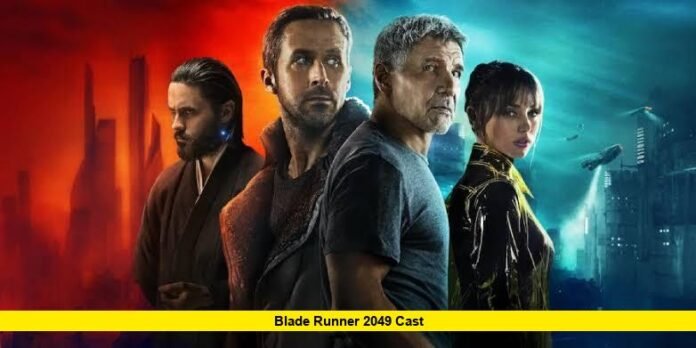

The Blade Runner 2049 cast brings together acclaimed Hollywood actors, established character performers, and emerging international talent in a science-fiction film that continues the story of the original Blade Runner. Released in 2017, the movie stars Ryan Gosling as Officer K and Harrison Ford as Rick Deckard, with Ana de Armas, Sylvia Hoeks, Robin Wright, Jared Leto, and Dave Bautista playing important roles in its futuristic world.
Directed by Denis Villeneuve, Blade Runner 2049 combines a mystery-driven story with questions about artificial intelligence, identity, memory, and what it means to be human. Its ensemble cast helps bring these themes to life through characters whose motivations are not always immediately clear.
The film takes place 30 years after the events of the original Blade Runner. While Gosling leads the story as a new blade runner investigating a potentially world-changing discovery, Ford returns to one of his most recognizable science-fiction roles. The supporting actors add depth to the film’s exploration of replicants, human relationships, corporate power, and survival.
Blade Runner 2049 Main Cast and Their Characters
The central performers establish the film’s emotional and narrative foundation. Each character contributes to Officer K’s investigation, although several have personal interests that complicate his search for the truth.
Ryan Gosling as Officer K
Ryan Gosling plays Officer K, a blade runner working for the Los Angeles Police Department in a future where advanced artificial humans known as replicants exist alongside humans. His job involves tracking down and retiring older replicants who are considered threats.
K begins the story as a professional who follows orders and appears comfortable with the boundaries of his position. However, an unexpected discovery during an assignment challenges his understanding of the world and his own identity.
Gosling’s restrained performance is central to the film’s atmosphere. Rather than relying on constant dialogue or exaggerated emotion, he communicates K’s uncertainty, isolation, and growing sense of purpose through subtle expressions and controlled physical movements.
The character’s investigation becomes more than a police assignment. It develops into a personal journey that raises difficult questions about memory, individuality, and whether a person’s origins determine their value.
Harrison Ford as Rick Deckard
Harrison Ford reprises his role as Rick Deckard, the former blade runner introduced in the 1982 film Blade Runner. In the sequel, Deckard has been missing for decades, and K’s investigation eventually brings them together.
Ford’s return creates a direct connection between the two films. Deckard carries the weight of his past, and his circumstances reveal how much the world has changed since the original story.
His relationship with the events surrounding K’s investigation is one of the sequel’s most important narrative elements. Ford balances the character’s familiar toughness with a more reflective quality, making Deckard a figure shaped by years of isolation and difficult choices.
The performance also allows the film to revisit questions raised by the original without simply repeating its story.
Ana de Armas as Joi
Ana de Armas portrays Joi, a holographic companion who shares K’s living space and plays a significant role in his personal life. Joi is an artificial intelligence designed to provide companionship, affection, and emotional connection.
Her relationship with K introduces a different perspective on the film’s central questions. Although Joi is not a replicant in the same sense as the physically embodied artificial humans, her existence raises related concerns about programmed behavior, personal attachment, and the meaning of genuine emotion.
De Armas gives the character warmth and personality, helping make Joi more than a technological feature of the futuristic setting. Her scenes with Gosling provide a contrast to K’s otherwise solitary professional life.
Joi’s role also encourages viewers to consider how people form emotional bonds with artificial companions and whether those relationships can carry personal significance.
Sylvia Hoeks as Luv
Sylvia Hoeks plays Luv, a highly capable replicant who serves Niander Wallace. Intelligent, disciplined, and dangerous, Luv is one of the principal threats K encounters.
Her loyalty to Wallace shapes much of her behavior, but the character is not presented simply as a machine carrying out routine instructions. Hoeks gives Luv a commanding presence and conveys a combination of precision, aggression, and emotional intensity.
Luv’s role is important because she represents the power Wallace holds over the replicants he creates. Her actions also demonstrate how artificial beings can occupy very different positions within the same social hierarchy.
Through Luv, the film explores obedience, ambition, and the consequences of treating sentient beings as instruments of someone else’s goals.
Robin Wright as Lieutenant Joshi
Robin Wright portrays Lieutenant Joshi, K’s superior at the LAPD. She oversees his work and understands the potential consequences of the discovery that drives the investigation.
Joshi is practical and direct, approaching the situation from the standpoint of maintaining order in a fragile society. She recognizes that certain information could threaten the existing balance between humans and replicants.
Wright’s performance gives the character authority without making her motivations entirely one-dimensional. Joshi’s decisions reflect the institutional pressures surrounding the investigation and the risks involved in allowing sensitive information to become public.
Her role helps establish the political and social stakes behind K’s mission.
Jared Leto as Niander Wallace
Jared Leto plays Niander Wallace, a powerful industrialist who controls a corporation responsible for producing replicants. Wallace sees artificial humans as essential to humanity’s future expansion and wants to overcome the limitations of existing replicant technology.
His ambition extends beyond commercial success. He seeks greater control over the creation of life, making him one of the film’s central representatives of technological power without sufficient ethical restraint.
Leto portrays Wallace as a controlled and unsettling figure whose calm manner contrasts with the consequences of his decisions. The character’s worldview reflects the film’s concern with corporate influence, human exploitation, and the moral questions raised by artificial life.
Wallace’s plans also provide a broader context for the conflict between the film’s individual characters and the systems that govern their lives.
Supporting Cast Members in Blade Runner 2049
The supporting performers help expand the story beyond K’s immediate investigation. Their characters represent different parts of a society shaped by environmental decline, economic inequality, and the continuing struggle between humans and replicants.
Dave Bautista as Sapper Morton
Dave Bautista appears as Sapper Morton, a replicant living in relative isolation on a protein farm. His encounter with K at the beginning of the film sets the central investigation in motion.
Although Bautista is physically imposing, his performance emphasizes the character’s thoughtful and guarded nature. Sapper’s dialogue and behavior suggest a deeper connection to the world around him than K initially understands.
The character’s brief but consequential appearance establishes the film’s tone and introduces the discovery that drives the plot.
Mackenzie Davis as Mariette
Mackenzie Davis plays Mariette, a replicant who becomes involved with K and Joi. Her character operates within the more vulnerable parts of the futuristic city, where survival often depends on navigating unequal social structures.
Mariette’s connection to K brings her into contact with developments that extend beyond her immediate circumstances. Davis gives the role an independent presence, adding another perspective to the film’s treatment of artificial identity and personal relationships.
Carla Juri as Dr. Ana Stelline
Carla Juri portrays Dr. Ana Stelline, a memory designer who creates artificial memories for replicants. Her specialized work is essential to the film’s examination of the relationship between memory and identity.
Stelline’s scenes introduce a distinction between possessing a memory and experiencing it as part of one’s personal history. Her work also demonstrates how technology can shape the way an artificial person understands their own existence.
Juri’s performance contributes to the mystery surrounding the information K discovers and gives the film one of its most important connections between science, emotion, and personal identity.
Lennie James as Mister Cotton
Lennie James plays Mister Cotton, an administrator associated with an orphanage where children perform labor under harsh conditions.
Cotton’s role exposes the exploitation hidden within the city’s wider social system. His presence also helps K pursue information connected to the film’s central mystery.
James brings a grounded quality to the character, reinforcing the idea that cruelty in this world is not limited to powerful corporations or advanced technology. It also exists in ordinary institutions where vulnerable people have little control over their circumstances.
Hiam Abbass as Freysa
Hiam Abbass portrays Freysa, a key figure connected to a replicant resistance movement. Her character represents a challenge to the established order and raises the stakes of K’s investigation.
Freysa’s perspective broadens the story from an individual mystery into a conflict involving the future of replicants as a group. Her actions are shaped by the belief that artificial beings deserve a future beyond the roles assigned to them.
Abbass gives the character a determined presence that complements the film’s larger questions about freedom, survival, and collective identity.
Barkhad Abdi as Doc Badger
Barkhad Abdi appears as Doc Badger, a dealer operating in the city’s underground economy. K visits him while investigating evidence that could help explain his discovery.
The character offers a glimpse into the informal networks that operate outside official institutions. Abdi’s performance adds a memorable supporting presence to the film’s depiction of a damaged but functioning urban society.
David Dastmalchian as Coco
David Dastmalchian plays Coco, a police forensic specialist who examines evidence connected to K’s investigation.
Coco’s work helps transform a discovery into a case that can be investigated scientifically. His role is relatively brief, but it contributes to the procedural side of the story and establishes how the police department processes evidence involving replicants.
Wood Harris as Nandez
Wood Harris portrays Nandez, a police officer who appears in connection with the investigation. His character contributes to the film’s institutional setting and the work carried out by K’s colleagues.
Edward James Olmos as Gaff
Edward James Olmos returns as Gaff, a character from the original Blade Runner. His appearance provides another link between the two films and offers a reminder of the earlier story’s unresolved questions.
Gaff’s presence is brief, but it carries significance for viewers familiar with the original movie.
Sean Young as Rachael
Sean Young is credited in connection with Rachael, the character she played in the original Blade Runner. The sequel uses digital visual effects and a performance double to recreate the character’s appearance in a limited sequence.
This appearance connects the new film to the earlier story while demonstrating how modern visual effects can incorporate a character from an older production.
Other Notable Cast Members
The wider ensemble includes several additional performers who contribute to the film’s detailed world:
- Tómas Lemarquis as the Wallace Corporation file clerk.
- Sallie Harmsen as a female replicant.
- Krista Kosonen as Doxie #2.
- Elarica Johnson as Doxie #3.
- Loren Peta as the performance double associated with Rachael’s recreation.
These supporting roles help create a believable society populated by different communities, occupations, and forms of artificial life.
Who Directed Blade Runner 2049 and Who Wrote the Film?
Denis Villeneuve directed Blade Runner 2049, continuing the story established by Ridley Scott’s original film. Villeneuve was known for his work in visually ambitious and psychologically complex cinema, making him a fitting choice for a sequel built around atmosphere, moral uncertainty, and philosophical questions.
The screenplay was written by Hampton Fancher and Michael Green. Fancher also contributed to the original Blade Runner, providing a connection to the earlier film’s storytelling approach. The story draws on characters originating in Philip K. Dick’s novel Do Androids Dream of Electric Sheep?
The production also benefited from the work of cinematographer Roger Deakins, whose photography gives the film its distinctive visual identity. The score was composed by Hans Zimmer and Benjamin Wallfisch, whose music reinforces the futuristic setting and the story’s emotional tension.
Together, the director, writers, cast, and technical crew created a sequel that builds on the original film while establishing its own characters and conflicts.
Why the Blade Runner 2049 Cast Remains Popular
The film’s cast continues to attract interest because it combines familiar stars with performers who bring different acting styles to the same fictional world.
Gosling’s quiet, inward-looking performance contrasts with Ford’s more weathered portrayal of Deckard. De Armas introduces emotional intimacy, while Hoeks and Leto bring tension to the film’s corporate and technological conflicts. Wright, Davis, Bautista, Juri, and Abbass each contribute distinct perspectives on the society in which the story unfolds.
The ensemble also serves the film’s themes. Many characters exist between categories that the wider society treats as fixed: human and artificial, independent and controlled, emotionally authentic and technologically constructed.
Rather than explaining every character’s motives directly, the film allows performances, expressions, and interactions to carry much of the meaning. This approach encourages repeated viewing, as details that initially seem incidental may take on greater importance when considered alongside the full story.
The movie’s continuing reputation also reflects the combination of acting, production design, cinematography, sound, and visual effects. Blade Runner 2049 won Academy Awards for Best Cinematography and Best Visual Effects, recognition that helped establish its place among the notable science-fiction films of its era.
Latest Updates on the Blade Runner 2049 Cast
As of the latest available information, Blade Runner 2049 remains a completed 2017 feature film with an established cast and credited characters. Its principal performers and supporting actors are documented in the film’s published credits.
The cast’s continued public visibility is connected to the careers of its performers and the enduring interest in the Blade Runner universe. However, the film’s existing cast should be distinguished from any potential future projects set in the same fictional world.
There is no need to assume that a new Blade Runner 2049 installment or reunion featuring the original cast has been confirmed. Any future production, casting announcement, or return of a particular character would require an official announcement before it could be treated as established news.
For readers revisiting the film, the most useful starting point remains its original ensemble: Ryan Gosling as K, Harrison Ford as Rick Deckard, Ana de Armas as Joi, Sylvia Hoeks as Luv, and Jared Leto as Niander Wallace, alongside the extensive supporting cast.
Final Thoughts on the Blade Runner 2049 Cast
The Blade Runner 2049 cast is one of the film’s defining strengths. Ryan Gosling anchors the story with a nuanced performance, Harrison Ford reconnects the sequel to its cinematic predecessor, and Ana de Armas, Sylvia Hoeks, Robin Wright, Jared Leto, and the supporting performers help create a world filled with competing desires and difficult moral choices.
Each major character contributes something different to the story, from K’s search for meaning to Deckard’s complicated past, Joi’s role in exploring artificial companionship, and Wallace’s ambitions for the future of replicant technology. These performances give the movie emotional depth beyond its futuristic setting.
For viewers interested in science-fiction movies, the film offers an ensemble worth examining closely. Its cast helps turn a mystery about artificial life into a broader story about memory, freedom, relationships, and what makes an individual matter.
Share your favorite Blade Runner 2049 character in the comments, and stay updated for more movie cast profiles and entertainment news.