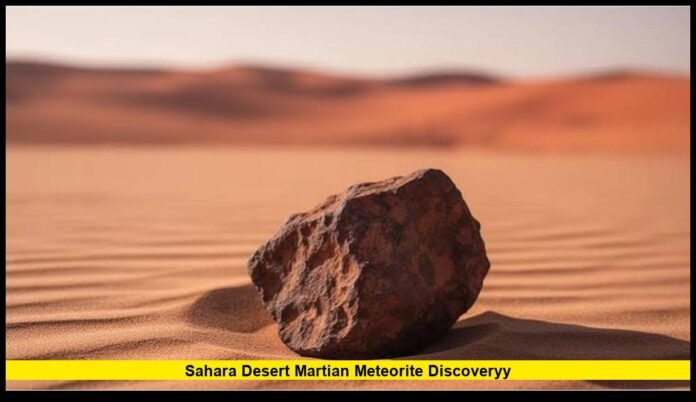

A rare Sahara Desert Martian meteorite discovery is giving scientists a closer look at Mars more than 4.1 billion years ago. Identified as Teghaza 001, the nearly two-pound rock was found in Mali in 2022. New research published in October 2026 has established its extraordinary age and revealed evidence that water altered its source material during the Red Planet’s early geological history.
The findings make Teghaza 001 one of the oldest known Martian meteorites recovered on Earth. Its unusual minerals and chemical signatures provide an opportunity to investigate how Mars developed its ancient crust and how water moved through its interior.
Scientists are particularly interested in what the specimen reveals about early Mars. Although the planet is now cold and largely dry at its surface, this ancient rock preserves evidence of processes that occurred when its geological environment was very different.
Teghaza 001: The Ancient Rock Found in Mali
Teghaza 001 takes its name from the Teghaza salt plain in Mali, where meteorite hunters recovered the specimen. The rose-colored rock weighs approximately 800 grams, or 1.76 pounds.
Its identification as a Martian meteorite initially established its extraterrestrial origin. Subsequent laboratory work revealed that its geological history was far older and more unusual than scientists first suspected.
Researchers identified the specimen as an ancient igneous rock containing a distinctive mixture of minerals. Igneous rocks form when molten material cools and crystallizes. Their mineral composition can preserve information about the conditions under which they developed.
Teghaza 001 is especially valuable because it represents a rare sample of Mars’ early crust. Its characteristics differ from those of many previously examined Martian meteorites, offering scientists another way to investigate the planet’s formation.
How Researchers Established Its Age
Determining the meteorite’s age required detailed analysis of its mineral grains. Scientists examined zircon crystals, which can preserve reliable records of geological events because they incorporate uranium during formation.
Uranium gradually decays into lead at a predictable rate. By measuring the isotopes of these elements, researchers can estimate when a mineral formed or underwent certain geological changes.
The zircon measurements placed Teghaza 001’s history at more than 4.1 billion years ago. Additional mineral analyses helped researchers investigate the timing of changes associated with water interacting with the rock.
This age places the specimen among an exceptionally small group of ancient Martian meteorites. Most known samples from Mars formed during substantially more recent periods.
The distinction matters because Mars experienced major changes during its earliest history. Studying rocks from this period helps scientists understand how its crust developed and how the planet’s internal and surface environments evolved.
Evidence That Water Altered Ancient Martian Rock
One of the most significant findings concerns the interaction between water and the meteorite’s source material.
Researchers identified chemical and mineralogical characteristics consistent with alteration by water on Mars. The evidence suggests that fluids interacted with the rock while it was part of the planet’s ancient crust.
A separate study published in June 2026 examined hydrogen isotopes and water-bearing minerals in Teghaza 001. Those measurements indicated that the rock incorporated a water component associated with ancient Martian crust that had already undergone alteration.
Hydrogen isotope ratios help scientists distinguish water reservoirs and reconstruct how water changed over geological time. The results support the interpretation that water circulated through early Martian materials and interacted with later geological processes.
The research also provides clues about how Mars lost water. Hydrogen can escape into space, gradually changing the isotopic composition of the water remaining on a planet. Teghaza 001 preserves evidence relevant to understanding that process.
However, scientists have not established every detail of the water’s movement or the exact conditions at the rock’s original location.
Why This Meteorite Stands Apart From Other Mars Samples
Teghaza 001 offers a different perspective on Martian geology from several well-known meteorites.
One famous example is Northwest Africa 7034, commonly called Black Beauty. That specimen contains fragments of different rocks and minerals, including ancient material that has helped researchers study water-related processes on Mars.
Teghaza 001 has a more uniform igneous composition. Its mineral assemblage provides a distinct record of ancient crust formation and subsequent alteration.
Another ancient Martian meteorite, Allan Hills 84001, also offers important evidence about the planet’s early history. Together, these rare specimens help scientists examine geological periods for which direct samples are extremely limited.
The importance of Teghaza 001 lies not simply in its age but in the combination of its age, mineralogy, and chemical evidence. It allows researchers to investigate aspects of Mars that other meteorites may not preserve as clearly.
Where on Mars Did the Meteorite Originate?
Scientists can establish a meteorite’s planetary origin without knowing its exact birthplace.
Researchers compared Teghaza 001’s mineral composition and chemistry with observations of Mars collected by spacecraft. Those comparisons identified several potential source regions, including areas whose geology is consistent with the specimen’s characteristics.
The precise location remains uncertain. Identifying a specific crater or geological formation would require stronger evidence connecting the meteorite to a particular launch event and source terrain.
Scientists do understand how Martian rocks can reach Earth. A large impact can eject material from the Martian surface into space. Some fragments escape the planet’s gravity and travel through the solar system before eventually entering Earth’s atmosphere.
Teghaza 001 followed this general pathway, although researchers have not determined exactly when it landed in the Sahara.
Does the Discovery Provide Evidence of Life on Mars?
The meteorite contributes to research into whether ancient Mars had conditions capable of supporting life. Liquid water is important in this investigation because all known life on Earth depends on water.
Scientists also examine chemical nutrients, available energy sources, and environments where biological signatures might survive over geological timescales.
Teghaza 001 helps researchers reconstruct some of the chemical conditions that existed during Mars’ earliest history. Its evidence of water-rock interaction adds to the growing body of knowledge about the planet’s ancient environment.
Nevertheless, the meteorite does not prove that life ever existed on Mars. Water-related minerals and chemical alterations can develop through nonbiological processes.
Establishing whether life existed would require evidence that can be distinguished convincingly from ordinary geological and chemical activity. The current findings instead help scientists understand whether some of the necessary environmental conditions may have been present.
What Scientists Hope to Learn Next
Further laboratory investigations could reveal additional information about the meteorite’s formation, its exposure to water, and the evolution of its source region.
Researchers can study individual mineral grains, examine chemical variations, and compare isotopic measurements with those from other Martian meteorites. These comparisons may help refine models of the planet’s early crust and water reservoirs.
The specimen may also help scientists interpret spacecraft observations of ancient Martian terrain. Matching laboratory measurements with minerals detected on Mars can improve understanding of the geological processes that shaped those regions.
Because material from Mars remains difficult to obtain, every well-characterized meteorite offers a valuable research opportunity. Teghaza 001 gives scientists direct access to ancient planetary material without requiring a spacecraft to collect it on Mars.
Its findings do not settle every question about the Red Planet. Instead, they provide a new foundation for investigating how its early environment changed over billions of years.
Conclusion
Teghaza 001 has emerged as an important scientific discovery because it preserves evidence from a formative period in Martian history. Its age and water-related chemical signatures are helping researchers investigate the development of Mars’ crust and the evolution of its ancient water reservoirs.
While questions remain about the meteorite’s exact birthplace and the environment in which its source material formed, its scientific value is already clear. Continued analysis may help reveal more about the Red Planet’s earliest geological processes and whether ancient Mars possessed conditions suitable for life.
What do you think scientists will discover next about ancient Mars? Share your thoughts in the comments as researchers continue examining this remarkable meteorite.