
How do you calculate estate tax in the United States? The process starts by determining the value of the deceased person’s assets, subtracting allowable deductions, and applying the federal estate and gift tax rules. For 2026, the federal basic estate tax exclusion is $15 million per individual. This means many estates will not owe federal estate tax, although state taxes and special circumstances can change the outcome.
Estate tax calculations require more than adding up bank accounts and property. Executors must consider real estate, investments, retirement assets, business interests, certain life insurance proceeds, debts, charitable gifts, transfers to a surviving spouse, and taxable gifts made during the deceased person’s lifetime.
The federal estate tax system also uses graduated tax rates, with a maximum marginal rate of 40%. However, that rate does not automatically apply to the entire estate. The final liability depends on the taxable estate, available exclusions, prior taxable gifts, and applicable credits.
Understanding these rules can help families estimate potential tax obligations, determine whether a federal estate tax return is necessary, and prepare for the responsibilities involved in settling an estate.
Key Points Summary
╔════════════════════════════════════════════════════════════════════╗
║ – The federal estate tax exclusion for 2026 is $15 million per individual. ║
║ – Estate tax calculations begin with the gross estate and account for allowable deductions. ║
║ – The maximum federal estate tax rate is 40%, but the entire estate is not automatically taxed at that rate. ║
║ – Certain lifetime taxable gifts can affect the federal estate tax calculation. ║
║ – State estate and inheritance taxes may apply even when no federal estate tax is due. ║
╚════════════════════════════════════════════════════════════════════╝
What Is Estate Tax?
Estate tax is a tax on the transfer of a deceased person’s taxable estate. The federal government calculates the tax under rules that combine estate transfers at death with certain taxable gifts made during life.
The estate generally pays any federal estate tax owed before the remaining property is distributed to beneficiaries. An executor or other authorized personal representative handles the estate’s tax filings and payment responsibilities.
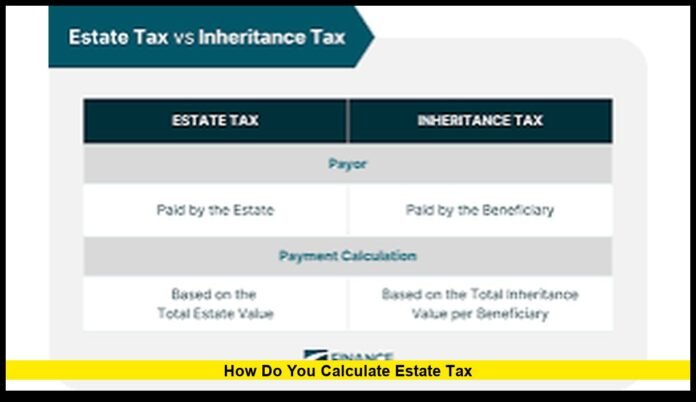
Estate tax differs from inheritance tax. Estate tax applies to the deceased person’s taxable estate, while inheritance tax generally applies to property received by beneficiaries. Some states impose one or both types of taxes.
Not every estate must pay federal estate tax. The applicable exclusion, deductions, credits, and other tax rules determine whether a liability exists.
For 2026, the federal basic exclusion amount is $15 million per individual. Estates below that threshold generally do not owe federal estate tax if no relevant adjustments change the calculation. However, filing requirements and state taxes must be evaluated separately.
How Do You Calculate Estate Tax Step by Step?
Calculating estate tax involves several stages. Each stage determines the amount used in the next part of the calculation.
Step 1: Determine the Gross Estate
The gross estate includes the value of property that federal tax rules treat as belonging to the deceased person for estate tax purposes. The calculation is not limited to assets that pass through probate.
Common assets that may form part of the gross estate include:
- Real estate: Primary residences, vacation homes, rental properties, and other real estate interests.
- Bank accounts: Checking accounts, savings accounts, and certificates of deposit.
- Investments: Stocks, bonds, mutual funds, and other investment holdings.
- Business interests: Ownership in private companies, partnerships, and other business entities.
- Retirement assets: Certain retirement accounts, benefits, and other retirement-related interests.
- Life insurance: Proceeds that are includible under federal estate tax rules.
- Personal property: Vehicles, jewelry, artwork, collectibles, and other valuable belongings.
- Certain transferred assets: Property transferred before death that remains includible under applicable rules.
Valuation usually reflects fair market value on the date of death. In certain circumstances, an estate can elect an alternative valuation date, provided it meets the legal requirements.
Ownership and control matter. Jointly owned property, trusts, community property, and partially owned businesses may require additional analysis. Moving property into a trust does not automatically remove it from the taxable estate.
Example: Suppose a deceased person owned a home worth $2 million, investments worth $5 million, bank accounts worth $500,000, and a business interest worth $2.5 million.
The total is $10 million. If those amounts represent all includible assets, the gross estate would be $10 million before accounting for other assets, adjustments, and deductions.
Step 2: Subtract Allowable Deductions
The gross estate is not necessarily the amount subject to federal estate tax. Eligible deductions can reduce the taxable estate.
Common deductions include:
- Qualifying debts owed by the deceased person.
- Eligible funeral expenses paid by the estate.
- Qualifying estate administration expenses.
- Transfers to eligible charitable organizations.
- Qualifying transfers to a surviving spouse.
- Certain taxes, losses, and other deductions permitted by law.
The estate must satisfy the relevant legal requirements for each deduction. Executors should retain records, invoices, valuations, and supporting documents.
Consider an estate with a gross value of $18 million and $1 million in allowable deductions.
| Calculation | Amount |
|---|---|
| Gross estate | $18,000,000 |
| Allowable deductions | −$1,000,000 |
| Taxable estate before applicable gift-tax adjustments | $17,000,000 |
This example assumes all listed deductions qualify and excludes additional adjustments that could affect the final federal calculation.
Step 3: Apply the Federal Estate Tax Exclusion
The federal basic exclusion amount determines how much can be transferred without federal estate and gift tax under the applicable combined tax rules.
For 2026, the basic exclusion is $15 million per individual. The amount differs from the 2025 exclusion of $13.99 million, so calculations for deaths in different years should use the appropriate threshold.
Suppose the taxable estate is $17 million and the deceased person has no adjusted taxable gifts or other relevant adjustments.
The amount above the exclusion is:
[
$17,000,000-$15,000,000=$2,000,000
]
The $2 million excess provides a starting point for estimating potential federal estate tax. It does not mean that every estate can determine its final liability by using this subtraction alone.
The actual calculation accounts for the federal rate schedule, applicable credits, lifetime taxable gifts, and other relevant circumstances.
A surviving spouse may also be eligible to use a deceased spouse’s unused exclusion through portability. This generally requires a proper election on the deceased spouse’s federal estate tax return.
Step 4: Account for Lifetime Taxable Gifts
Federal estate and gift taxes operate under a unified system. Certain taxable gifts made during a person’s lifetime can affect the exclusion and tax calculation at death.
For example, a person who made substantial taxable gifts before death may have less exclusion available for the remaining estate than someone who made no such gifts.
Executors should review previous gift tax returns and records. The tax treatment depends on the nature of each gift, its value, the date of transfer, and whether it qualified for an exclusion or deduction.
Annual gift tax exclusions are different from the lifetime basic exclusion. Qualifying gifts within the annual exclusion generally receive different treatment from taxable gifts that exceed the applicable exclusion.
Because the calculation can become complicated, an estate with significant lifetime gifts should not rely solely on the difference between the estate’s value and the $15 million threshold.
Step 5: Calculate the Federal Estate Tax
The federal estate and gift tax rate schedule uses graduated rates ranging from 18% to a maximum marginal rate of 40%.
A graduated system applies different rates to different portions of the taxable amount. The top marginal rate does not automatically apply to the entire value of an estate.
For a simplified example, assume the taxable estate is $17 million, the deceased person made no adjusted taxable gifts, and no additional exclusions or credits apply.
| Item | Amount |
|---|---|
| Taxable estate | $17,000,000 |
| Federal basic exclusion | $15,000,000 |
| Amount above exclusion | $2,000,000 |
| Simplified marginal rate used | 40% |
| Estimated federal estate tax | $800,000 |
The estimate is based on multiplying $2 million by 40%. It illustrates the calculation under the stated assumptions, rather than replacing the official federal tax computation.
The executor generally uses IRS Form 706 to calculate the tentative tax, account for adjusted taxable gifts, apply the available credit, and determine the amount payable.
Which Assets Count Toward Estate Tax?
Correctly identifying the assets is essential to calculating estate tax. An incomplete inventory can produce an inaccurate estimate and complicate the filing process.
Real Estate
A house, rental property, vacation home, or other real estate interest may be included in the gross estate. The applicable value generally reflects fair market value at death, subject to the relevant valuation rules.
Mortgage debt and ownership arrangements can affect the calculation. Executors should document property values and the deceased person’s ownership interest.
Bank Accounts and Investments
Cash accounts, certificates of deposit, stocks, bonds, and mutual funds may be included. Financial statements and date-of-death valuations can help establish the relevant values.
The original purchase price of an investment does not determine its estate tax value. The applicable valuation rules govern the amount included in the estate.
Retirement Accounts
Certain retirement accounts and benefits may be included in the gross estate. Estate tax treatment and the income tax consequences for beneficiaries are separate questions, and the same account may require consideration under both systems.
Life Insurance
Life insurance proceeds may be included in the gross estate when the deceased person owned the policy or when other inclusion rules apply. The identity of the beneficiary does not, by itself, determine the entire tax outcome.
Trusts and Jointly Owned Property
Trust assets and jointly owned property require an examination of ownership rights, retained powers, and the relevant federal rules. Some property may remain includible even if it does not pass through probate.
Executors should also review transfers made before death because certain transfers remain subject to estate tax inclusion rules.
How Deductions Can Reduce Estate Tax
Deductions can lower the taxable estate and may substantially affect the final tax liability.
For example, consider an estate with a gross value of $20 million and $2 million in allowable deductions.
| Item | Amount |
|---|---|
| Gross estate | $20,000,000 |
| Allowable deductions | −$2,000,000 |
| Taxable estate before gift-tax adjustments | $18,000,000 |
| Federal basic exclusion | $15,000,000 |
| Amount above exclusion | $3,000,000 |
The amount above the exclusion is a starting point for the tax calculation. Prior taxable gifts, credits, and other adjustments can affect the final liability.
The marital deduction can be particularly important when eligible property passes to a surviving spouse. Qualifying charitable transfers may also reduce the taxable estate.
However, not every payment or transfer qualifies. Executors must verify that each deduction satisfies the relevant requirements and maintain supporting documentation.
What Is the Federal Estate Tax Rate in 2026?
Federal estate tax rates range from 18% to 40%. The applicable rate depends on the taxable amount under the statutory schedule.
Three terms help explain the calculation:
- Marginal tax rate: The rate that applies to an additional taxable amount within a particular bracket.
- Effective tax rate: The total tax divided by the selected measure of estate value.
- Basic exclusion amount: The amount protected by the federal exclusion under the applicable estate and gift tax rules.
An estate above $15 million does not automatically pay 40% of its entire value. The applicable credit and graduated rate schedule affect the final amount.
The correct calculation also depends on the year of death. Executors should use the federal rules and Form 706 instructions that apply to that year.
Does Every Estate Need to File Form 706?
No. Federal filing requirements depend on the gross estate, adjusted taxable gifts, and other applicable rules.
For deaths in 2026, a U.S. citizen’s or resident’s estate generally must file Form 706 when the gross estate, increased by adjusted taxable gifts and the applicable specific gift tax exemption, exceeds $15 million.
An estate may also need to file Form 706 to elect portability, even if no federal estate tax is ultimately due.
Portability allows a surviving spouse to use a deceased spouse’s unused exclusion if the legal requirements are met and the election is properly made. It is not automatically available merely because the couple was married.
Different filing rules can apply to nonresident individuals who are not U.S. citizens and who own property situated in the United States.
A filing requirement and a tax payment requirement are not the same. An estate might need to file a return to preserve a benefit or satisfy a reporting obligation even when no federal tax is payable.
When Is Estate Tax Due?
Federal Form 706 is generally due nine months after the date of death.
An executor can request an extension of time to file by submitting Form 4768 by the original due date. An extension to file generally does not automatically extend the deadline to pay the tax.
Executors should begin collecting asset valuations, debt records, deduction documentation, and lifetime gift records as early as possible.
Late filing or payment can result in penalties and interest when the applicable requirements are not met. An estate that expects to owe tax should plan for the payment deadline instead of waiting until every administrative task is complete.
How State Estate Taxes Affect the Calculation
Federal estate tax is not the only potential tax on an estate. Several states and the District of Columbia impose their own estate taxes, while some states impose inheritance taxes on beneficiaries.
State exemptions can be substantially lower than the federal exclusion. As a result, an estate may owe state estate tax even when it owes no federal estate tax.
Examples of state estate tax exemption amounts for 2026 include:
| State | Exemption amount |
|---|---|
| Connecticut | $15,000,000 |
| Illinois | $4,000,000 |
| Maine | $7,160,000 |
| Maryland | $5,000,000 |
| Massachusetts | $2,000,000 |
| Minnesota | $3,000,000 |
| New York | $7,350,000 |
| Oregon | $1,000,000 |
| Vermont | $5,000,000 |
| Washington | $3,000,000 |
These figures are examples rather than a complete list. State rules can differ in how they value assets, calculate deductions, apply rates, and establish filing deadlines. Exemptions and other rules may also change.
Property located in more than one state can require additional analysis. Executors should evaluate the rules of every relevant jurisdiction instead of assuming that the federal exclusion determines all tax obligations.
Common Mistakes When Calculating Estate Tax
Several mistakes can make an estate tax estimate unreliable.
- Using an outdated exclusion: The federal exclusion for 2026 differs from the amount that applied in 2025.
- Ignoring lifetime gifts: Certain previous taxable gifts affect the unified federal tax calculation.
- Applying 40% to the entire estate: The top marginal rate does not automatically apply to every dollar.
- Overlooking deductions: Eligible debts, administration expenses, charitable transfers, and marital deductions can reduce the taxable estate.
- Assuming trust assets are always excluded: Trust ownership alone does not determine estate tax treatment.
- Ignoring state taxes: State estate or inheritance tax may apply even if federal estate tax is zero.
- Missing filing deadlines: A return may be necessary to meet federal requirements or preserve portability.
Keeping detailed records helps executors support valuations, deductions, and tax elections. Professional advice may be especially useful when an estate includes a business, complex trusts, substantial gifts, or property in multiple states.
Frequently Asked Questions About Calculating Estate Tax
1. How do you calculate estate tax on $10 million?
For a U.S. citizen or resident who dies in 2026, a $10 million estate generally falls below the $15 million federal basic exclusion. However, adjusted taxable gifts, asset inclusion rules, and filing requirements must still be reviewed. State estate taxes may apply independently.
2. What is the federal estate tax exemption for 2026?
The federal basic estate and gift tax exclusion is $15 million per individual for 2026. A surviving spouse may be eligible for an additional exclusion through portability if the required election and other conditions are satisfied.
3. Is estate tax calculated before or after deductions?
The taxable estate is generally determined after allowable deductions are subtracted from the gross estate. The federal tax computation then accounts for applicable lifetime taxable gifts, the available credit, and other relevant adjustments.
4. Do beneficiaries pay federal estate tax?
Generally, the estate pays federal estate tax before distributing the remaining assets. However, certain states impose inheritance taxes that may create tax obligations for individual beneficiaries.
5. What happens if an estate exceeds $15 million?
An estate exceeding $15 million does not automatically owe tax on its entire value. The executor must calculate the taxable estate, review adjusted taxable gifts, determine the available exclusion and credit, and apply the federal tax schedule.
6. Can a married couple exclude $30 million from estate tax in 2026?
A married couple may potentially use up to $30 million in combined federal exclusions. The result depends on the ownership of assets, transfers between spouses, lifetime gifts, and whether the deceased spouse’s unused exclusion was properly preserved through portability.
7. Does a house count toward estate tax?
Yes. A house owned by the deceased person may be included in the gross estate at its applicable fair market value. Mortgage debt, ownership arrangements, and allowable deductions can affect the calculation.
8. Are retirement accounts included in the gross estate?
Certain retirement accounts and benefits may be included in the gross estate under federal rules. The estate tax treatment and the beneficiary’s potential income tax liability are separate matters.
9. Is estate tax the same as capital gains tax?
No. Estate tax applies to transfers of property at death. Capital gains tax generally applies when an asset is sold or otherwise disposed of at a taxable gain. Inherited property may have separate income tax consequences depending on its tax basis and subsequent transactions.
10. When must the federal estate tax return be filed?
Form 706 is generally due nine months after the date of death. An executor can request an extension to file, but the extension generally does not automatically extend the payment deadline.
11. Can an estate owe state tax but no federal estate tax?
Yes. Some states have estate tax exemptions well below the federal $15 million exclusion. An estate may therefore owe state estate tax even when no federal estate tax is due.
12. What documents help calculate estate tax?
Useful records include bank and brokerage statements, property appraisals, retirement account statements, life insurance documents, business valuations, debt records, charitable gift records, trust documents, and prior gift tax returns. The exact documents required depend on the estate’s assets and circumstances.
Final Thoughts
Calculating estate tax requires a careful review of the deceased person’s assets, eligible deductions, lifetime taxable gifts, available exclusions, and applicable tax rates. The federal $15 million basic exclusion for 2026 is an important starting point, but state rules and individual circumstances can change the final result.
Executors should verify asset values, preserve supporting records, and determine whether a federal or state return is required. For complicated estates, professional tax guidance can help reduce calculation errors and identify available deductions and elections.
Do you have questions about estate tax calculations or how the 2026 exclusion affects an inheritance? Share your thoughts in the comments and stay informed about the latest confirmed tax updates.