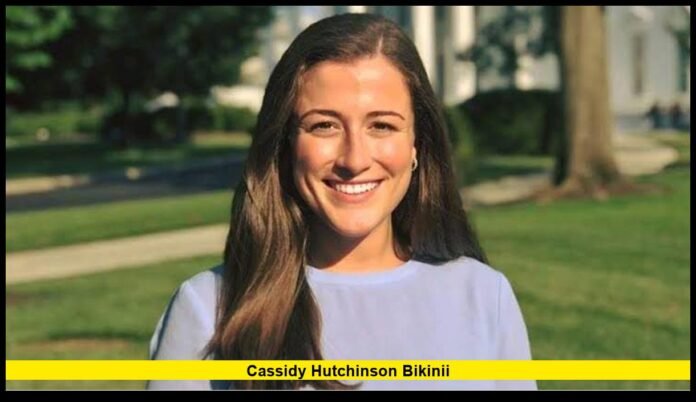

The search for cassidy hutchinson bikini reflects online curiosity about photographs associated with Cassidy Hutchinson, the former White House aide who became a prominent public figure after testifying about the January 6, 2021, attack on the U.S. Capitol. However, identifying an authentic photograph requires more than a search result or a social media caption. The image must have a credible source, accurate attribution, and sufficient context to support the claim being made.
Hutchinson rose to national prominence in June 2022, when she appeared before the House Select Committee investigating the Capitol attack. Her testimony attracted extensive media attention, bringing her name to audiences beyond Washington’s political circles. Since then, her public profile has remained associated with political interviews, her memoir, and discussion of her experiences in the first Trump administration.
Interest in photographs of public figures often extends beyond their professional activities. Nevertheless, online curiosity should not be confused with verified evidence. As of October 28, 2026, I cannot independently confirm an authenticated bikini photograph of Hutchinson or establish that she has recently published such an image publicly. This limitation does not prove that no photograph exists; it means the claim cannot responsibly be presented as an established fact.
Why Are People Searching for Cassidy Hutchinson Bikini Photos?
Online searches for photographs of recognizable people can reflect several different intentions. Some users want to find publicly shared images, while others are checking a claim they encountered on social media or trying to establish whether a photograph is genuine.
In Hutchinson’s case, her prominence following the January 6 congressional hearings has made her a recognizable name in American political discussions. People who know her through news coverage may search for additional photographs to learn more about her public appearances and online presence.
Search results, however, do not always answer the question that prompted a search. A page may include a person’s name in its title without providing an authenticated image that supports the title. Another page may reproduce a photograph without identifying the original source.
These differences matter when a search concerns a specific type of clothing or a potentially personal image. A reliable report must establish that the photograph actually depicts the person named and that the description accurately represents what the image shows.
Who Is Cassidy Hutchinson?
Cassidy Jacqueline Hutchinson is an American former White House aide who worked during Donald Trump’s first presidential administration. She served as an aide to White House chief of staff Mark Meadows and later became a significant witness in the congressional investigation into January 6.
Her public profile changed substantially on June 28, 2022. On that date, she testified during a televised hearing of the House Select Committee investigating the attack on the U.S. Capitol.
During her testimony, Hutchinson described events and conversations she said she witnessed or learned about while working in the White House. Her account received extensive national coverage and became a major subject of political debate.
Her subsequent memoir, Enough, was published in September 2023. The book recounts her experiences in the Trump administration and her decision to speak publicly about events surrounding January 6.
These developments explain why Hutchinson became a widely recognized public figure. They also establish the background against which searches about her name should be understood. Her professional visibility, however, does not independently confirm claims about specific photographs or personal activities.
Are Bikini Photographs of Cassidy Hutchinson Verified?
The most important question is whether a particular image can be connected reliably to Hutchinson.
At present, I cannot establish a verified original source confirming that she has publicly shared a bikini photograph. Without an authenticated post, a credible image archive, or another reliable form of attribution, it would be misleading to report the existence of such a photograph as confirmed.
There is an important distinction between saying that a photograph has not been verified and saying that it does not exist. The first describes the available evidence. The second makes a broader claim that would require substantially more information.
A photograph might appear on an unfamiliar website, in a social media post, or in an image-search result. None of those circumstances alone establishes the identity of the person shown.
A responsible assessment would examine the original upload, the account or publisher responsible for it, and any available information about the image’s date and context. If those details cannot be established, the photograph should remain unverified.
How Search Engines Can Create Confusion
Search engines help users discover webpages and images, but their results should not be treated as a guarantee of authenticity.
Their ranking systems consider multiple signals, including page titles, captions, surrounding text, and relevance to the search. A webpage may therefore appear for a particular query even when its content does not substantiate the claim suggested by its title.
Several situations can contribute to confusion:
- Misleading headlines: A page may target a popular search term without providing reliable evidence.
- Incorrect captions: A genuine photograph may be attributed to the wrong person.
- Reposted images: A picture may circulate without its original date, photographer credit, or description.
- Unrelated photographs: Images of different people may appear in results because of similar names or contextual associations.
- Edited content: Cropping, retouching, or digital manipulation may change how a photograph is presented.
Repeated appearances across websites do not necessarily resolve these problems. Multiple pages may have copied one original upload, meaning they do not provide independent confirmation.
The strongest evidence comes from a trustworthy original source and a clear connection between that source and the photograph being discussed.
How to Verify a Photograph Attributed to Hutchinson
Readers who encounter a photograph claiming to show Hutchinson can use several practical checks to evaluate its credibility.
Find the Original Source
The first step is to determine where the photograph originally appeared. An original social media post or an established publication with clear image attribution generally provides a better starting point than an anonymous gallery.
Original posts may include dates, captions, and contextual details that disappear when an image is copied elsewhere. Finding the earliest available version can help researchers determine whether a later description accurately represents the photograph.
Check the Account’s Authenticity
If a photograph is attributed to a social media account, readers should establish whether that account can reliably be connected to Hutchinson.
A recognizable name, profile picture, or verification symbol should not be considered sufficient on its own. Account history, links from established public profiles, and credible references may provide additional context.
Even an authentic account does not automatically validate every image reposted by other users. The specific post must still be examined.
Examine the Caption and Date
Captions frequently influence how people interpret photographs. An image described as recent may actually be several years old, while a picture associated with a particular location may have been taken somewhere else.
Readers should look for evidence supporting the date, location, and circumstances claimed in the caption. If those details cannot be confirmed, they should not be repeated as established facts.
Use Reverse Image Search
Reverse image search can help identify earlier copies of a photograph and locate websites that have published it.
However, the results may include visually similar images, altered versions, or pages that copied the same unverified upload. Reverse image search is therefore a useful investigative tool, not definitive proof of identity.
Consider Possible Digital Manipulation
Image-editing software can alter clothing, backgrounds, facial features, and other details. Generative artificial intelligence can also produce realistic-looking images that do not document actual events.
Visual inspection may reveal inconsistencies, but it cannot reliably detect every manipulation. A credible conclusion should consider both the image itself and the evidence surrounding its publication.
What Can Public Photographs Tell Us?
Photographs associated with Hutchinson’s public career document her participation in political events, interviews, and other professional appearances.
Images from her June 2022 congressional testimony, for example, can establish her presence at the televised hearing. Editorial photographs connected to interviews or her memoir can similarly document particular public appearances when their sources and context are reliable.
These images should not be used to support unrelated claims about her private life. A photograph taken at a public event does not establish what she wears in other circumstances, and a collection of professional images cannot confirm the existence of a separate personal photograph.
This principle applies to every public figure. Photographs need to be evaluated according to what they actually demonstrate rather than what a headline or online discussion suggests.
For readers investigating cassidy hutchinson bikini searches, the essential question is not whether an image appears online. It is whether reliable evidence confirms the identity of the person shown and supports the description attached to the image.
What About Instagram and Other Social Media Platforms?
Social media is a common starting point for people looking for photographs of public figures. However, users should distinguish between an individual’s own account and accounts operated by fans, commentators, or unrelated publishers.
Earlier online references have associated Hutchinson with the Instagram username @cass_hutchinson. That historical reference does not independently establish the account’s current ownership, activity, or content as of October 28, 2026.
Readers should verify the account’s current status before relying on it as an authoritative source. They should also check whether a particular photograph appears in an original post or has simply been copied by another account.
The same caution applies to other social platforms. A photograph shared by an unidentified account is not automatically authentic, and a post’s popularity does not substitute for verification.
Social media can provide valuable first-hand evidence when a post’s origin is established. Without that connection, the content should be treated cautiously.
Why Responsible Reporting Matters
Claims about photographs can spread quickly because images are easy to copy and share. Once a picture loses its original caption or context, later viewers may have difficulty determining where it came from.
An inaccurate attribution can also create a misleading impression about a person’s appearance, activities, or personal choices. Repeating an unverified claim may give it credibility that the underlying evidence does not justify.
Responsible reporting separates confirmed information from unresolved questions. It avoids presenting assumptions as facts and does not treat repeated online claims as independent proof.
For Hutchinson, the established public record includes her former White House role, her testimony before Congress, and her memoir. Those documented facts provide a reliable basis for describing her public profile, but they do not confirm a specific bikini photograph.
The same standard should apply to future claims. If a credible original source becomes available, the image can be evaluated using its provenance, context, and supporting evidence. Until then, uncertainty should be acknowledged clearly.
Frequently Asked Questions
1. Are Cassidy Hutchinson bikini photos confirmed?
I cannot independently confirm an authenticated bikini photograph of Hutchinson from the available evidence. This does not prove that no such photograph exists; it means the claim remains unverified.
2. Where can readers find authentic photographs of Cassidy Hutchinson?
Readers can consult established media coverage, credible editorial image archives, and social media accounts that can be reliably authenticated. Each photograph should still be assessed individually.
3. Does Cassidy Hutchinson have an official Instagram account?
An earlier online reference identifies the username @cass_hutchinson, but its current status and ownership cannot be established from that reference alone. Readers should verify the account before treating it as an official source.
4. Does an image appearing in search results prove it is genuine?
No. Search engines can display mislabeled, edited, outdated, or incorrectly attributed images. A result’s appearance does not independently establish authenticity.
5. Can reverse image search verify someone’s identity?
Reverse image search can help locate earlier copies and possible original publications. It cannot conclusively establish identity without supporting evidence.
6. Could an image attributed to Hutchinson be AI-generated?
AI-generated or digitally altered images are possible in general. However, an individual image should not be labeled artificial without evidence supporting that conclusion.
7. Has a recent bikini photograph been verified as of October 28, 2026?
I cannot independently verify a recent photograph matching that description as of the stated date. Any new claim should be evaluated through its original source and supporting context.
Conclusion
Interest in Cassidy Hutchinson’s photographs reflects the broader attention that follows people who become prominent in American political life. Yet public recognition and online search activity cannot establish the authenticity of a particular image.
As of October 28, 2026, I cannot confirm a reliable, authenticated source showing Hutchinson in a bikini. Readers should distinguish original publications from reposts, examine captions carefully, and avoid treating unsupported online claims as established facts.
Have you seen an image attributed to Cassidy Hutchinson? Share your thoughts in the comments, and stay tuned for verified information as reliable evidence becomes available.