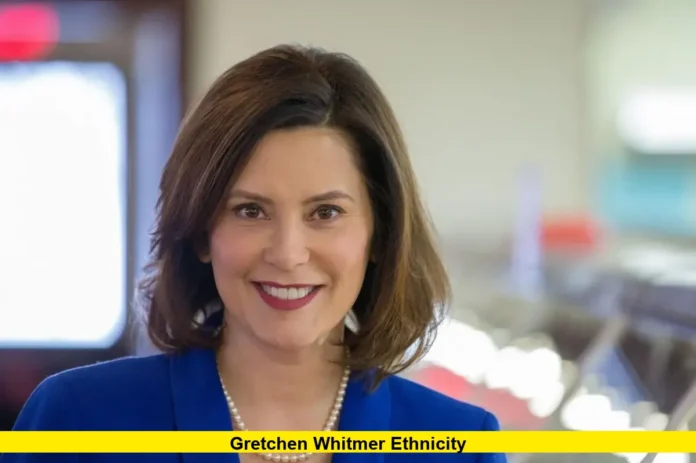

The topic of Gretchen Whitmer ethnicity has attracted interest as Michigan’s Democratic governor continues to make national headlines for her political positions, leadership style, and views on the future of American politics. Born in Lansing, Michigan, Whitmer is publicly identified as White, and her personal background reflects a lifelong connection to Michigan. At 55, she remains a prominent political figure as her second gubernatorial term approaches its conclusion in 2026. Recent attention has also focused on her belief that America is ready to elect a woman president, her approach to working with President Donald Trump, and her criticism of Republicans over the cost of living.
Gretchen Whitmer Ethnicity and Family Background
Gretchen Esther Whitmer was born on August 23, 1971, in Lansing, Michigan. Public biographical records classify her race as White. However, detailed information about her specific ethnic ancestry has not been firmly established in the public biographical information reviewed. It is important to distinguish racial identification from ethnic heritage because the two terms do not mean exactly the same thing.
Whitmer grew up in Michigan and developed an early connection to public service through her family. Her father, Richard Whitmer, worked in state government before becoming a senior executive in the health insurance industry. Her mother, Sharon H. Reisig, was an attorney who served as an assistant attorney general in Michigan.
Her parents belonged to different political traditions. Her father was a Republican associated with the administration of former Michigan Governor William Milliken, while her mother was a Democrat. Growing up with these contrasting political perspectives gave Whitmer an early example of how people with different political beliefs could contribute to public life.
Although family background can help explain a politician’s upbringing, it does not automatically determine personal beliefs or political priorities. Whitmer’s public career has been shaped by her education, legislative experience, and years of serving Michigan residents.
Her identity as a Michigan native has also remained central to her political image. Rather than presenting herself as an outsider entering state politics, she has consistently emphasized her roots in the communities where she grew up, studied, and began her career.
How Old Is Gretchen Whitmer?
Gretchen Whitmer is 55 years old as of October 25, 2026. She celebrated her birthday on August 23, 2026.
Her age is often mentioned in discussions about her political experience and possible future opportunities. Whitmer entered the Michigan Legislature in 2000, when she was 29. Over the following years, she developed a record in state government that eventually led to her election as governor.
She served in the Michigan House of Representatives before moving to the state Senate. In 2011, she became the Senate’s Democratic leader, making history as the first woman to lead a caucus in that chamber.
Whitmer’s experience in the legislature gave her familiarity with budget negotiations, public policy, and the practical challenges of governing a politically divided state. She also served as Ingham County prosecutor before winning the governorship.
Her career demonstrates a progression through several levels of public service rather than a sudden entry into statewide politics. That experience remains an important part of her public profile.
Education and Early Career
Whitmer attended Michigan State University, where she earned her undergraduate degree. She subsequently completed her law degree at Michigan State University College of Law.
Her legal education helped prepare her for work in the state legislature and public administration. Before becoming governor, she developed experience with legislative procedures, constituent concerns, and the policy debates that affect Michigan families.
Whitmer won election to the Michigan House of Representatives in 2000. She later moved to the state Senate, where she became a leading Democratic voice.
Her legislative career included work on health care, education, and other issues affecting residents. She also developed a reputation for negotiating with lawmakers across party lines when agreements could advance her priorities.
In 2016, Whitmer served as Ingham County prosecutor. That role expanded her experience beyond legislative work and gave her responsibilities involving the local justice system.
These professional milestones provide important context for understanding her later political decisions. They also explain why her public image is closely connected to Michigan’s institutions and the concerns of its residents.
Gretchen Whitmer’s Political Career as Michigan Governor
Whitmer became Michigan’s 49th governor on January 1, 2019, after defeating Republican Bill Schuette in the 2018 election. Voters reelected her in 2022, giving her a second four-year term.
Her administration has concentrated on infrastructure, education, economic development, health care, and household affordability. She has also promoted investments intended to strengthen Michigan’s manufacturing sector and help businesses attract skilled workers.
As governor, Whitmer has faced difficult challenges, including the COVID-19 pandemic, debates over public health restrictions, economic uncertainty, and disagreements with Republican lawmakers. These experiences have made her a nationally recognized Democratic governor.
Her political background is relevant to searches about Gretchen Whitmer ethnicity because people researching public figures often want to understand their family origins, upbringing, education, and career alongside their racial or ethnic identity.
Whitmer’s public profile, however, extends beyond her personal background. Her positions on economic policy and relations with the federal government have become important parts of her political identity.
Is Gretchen Whitmer Running for Governor in 2026?
No. Gretchen Whitmer is not eligible to seek another consecutive term as Michigan governor in 2026 because she has reached the state’s two-term limit.
Michigan voters elected Whitmer in 2018 and reelected her in 2022. Her current term ends in January 2027, following the conclusion of her second four-year term.
The 2026 Michigan gubernatorial election is therefore an open-seat contest. Candidates from both major political parties are competing to succeed her, rather than challenge her for another term.
Whitmer’s departure creates an important transition for Michigan politics. Her successor will inherit responsibilities involving the state budget, infrastructure, education, economic development, and relationships with the federal government.
Although she cannot run for governor again under the current term limits, the end of her governorship does not automatically end her political career. Her future decisions remain separate from the question of whether she can seek another gubernatorial term.
Gretchen Whitmer Says America Is Ready to Elect a Woman President
Whitmer’s national political profile has received renewed attention following her latest comments about women in presidential politics.
In an interview with NBC’s Meet the Press on October 25, 2026, she said she believes America is ready to elect a woman president. Her comments challenge the idea that the defeat of former Vice President Kamala Harris in the 2024 presidential election means the country is unwilling to choose a woman for the nation’s highest office.
Whitmer’s position reflects her broader argument that gender alone does not determine whether a presidential candidate can win. Voters also consider a candidate’s policies, experience, communication, economic agenda, and ability to build a broad coalition.
The United States has never elected a woman president. Hillary Clinton won the popular vote in 2016 but lost the Electoral College, while Harris lost the 2024 election to Donald Trump.
Whitmer has frequently attracted attention as a possible future Democratic presidential contender. Her experience governing a competitive Midwestern state gives her a national profile, particularly among Democrats interested in candidates with executive experience.
However, discussing the possibility of a woman president does not establish that Whitmer has launched a presidential campaign. Her comments should be understood as an expression of political confidence, not a formal announcement of candidacy.
Gretchen Whitmer on Working With Trump: ‘I Don’t Go Looking for Fights, but I Don’t Back Down’
Whitmer’s approach to President Donald Trump has also become a defining feature of her public leadership.
The Republican president and the Democratic governor have different political priorities, but their positions require them to engage on matters affecting Michigan. Federal decisions can influence the state’s manufacturing industry, infrastructure investments, trade relationships, public funding, and employment.
Whitmer has presented herself as willing to work with the administration when cooperation benefits Michigan. At the same time, she has emphasized that cooperation does not require abandoning her policy positions or remaining silent when she disagrees with federal decisions.
Her approach reflects the practical responsibilities of a governor. Michigan has major automotive and manufacturing interests, and federal policies can have direct consequences for businesses, workers, and local communities.
The relationship is particularly significant because Michigan plays an important role in national elections. The state’s industrial economy and competitive political landscape often place its governor at the center of national discussions.
Whitmer’s position also helps explain why she has received attention beyond traditional Democratic audiences. Her public statements combine a willingness to negotiate with a stated determination to defend her state’s interests.
Gretchen Whitmer Says Republicans ‘Don’t Have a Plan’ to Lower Costs
Affordability remains another central issue in Whitmer’s political messaging. She has criticized Republicans over household expenses, arguing that their policies do not adequately address the financial pressures facing American families.
Her concerns involve issues such as health care, housing, transportation, education, child care, and everyday necessities. These costs influence family budgets and can shape voters’ decisions in both state and national elections.
Whitmer has promoted state-level measures intended to reduce certain expenses and expand access to education and workforce training. Her administration has also emphasized infrastructure improvements and economic development as ways to support Michigan’s long-term competitiveness.
Republicans dispute Democratic criticism of their economic agenda and point to their own approaches to taxes, regulation, energy, and health care costs. The disagreement reflects a broader national debate about which policies can provide meaningful financial relief.
Whitmer’s criticism is therefore a political argument, rather than an independently established conclusion that Republicans have no affordability proposals. Evaluating the competing claims requires examining the policies involved, their costs, and their actual effects on households.
The issue nevertheless offers a clear explanation for why Whitmer continues to appear in national political coverage. Economic pressures remain a major concern for voters, and both parties are competing to convince Americans that their policies will improve everyday life.
Personal Life and Family
Whitmer is married to Marc Mallory, a dentist. Her family includes two daughters from her first marriage and three stepsons from Mallory’s previous marriage.
She has often described motherhood as an important part of her identity. Her public biography also emphasizes her Michigan upbringing and her commitment to serving the state.
Her parents’ different political affiliations provide another notable detail about her background. Having grown up with a Democratic mother and a Republican father, she experienced differing political perspectives within her own family.
That history does not mean she shares every political view held by either parent. Instead, it provides context for the family environment in which she developed her own interests and eventually entered public service.
Whitmer’s personal life remains distinct from her official responsibilities, although her experiences as a parent and longtime Michigan resident frequently inform how she discusses issues affecting families.
Why Gretchen Whitmer’s Background Continues to Attract Attention
Interest in Gretchen Whitmer ethnicity is part of a broader curiosity about the people who lead American government. Readers often want straightforward information about a politician’s race, family, age, birthplace, education, and professional history.
Whitmer’s publicly documented racial classification is White. More specific claims about her ethnic ancestry should not be treated as established facts without reliable documentation.
Her political significance, meanwhile, comes from decades of public service and two successful gubernatorial elections. She has become a recognizable Democratic figure through her work on state policy and her participation in national political debates.
The approaching end of her second term adds another dimension to that interest. Although she cannot run for governor again in 2026, her comments on presidential politics and her dealings with the Trump administration continue to draw national attention.
Her next professional chapter remains distinct from her current duties as governor. For now, her record in Michigan and her public statements continue to shape discussions about her leadership and future in American politics.
As Gretchen Whitmer’s governorship approaches its conclusion, share your thoughts in the comments and stay informed about the latest developments in her political career.